

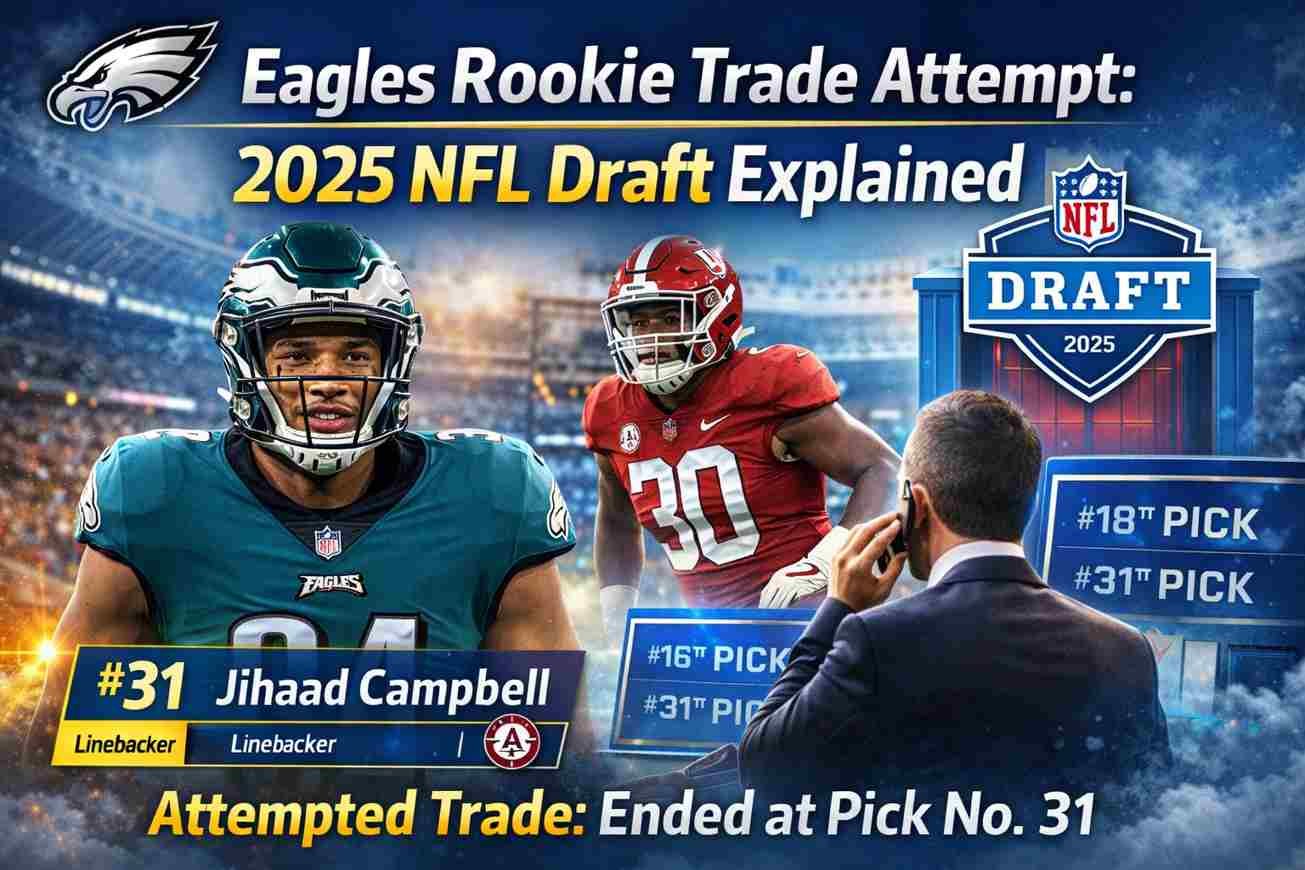
The eagles rookie trade attempt is one of the more telling moments from the 2025 NFL Draft. The Philadelphia Eagles tried to move into the top 20 to select Alabama linebacker Jihaad Campbell. When the cost became too high, the front office stepped back — and still got their man at pick No. 31.
- What Was the Eagles Rookie Trade Attempt?
- How the Eagles’ Draft Strategy Developed
- Why the Eagles Targeted Jihaad Campbell
- Attempts to Move Higher in the First Round and Why the Larger Trade Did Not Happen
- The Trade That Secured the Rookie
- The Anatomy of a Modern NFL Trade Attempt
- What the Trade Attempt Reveals About Draft Risk Management
- Howie Roseman’s Draft Philosophy in Action
- Supporting Moves That Strengthened the Roster
- Impact on the Eagles’ Roster and Team Identity
- Impact on 2026 Draft Capital and Salary Cap
- Why Draft Capital Is More Valuable Than Immediate Trades
- Management Philosophy: Aggression vs. Patience
- Comparing the Eagles to Other NFL Franchises and Historical Rookie Trades
- Separating Confirmed Moves From Rumors
- Timeline of Events
- Why This Story Matters for Eagles Fans and the NFL
- Conclusion
- FAQs
- What was the Eagles Rookie Trade Attempt?
- Why did the Eagles try to trade up in the draft?
- Why did the Eagles not complete the top 20 trade?
- Did the Eagles complete the rookie trade?
- How did this decision affect future draft picks?
- Did the Eagles trade any major players during this attempt?
- How does a failed trade attempt impact the Eagles’ salary cap?
- Will the Eagles make a similar trade move during the mid-season deadline?
- Why is the Eagles Rookie Trade Attempt important?
This story matters to fans and analysts alike because every roster construction decision shapes the franchise’s future. From free-agent acquisitions to draft strategy, the Eagles have built a competitive edge through disciplined negotiation and smart market dynamics. This article breaks down exactly what happened, why it matters, and what it reveals about how Philadelphia builds its roster.
What Was the Eagles Rookie Trade Attempt?
During the 2025 NFL Draft, the Eagles explored a trade near pick No. 18 to secure Jihaad Campbell before another team could take him.
Teams holding picks in that range demanded heavy compensation — likely multiple future selections. General manager Howie Roseman declined.
Instead, the Eagles moved up just one spot, from pick No. 32 to No. 31, selecting Campbell while preserving draft capital. The entire sequence is what defines the eagles rookie trade attempt: aggressive interest managed with long-term roster control.
How the Eagles’ Draft Strategy Developed
Philadelphia’s draft preparation starts months before the event. Coaches and scouts build a detailed draft board based on player performances, positional needs, and scheme fit.
Heading into 2025, the Eagles identified defensive depth as a priority. The scouting staff evaluated multiple linebackers, and Campbell stood out early as someone who matched both short-term goals and the team’s long-term vision for a championship-caliber roster.
Because the Eagles held the final pick of the first round, there was a real risk that another team would grab their target. The front office prepared multiple trade scenarios in advance to stay ready on draft night. Asset optimization — getting maximum value from every pick — guided every decision.
This approach reflects the Eagles’ history. The team consistently balances young talent development with the presence of veterans who stabilize the roster. Under current leadership, preparing multiple draft paths is standard practice — not a panic move.
Why the Eagles Targeted Jihaad Campbell
Modern NFL offenses are built on spacing, motion, and speed. Defenses need linebackers who can handle both run defense and pass coverage without breaking down.
Campbell fit that profile precisely. His college career at Alabama — playing within one of the country’s most demanding college programs — showcased his readiness for the next level. The coaching staff valued his ability to shadow receivers in coverage while maintaining run-stopping discipline.
His skillset included:
- Strong sideline-to-sideline range
- Reliable pass coverage skills against receivers
- Solid run defense awareness
- Tackling consistency and quick reaction speed
- Leadership within a top college program
The Eagles’ defensive system demands versatility. Campbell wasn’t viewed as short-term depth — he was identified as a long-term building block at a position that connects the defensive line and secondary.
Attempts to Move Higher in the First Round and Why the Larger Trade Did Not Happen
Reports indicate the Eagles engaged in real trade discussions to get inside the top 20. The asking price from teams holding those picks was steep — likely second or third round picks in future drafts.
The front office faced a straightforward decision: overpay to guarantee the pick, or trust the draft board and stay patient.
They chose patience.
As the draft progressed, unexpected selections caused Campbell to slide further than most expected. By the time the Eagles needed to act, a minor one-spot move was all it took.
Key reasons the larger trade did not happen:
- Compensation demands exceeded fair value
- Uncertain draft results made overpaying a long-term roster planning risk
- Future draft flexibility was a priority
- The draft board shifted in Philadelphia’s favor
- Overpaying creates sustained roster pressure across multiple seasons
The Trade That Secured the Rookie
Late in the first round, the Eagles completed a small trade to move from pick No. 32 to No. 31.
| Eagles Received | Other Team Received |
| Pick No. 31 | Pick No. 32 + later round pick |
This minor move secured the selection. Jihaad Campbell was drafted, and the Eagles protected future draft assets in the process.
The Anatomy of a Modern NFL Trade Attempt
NFL trade discussions are rarely simple. Teams assess player value against team needs, scheme fit, and the cost of moving up or down the board within a competitive landscape.
Advanced analytics now play a real role in these evaluations. Front offices model expected player production against the draft capital required to acquire that position. Strategic positioning — knowing when to push and when to hold — separates disciplined teams from reactive ones.
Negotiations often hinge on trust between front offices and timing. Tension builds quickly when both sides hold different expectations about asset value. When those expectations don’t align, market forces determine whether a deal gets done or collapses.
A team that waits too long loses leverage. One that overpays too early damages future flexibility. The Eagles’ approach in 2025 reflected a disciplined understanding of these negotiation dynamics — explore every path, but don’t commit beyond fair value.
What the Trade Attempt Reveals About Draft Risk Management
Trading into the top 20 carries real cost. It typically requires giving up:
- Future second or third round picks
- Reduced flexibility across active drafts in the following years
- Increased pressure on the rookie to justify the price
Philadelphia declined that risk. By trusting the draft board, they maintained flexibility for the 2026 NFL Draft while still landing the same player.
This is the core lesson: draft value matters as much as draft talent. Securing both is the ideal outcome, which is exactly what the Eagles achieved.
Howie Roseman’s Draft Philosophy in Action
Howie Roseman has built a consistent draft identity in Philadelphia. He explores bold moves but rarely commits beyond fair market value. His adaptability — adjusting plans as the draft board shifts — reflects genuine strategic foresight rather than reactive decision-making.
His approach follows a clear structure:
- Identify elite traits and immediate talent worth pursuing
- Explore every viable trade path
- Refuse decisions driven by emotion or short-term pressure
- Protect long-term potential and team culture above all
These steps reduce long-term damage from impulsive moves. Roseman understands that game dynamics change quickly on draft night. A calculated risk taken too early — before the board reveals its true shape — can cost a franchise years of flexibility.
The Campbell situation fits this pattern exactly. Roseman explored the top 20 options, declined when the price was too high, and executed a disciplined alternative that preserved both the player and the team’s future assets.
Supporting Moves That Strengthened the Roster
The eagles rookie trade attempt didn’t happen in isolation. Philadelphia made several supporting moves that improved overall roster balance with both seasoned players and younger players across key positions.
Thomas Booker for Jakorian Bennett The Eagles traded defensive tackle Thomas Booker to the Raiders for cornerback Jakorian Bennett. This converted defensive line depth into secondary support — a quiet but effective positional upgrade that added talent where it was needed most.
Adding Sam Howell for Stability Later in 2025, the Eagles traded for quarterback Sam Howell to reinforce depth behind Jalen Hurts. With Tanner McKee managing a minor injury, the front office acted early rather than waiting for a problem to develop. Investing in backup development supports long-term vision across a full season.
These moves reflect a broader philosophy: build roster balance through deliberate talent acquisition at key positions, not reactively.
Impact on the Eagles’ Roster and Team Identity
Campbell’s addition improved the defense at a position critical to scheme execution. Young talent at linebacker gives the team competitive depth now while building for future seasons.
The Eagles’ talent pursuit has always been tied to ambition — the organization’s forward-thinking approach shapes how recruits and existing players view the culture. A winning culture built on resilience and adaptability attracts the right kind of players and reinforces what the organization stands for.
Beyond individual performance, the front office’s approach shapes team identity. When players see the coaching staff and organization prioritize long-term planning over short-term fixes, it builds trust across the roster.
The Eagles avoided disrupting player roles and morale by avoiding an overpay. Their scouting process was validated — patience produced the same result as aggressive spending would have. That balance between performance and evaluations is what keeps depth and competitiveness intact season after season.
Impact on 2026 Draft Capital and Salary Cap
Because the Eagles didn’t overpay to reach the top 20, they enter the 2026 NFL Draft in a strong position. Philadelphia is projected to hold multiple picks, including possible compensatory selections.
Avoiding a heavy trade also protected the team from difficult financial considerations. Large trades often involve contracts that carry cap implications beyond the draft itself — roster adjustments become harder when cap space is already stretched. By declining the expensive move, the Eagles kept those obligations manageable.
Maintaining that capital matters for several reasons:
- Supports future roster depth across all positions
- Keeps salary cap flexibility intact for future signings
- Avoids unfavorable contracts that limit roster adjustments
- Allows the team to trade up or down depending on future needs
The disciplined 2025 decision extends its value well beyond a single draft.
Why Draft Capital Is More Valuable Than Immediate Trades
Draft picks represent future potential — not guaranteed production. But they provide franchise trajectory control that no single trade can replicate.
Teams that consistently accumulate draft capital gain a psychological advantage over rival teams. They control the narrative during trade negotiations — other franchises know they can’t easily pressure a team that holds multiple quality picks. That draft control builds confidence in management decisions and creates more stable team dynamics across the roster.
Emerging talent identified through deep draft boards gives front offices negotiation leverage. Immediate impact players are valuable, but they rarely reshape a franchise the way a well-managed draft class can. Philadelphia understands this reality.
The Eagles’ ability to build through the draft while staying competitive for championships depends on never trading away future assets for uncertain short-term gains. Every decision ties back to franchise trajectory — and protecting that trajectory requires treating draft capital as a long-term asset, not a currency to spend impulsively.
Management Philosophy: Aggression vs. Patience
The Eagles don’t choose between aggression and patience — they use both, depending on the situation.
When the value is right, Roseman moves fast. When the cost is too high, the team steps back. This dual approach reflects a clear strategic direction: build for sustainable success without sacrificing the franchise’s future for a single season’s needs.
Philadelphia’s win-now mentality never overrides long-term team-building. Player development stays central to how the roster grows — young players aren’t discarded for short-term fixes. The front office pursues talent acquisition strategically, keeping team identity and NFL landscape realities in mind at every step.
Innovation in how the Eagles evaluate players, manage the draft, and approach free agency keeps their roster-building model ahead of teams locked into rigid systems. Strategic foresight — not just immediate results — defines this organization’s philosophy.
Comparing the Eagles to Other NFL Franchises and Historical Rookie Trades
Rookie trades — or failed trade attempts — are not unique to the Eagles. History offers several instructive comparisons that highlight the importance of talent evaluation, long-term vision, and avoiding quick fixes:
| Player | Team | Outcome |
| Josh Rosen | Arizona Cardinals → Miami Dolphins | Traded after 1 season; Cardinals drafted Kyler Murray (2019) |
| Isaiah Wilson | Tennessee Titans | Traded after 1 season due to off-field issues (2020 Draft) |
| Denzel Mims | New York Jets → Detroit Lions | Moved after failing to secure a consistent role |
| Jay Ajayi | Trade to Eagles (2017) | Contributed to Super Bowl victory |
Successful franchises in competitive divisions share one trait: aggressive roster moves are made within a framework of long-term vision, not panic. The Cardinals’ handling of Josh Rosen is a textbook example of what happens when talent evaluation breaks down at the highest level. The championship window closes quickly when quick fixes replace disciplined planning.
What distinguishes the Eagles is that their 2025 situation ended without regret. They explored the trade, declined the overpay, and still landed their target — a result that reflects sound roster management rather than luck.
Separating Confirmed Moves From Rumors
During this period, speculation surfaced about possible trades involving A.J. Brown and a potential Tanner McKee move in early 2026. Neither was confirmed. These trade rumors reflect how quickly league discussion turns into assumed roster changes — but team strategies should never be evaluated on speculation alone.
The verified facts remain:
- Eagles explored a top-20 trade for Campbell
- That trade did not happen due to compensation demands
- A minor trade from No. 32 to No. 31 was completed
- Jihaad Campbell was successfully selected
Separating confirmed transactions from unverified rumors is essential when evaluating what the Eagles actually did versus what was reported.
Timeline of Events
| Stage | Event |
| Pre-Draft | Jihaad Campbell was identified as a defensive target |
| Draft Planning | Multiple trade scenarios prepared |
| Draft Night – Early | Top 20 trade discussions begin |
| Draft Night – Mid | Compensation demands rejected; team stays patient |
| Late Round One | Minor trade from No. 32 to No. 31 completed |
| Selection | Jihaad Campbell drafted by the Philadelphia Eagles |
Why This Story Matters for Eagles Fans and the NFL
The eagles rookie trade attempt is more than a draft footnote. It illustrates how disciplined front offices operate under pressure within a shifting NFL landscape.
Philadelphia explored a bold move, declined when value exceeded price, and secured the same outcome through patience. That’s controlled execution — not hesitation. It’s the kind of innovation in roster management that separates franchises with sustained success from those chasing short-term results.
For Eagles fans, this story confirms that the front office prioritizes long-term flexibility over emotional decisions. For the broader NFL, it’s a case study in how to manage draft risk without sacrificing roster quality — and how discipline, scouting, coaching alignment, and leadership produce better outcomes than aggressive spending alone.
Conclusion
The Philadelphia Eagles’ rookie trade attempt during the 2025 NFL Draft demonstrated exactly how the organization operates. Jihaad Campbell was identified early, a trade into the top 20 was explored and declined, and a minor move to pick No. 31 secured the same result.
By adding linebacker depth, reinforcing the secondary, stabilizing quarterback depth, and protecting 2026 draft capital, the Eagles improved both present performance and long-term flexibility.
Preparation, timing, and sustainable success don’t happen by accident. They result from a roster-building strategy built on discipline and controlled execution — values that continue to define how Philadelphia competes at the highest level.
FAQs
What was the Eagles Rookie Trade Attempt?
The Eagles Rookie Trade Attempt refers to Philadelphia’s effort during the 2025 NFL Draft to trade into the top 20 — near pick No. 18 — to select Alabama linebacker Jihaad Campbell. The larger trade didn’t happen, and the Eagles instead moved from pick No. 32 to No. 31 to make the selection.
Why did the Eagles try to trade up in the draft?
The Eagles wanted to guarantee their selection of Jihaad Campbell, who matched their defensive system as a long-term building block. Moving higher in the draft would have eliminated the risk of another team selecting him first.
Why did the Eagles not complete the top 20 trade?
The reported asking price from teams holding top 20 picks required significant draft compensation — likely future second or third round picks. The Eagles chose not to overpay and trusted the draft board to shift in their favor, which it did.
Did the Eagles complete the rookie trade?
Yes. The Eagles completed a minor trade, moving from pick No. 32 to pick No. 31. They selected Jihaad Campbell and preserved future draft picks in the process.
How did this decision affect future draft picks?
By avoiding an expensive top 20 trade, Philadelphia protected valuable draft capital heading into the 2026 NFL Draft, including projected compensatory selections, giving the team continued roster depth and salary cap balance.
Did the Eagles trade any major players during this attempt?
No major player trades were confirmed as part of the draft move. The Eagles did trade defensive tackle Thomas Booker to the Raiders for cornerback Jakorian Bennett — a supporting roster move, not directly tied to the Campbell selection.
How does a failed trade attempt impact the Eagles’ salary cap?
A failed trade with contract negotiations attached can leave residual financial considerations. In this case, the Eagles avoided committing excess capital by declining the large trade, which preserved cap space for future signings and roster adjustments.
Will the Eagles make a similar trade move during the mid-season deadline?
Speculation about mid-season activity remains open. If the Eagles identify weaknesses that threaten playoff prospects, their management philosophy suggests they will act — but only when the value justifies the cost.
Why is the Eagles Rookie Trade Attempt important?
It shows how the franchise balances aggressive planning with careful decision-making. The Eagles secured their targeted player without sacrificing future draft assets — a result that reflects disciplined franchise strategy and sound roster building.