

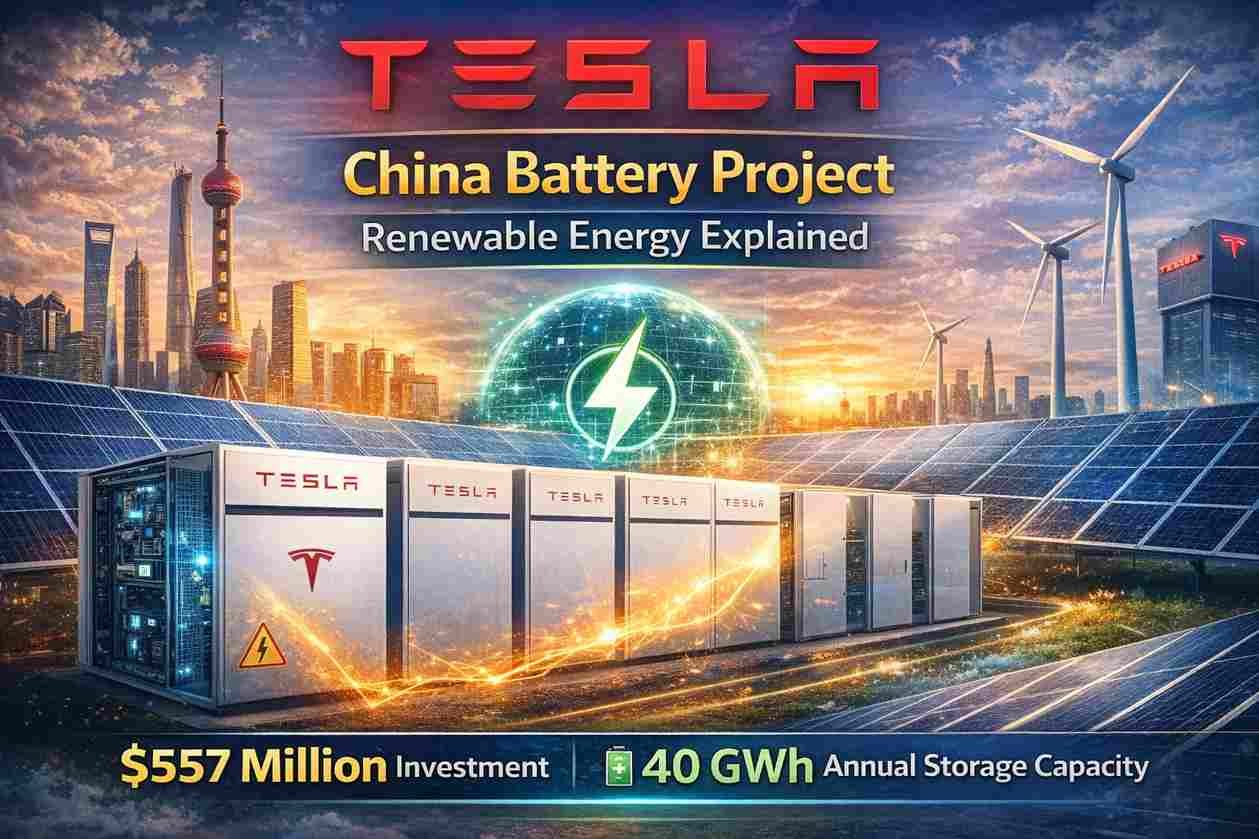
In June 2025, Tesla signed a $557 million agreement with the Shanghai municipal government to build what is expected to become China’s largest grid-scale battery storage station. This Tesla China battery project marks a clear pivot — from selling electric vehicles in China to building the energy infrastructure that powers its cities. The deal, confirmed by Reuters and Yicai, positions Tesla’s energy division at the center of China’s push to move away from fossil fuels toward grid-stable renewable power. For ESG-focused investors tracking sustainable growth, the project also earned attention following Tesla’s inclusion considerations within ESG-aligned indices such as the S&P 500 ESG Index.
- Tesla’s Strategic Shift From EV Manufacturing to Energy Infrastructure
- The Shanghai Grid-Scale Battery Project
- Scale and Investment
- Megapack Technology — How It Works as a Smart Regulator
- Project Partners and Collaboration
- The Shanghai Megafactory — Production Backbone and Global Role
- Strategic Context — Why This Project Matters for China’s Renewable Energy Goals
- How Megapacks Strengthen Renewable-Heavy Grids
- Economic and Industrial Impact
- Facts vs Interpretation — What Is Confirmed and What Is Analysis
- Why This Project Signals a Broader Global Energy Transition
- Conclusion
- FAQs
China Kangfu International Leasing is a confirmed financial partner in the initiative, alongside the Shanghai municipal government. At the same time, Tesla’s Shanghai Megafactory began producing Megapack units at an industrial scale, adding 40 GWh of annual storage capacity to both domestic and global markets.
Tesla’s Strategic Shift From EV Manufacturing to Energy Infrastructure
Tesla entered China primarily as an EV maker. The Gigafactory Shanghai became one of its most productive vehicle plants globally. But the energy storage push signals something different.
Rather than competing only in the automotive market, Tesla now operates inside China’s electricity system. Grid-level energy storage is a different business — one tied to national infrastructure, government contracts, and long-term power policy.
This shift matters for several reasons:
- Renewable energy growth creates unstable grids that need large storage buffers
- China’s energy storage sector is forecast to reach $8 billion in revenue by 2030
- ESG-focused investors increasingly value companies with clean energy infrastructure exposure
- Tesla’s energy division has historically been undervalued relative to its vehicle business
This repositioning also appeals to eco-conscious markets where corporate behavior is measured beyond products alone. Governance norms in China’s energy sector increasingly require international partners to align with state infrastructure priorities — and Tesla has done exactly that. Ethical business practices, including transparent partnership structures with local government entities, have become part of how Tesla signals long-term commitment to the Chinese market.
The Shanghai Grid-Scale Battery Project
Scale and Investment
In June 2025, Tesla and the Shanghai municipal government formalized a 4 billion yuan ($557 million) agreement to build a grid-side battery storage station. Reports from Reuters and Yicai confirmed that China Kangfu International Leasing is also a project partner.
The station is expected to be China’s largest grid-side battery storage project. It directly addresses urban electricity pressure in Shanghai, where renewable energy supply continues to grow faster than grid stability allows.
| Key Detail | Data |
| Agreement Value | $557 million (4 billion yuan) |
| Announced | June 2025 |
| Location | Shanghai |
| Project Type | Grid-side battery storage station |
| Partners | Tesla, Shanghai Government, China Kangfu International Leasing |
The project was first publicized through Tesla’s official Weibo account before being picked up by international outlets, reflecting how China-facing announcements are increasingly distributed through domestic social channels first.
Megapack Technology — How It Works as a Smart Regulator
The project uses Tesla’s Megapack, a utility-scale lithium-ion battery system designed for grid deployment.
Each Megapack unit:
- Stores approximately 3.9 megawatt hours of electricity
- Can power roughly 3,600 homes for one hour
- Integrates battery cells, inverters, and cooling systems into one unit
- Responds within milliseconds to grid signals
Each unit also delivers up to 1 megawatt of continuous power output and can sustain discharge for four hours under standard grid conditions, making it suitable for both short-duration peak shaving and longer stabilization cycles.
Because Megapacks respond quickly to grid signals, they act as a smart regulator. When renewable output drops, stored energy flows into the grid. When supply exceeds demand, the system absorbs extra power.
As a result, power fluctuations decrease, supply-demand balance improves, and grid reliability strengthens.
Project Partners and Collaboration
This is not a standalone private investment. The project structure reflects a deliberate alignment between an international technology company and China’s urban power strategy.
Partners include:
- Tesla — technology and system integration
- Shanghai municipal government — regulatory support and grid access
- China Kangfu International Leasing — financial structuring
This kind of government-backed collaboration is standard for grid-scale infrastructure in China and signals that the project is embedded in long-term urban planning rather than a short-term commercial deal.
The Shanghai Megafactory — Production Backbone and Global Role
Launch, Output, and Capacity
Tesla’s Shanghai battery megafactory began production in February 2025. It is designed to produce 10,000 Megapack units per year, totaling approximately 40 GWh of storage capacity annually.
This makes Shanghai not just a deployment site but a global production hub for utility-scale storage.
| Metric | Figure |
| Production Start | February 2025 |
| Annual Output | 10,000 Megapack units |
| Annual Storage Capacity | ~40 GWh |
| Primary Market | China + Global Export |
Global Export Role
While the grid-side project serves Shanghai’s local electricity network, the factory supplies markets well beyond China. Tesla exports Megapacks from Shanghai to:
- Australia — one of the world’s most active grid-scale battery markets
- Europe — where grid decarbonization creates strong storage demand
- Asia Pacific — markets rapidly scaling solar and wind capacity
This dual role — domestic deployment plus international export — makes the Shanghai facility central to Tesla’s global energy storage strategy.
Supply Chain and CATL Partnership
Tesla sources battery cells and components from CATL, the Chinese battery manufacturer that holds approximately 40 percent of the global market share. This creates an unusual dynamic: Tesla competes with domestic Chinese companies for storage contracts while simultaneously relying on China’s battery supply chain to build its products.
This interdependence makes the Shanghai operation deeply embedded in China’s industrial ecosystem, regardless of geopolitical pressures affecting US-China trade relations.
Strategic Context — Why This Project Matters for China’s Renewable Energy Goals
National Energy Goals and Grid Balancing
China has set two landmark climate targets:
- Carbon peaking by 2030
- Carbon neutrality by 2060
Achieving these requires massive renewable energy deployment. But solar and wind output is intermittent — it fluctuates with weather, not demand. The International Energy Agency reported that global battery storage capacity reached 42 GW in 2023, with China driving a significant share of that growth.
China’s target is to add 40 gigawatts of battery-powered storage capacity by the end of 2025. Tesla’s Shanghai grid-side project feeds directly into this national buildout — reducing reliance on fossil fuel peaker plants and enabling higher renewable integration without grid instability.
China has also set interim deployment benchmarks, with 5 gigawatts of new storage capacity earmarked for specific grid-constrained regions as part of its phased rollout ahead of the broader 2025 national target.
Market Competition — Tesla vs CATL vs BYD
Tesla does not operate in isolation. China’s energy storage market is dominated by domestic players.
| Company | Position | Key Advantage |
| CATL | Global market leader (~40% share) | Battery cell manufacturing scale |
| BYD | Major domestic storage and EV player | Vertically integrated supply chain |
| Tesla | International entrant, Megapack focus | Integrated system design, global deployment track record |
US-China trade tensions add complexity. Washington and Beijing have traded restrictions on technology and manufacturing in recent years. Tesla’s continued investment in Shanghai — both in vehicle production and now energy infrastructure — suggests it views the Chinese market as too strategically important to exit.
How Megapacks Strengthen Renewable-Heavy Grids
Traditional power grids were built around predictable generation — coal plants that run on schedule. Renewable-heavy grids operate differently.
Unlike coal plants, which generate power on demand, intermittent energy sources like solar and wind require a buffer layer between generation and consumption. Battery energy storage systems (BESS) serve as that buffer, and grid-side energy storage installations like Tesla’s Shanghai project sit at the point in the network where stabilization has the greatest system-wide effect.
Solar generation peaks midday and drops at night. Wind varies by season and geography. This variability creates three common grid problems:
- Peak demand gaps — when renewable output can’t meet consumption spikes
- Renewable curtailment — when excess generation has nowhere to go
- Frequency instability — when generation and load fall out of balance
Megapacks address all three. They store surplus energy during low-demand or high-generation windows, then discharge it during shortfalls. The result is a more stable, dependable electricity system that can absorb more renewable capacity without compromising reliability.
Economic and Industrial Impact
Beyond electricity, the Tesla China battery project creates measurable economic effects:
- Job creation in Shanghai across manufacturing, installation, and maintenance
- Export revenue from Megapack sales to Australia, Europe, and the Asia Pacific
- Industrial development in advanced battery manufacturing techniques
- Deeper cooperation between international technology firms and Chinese state entities
- Clean energy infrastructure expansion aligned with national decarbonization targets
Beyond direct employment, the project supports community engagement initiatives tied to Shanghai’s broader urban sustainability agenda. For institutional investors, Tesla’s energy infrastructure role in China strengthens its position within ESG-aligned portfolios, including indices like the S&P 500 ESG Index, where clean energy infrastructure exposure is increasingly weighted alongside traditional financial metrics.
Facts vs Interpretation — What Is Confirmed and What Is Analysis
It is worth separating verified information from forward-looking assessment.
Confirmed facts:
- Tesla signed a $557 million grid-side battery project agreement in June 2025
- Shanghai Megafactory began production in February 2025
- Factory capacity: 10,000 Megapack units and ~40 GWh annually
- Each Megapack stores ~3.9 MWh, enough for ~3,600 homes for one hour
- Project partners: Tesla, Shanghai government, China Kangfu International Leasing
Reasoned interpretation:
- Battery storage demand will grow as China’s renewable capacity scales
- Tesla’s infrastructure role in China may deepen if grid storage targets expand post-2025
- Competition from CATL and BYD will remain intense, but demand growth is large enough to support multiple players
These interpretations align with observable renewable growth trends and official storage targets across China’s national energy planning documents.
Why This Project Signals a Broader Global Energy Transition
The Tesla China battery project is one data point in a much larger shift. Energy systems worldwide are moving away from centralized fossil fuel generation toward distributed renewable sources. That shift requires storage infrastructure at the grid scale.
What makes the Shanghai project notable is its structure — a coordinated energy effort combining private technology, government partnership, and grid integration in one initiative. The International Energy Agency projects battery storage deployment will continue accelerating through the late 2020s as solar and wind capacity expands globally, reinforcing urban power reliability across major consumption centers.
Tesla’s Q1 2025 deployment of 100 Megapacks in early pilot phases, followed by the full grid-side agreement, shows an execution pathway from concept to infrastructure at speed.
In simple terms, clean energy only works at scale when storage works reliably. This project is evidence that the global transition is moving from policy commitment to physical infrastructure.
Conclusion
Tesla’s China battery project represents a meaningful transition — from vehicle manufacturer to grid infrastructure provider. The $557 million Shanghai grid-side battery storage station, backed by the Shanghai municipal government and China Kangfu International Leasing, is designed to stabilize a renewable-heavy electricity network at the city scale.
The Shanghai Megafactory, producing 10,000 Megapack units annually at 40 GWh capacity, underpins both this domestic deployment and global exports to Australia, Europe, and the Asia Pacific.
Tesla now competes directly with CATL and BYD in China’s $8 billion energy storage market while simultaneously relying on CATL’s supply chain. That tension — competition and collaboration in one — defines Tesla’s current position in China’s clean energy system.
From an ESG standpoint, the project also reinforces Tesla’s credentials as a clean energy infrastructure company — not just an automaker — which carries weight with institutional investors applying sustainability screens to their portfolios.
With carbon peaking targeted for 2030 and carbon neutrality for 2060, China’s demand for grid-scale battery storage will only grow. Tesla has placed itself at the center of that buildout.
FAQs
What is the Tesla China Battery Project Renewable Energy initiative?
It is Tesla’s large-scale Megapack production and grid-side battery storage project in Shanghai, supported by the Shanghai municipal government and China Kangfu International Leasing. It uses Megapack technology to stabilize Shanghai’s renewable-heavy electricity grid and is expected to be China’s largest grid-side storage station.
How many Megapacks will the Shanghai factory produce each year?
The Shanghai Megafactory is designed to produce 10,000 Megapack units annually, delivering approximately 40 GWh of total storage capacity per year for both domestic deployment and international export.
How much energy can one Tesla Megapack store?
Each Megapack stores approximately 3.9 megawatt hours of electricity — enough to power around 3,600 homes for one hour. It delivers up to 1 megawatt of continuous power output and can sustain discharge for four hours, with integrated lithium-ion cells, inverters, and cooling systems in a single deployable unit.
Why is this project important for China’s renewable energy goals?
China is targeting 40 gigawatts of battery-powered storage capacity by the end of 2025 to support rapid solar and wind growth. Grid-scale battery systems reduce renewable curtailment, prevent frequency instability, and support China’s carbon peaking target of 2030 and carbon neutrality goal of 2060.