

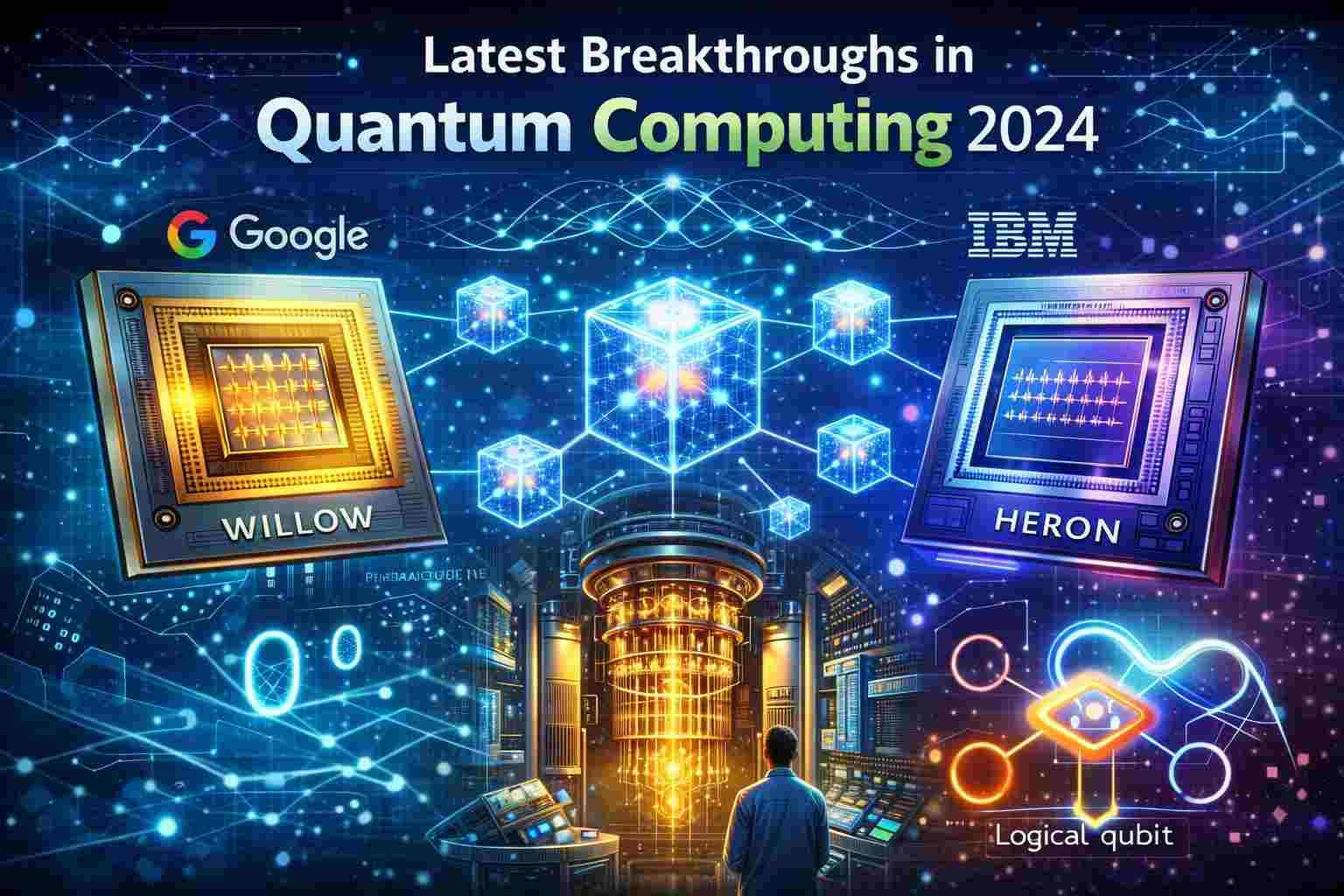
The latest breakthroughs in quantum computing in 2024 mark a clear shift from experimental systems to practical, reliable technology. Researchers moved beyond simply increasing qubit numbers and focused on stability, error correction, and scalable architectures. Major advances — including Google’s Willow chip, IBM’s Heron processor, and progress in logical qubits — brought quantum machines closer to real-world use than ever before.
- What Is Quantum Computing?
- Why 2024 Was a Turning Point for Quantum Computing
- Major Hardware Breakthroughs in 2024
- Google Willow Quantum Processor
- IBM Heron Processor
- Quantinuum H2 Quantum System
- Large Scale Quantum Systems
- Advances in Quantum Error Correction (QEC)
- New Quantum Hardware Architectures
- Superconducting Qubits
- Neutral Atom Quantum Systems
- Trapped Ion Systems
- Optical and Photonic Quantum Computing
- Emerging Materials
- Artificial Intelligence Integration in Quantum Research
- Hybrid Quantum Classical Computing
- Cloud Quantum Computing
- Post-Quantum Cryptography and Security
- Real-World Applications of Quantum Computing
- Healthcare and Drug Discovery
- Materials Science
- Artificial Intelligence and Finance
- Climate and Scientific Research
- Economic and Industrial Implications of Quantum Advancements
- Challenges That Still Remain
- The Future of Quantum Computing
- Conclusion
- FAQs
- What was the biggest quantum computing breakthrough in 2024?
- What is a logical qubit and why does it matter?
- How many qubits did quantum computers reach in 2024?
- Why is quantum error correction important?
- What industries will benefit most from quantum computing?
- How does quantum computing affect artificial intelligence?
- Will quantum computers replace classical computers?
- Is quantum computing practical today?
- Will quantum computers affect encryption?
What Is Quantum Computing?
Quantum computing processes information using the laws of quantum mechanics rather than standard binary logic. Traditional computers use bits — values of either 0 or 1. Quantum computers use qubits, which can exist in multiple states at the same time through a property called superposition. Another key property, entanglement, links qubits so that the state of one instantly affects another.
These properties allow quantum systems to explore many solutions in parallel, making them far more powerful than classical computers for certain complex problems. However, quantum information is fragile. Environmental noise and temperature changes cause errors and instability, which is why most 2024 breakthroughs focused on error correction and qubit stability.
Why 2024 Was a Turning Point for Quantum Computing
For years, progress was measured by raw qubit counts. In 2024, the focus shifted to qubit quality and reliability.
Key priorities became:
- Quantum error correction
- Stable logical qubits
- Scalable hardware architectures
- Efficient quantum algorithms
Researchers demonstrated that quantum processors could become more reliable as they scaled, reversing a long-standing problem in which larger systems produced more errors. This milestone made 2024 a defining year for the field.
Major Hardware Breakthroughs in 2024
Google Willow Quantum Processor
Google’s Willow quantum processor was one of the year’s most significant releases. It contains 105 superconducting qubits and demonstrated a concept called threshold scalability — meaning error rates decrease as more qubits are added, rather than increase.
In benchmark tests, Willow completed specialized calculations in minutes that would take classical supercomputers an impractical amount of time. This result confirmed that advanced error-correction methods can make large-scale quantum systems viable.
IBM Heron Processor
IBM introduced its Heron quantum processor with 156 qubits, designed for both performance and reliability. Key improvements included:
- Faster quantum circuit execution
- Reduced operational errors
- Better qubit connectivity
IBM also expanded its Quantum System Two architecture, a modular design that allows multiple processors to operate together — similar to how classical data centers are structured.
Quantinuum H2 Quantum System
Quantinuum upgraded its H2 quantum computer, achieving improved scores on the Random Circuit Sampling benchmark — a standard test for quantum computational power. The system also produced more reliable logical qubits, bringing fault-tolerant quantum computing closer to reality.
Large Scale Quantum Systems
Several organizations crossed the 1,000-qubit milestone in 2024, with Atom Computing among the first to achieve this. While most advanced processors operated in the 100–200 qubit range with high reliability, larger systems demonstrated improved chip architecture, better qubit connections, and promising pathways toward commercial use.
Advances in Quantum Error Correction (QEC)
Quantum error correction remains the most critical challenge in the field. Unlike classical systems, quantum computers cannot simply copy data to detect errors. They use special encoding techniques that distribute quantum information across multiple physical qubits. In 2024, researchers made significant progress developing logical qubits — stable units built from several physical qubits that protect information from noise and instability.
Key outcomes included:
- Error rates are reduced by hundreds of times compared to physical qubits
- Longer computational cycles without failure
- Architectures theoretically capable of supporting millions to trillions of error-free quantum operations
These advances form the foundation of fault-tolerant quantum systems — machines that can detect and fix errors automatically during calculations.
New Quantum Hardware Architectures
Researchers continued exploring multiple hardware approaches, each with distinct advantages.
Superconducting Qubits
Used by Google and IBM, these systems rely on electrical circuits cooled to near absolute zero. They offer fast operations and mature manufacturing techniques, making them currently the most widely deployed approach.
Neutral Atom Quantum Systems
Neutral atom computers use lasers to trap individual atoms. They support large, flexible qubit arrays and have demonstrated control over hundreds of atoms simultaneously, offering strong scalability.
Trapped Ion Systems
Trapped ion systems use charged atoms controlled by electromagnetic fields. They deliver high accuracy and are well-suited for precise, low-error computations.
Optical and Photonic Quantum Computing
Optical quantum computers use photons as qubits. They can operate closer to room temperature and are compatible with optical communication networks, making future integration with existing infrastructure more practical.
Emerging Materials
New materials are opening additional pathways. Q-silicon, discovered at North Carolina State University, is a magnetic material showing promise for spintronic quantum computing. Advances in super-pure silicon and semiconductor processing are also enabling more stable qubit fabrication. Research into quantum dots — nanoscale particles with unique quantum properties — continues to generate interest across multiple hardware platforms.
Artificial Intelligence Integration in Quantum Research
AI is becoming a key tool in quantum development. Researchers are using AI models to monitor quantum systems in real time, analyze experimental data, and identify sources of error.
Specific applications include:
- Optimizing quantum circuits for lower error rates
- Adjusting control signals to improve qubit stability
- Accelerating error detection and system optimization
Beyond hardware support, quantum-enhanced algorithms are showing potential to transform AI itself. By leveraging quantum parallelism, these algorithms can process massive datasets more efficiently, with applications in natural language processing, image recognition, and autonomous systems — pointing toward a new generation of AI capabilities.
Hybrid Quantum Classical Computing
Quantum computers are not replacing classical systems. Instead, hybrid computing models are emerging where both work together. Classical computers handle preparation, data management, and post-processing. Quantum processors handle specialized calculations, offering clear advantages. This approach makes quantum technology practical today, even while fully fault-tolerant systems are still in development.
Cloud Quantum Computing
Cloud platforms expanded significantly in 2024, giving researchers and developers remote access to quantum hardware without owning physical systems.
Benefits include:
- Global research collaboration
- Faster algorithm development
- Lower barriers to entry for education and experimentation
Cloud platforms are accelerating progress by putting quantum tools in the hands of a much wider community.
Post-Quantum Cryptography and Security
Quantum computers pose a long-term threat to current encryption methods. Sufficiently powerful quantum systems could break widely used cryptographic standards.
In response, researchers advanced post-quantum cryptography — algorithms designed to resist quantum attacks. In 2024, new global standards for quantum-safe cryptographic algorithms were formally introduced, helping governments and organizations begin transitioning their digital systems to quantum-resistant security.
Work also continued on quantum cryptography itself, including quantum-safe communication networks that use quantum mechanics to detect eavesdropping.
Real-World Applications of Quantum Computing
Healthcare and Drug Discovery
Quantum simulations can model molecular structures and chemical reactions with a precision that is impossible for classical systems. In 2024, quantum-powered tools accelerated the identification of drug candidates and optimized molecular designs, cutting time and cost in pharmaceutical research.
Materials Science
Quantum models are helping researchers design next-generation batteries, superconductors, and advanced electronics by simulating material behavior at the atomic level.
Artificial Intelligence and Finance
Quantum algorithms are being tested for financial modeling, risk analysis, and portfolio optimization. In logistics, quantum systems can improve scheduling and routing far more efficiently than classical solvers.
Climate and Scientific Research
Quantum simulations offer new tools for analyzing complex environmental systems, improving climate predictions, and advancing fundamental research in physics and related sciences.
Economic and Industrial Implications of Quantum Advancements
Governments and corporations worldwide are increasing investments in quantum research and infrastructure. The motivation is clear: quantum computing is expected to drive economic growth and global competitiveness.
Industries including finance, logistics, and energy are exploring quantum solutions to reduce operational costs and improve decision-making. As the technology matures, it is expected to generate new markets, job opportunities, and entirely new technological ecosystems.
Challenges That Still Remain
Error Sensitivity and High Error Rates
Even with advances in 2024, qubits remain sensitive to noise and environmental disturbances. Error correction still requires significant overhead — many physical qubits per logical qubit.
Scalability and Infrastructure
Building systems with millions of qubits — necessary for full fault tolerance — remains a major engineering challenge. Most quantum computers require cooling systems that maintain temperatures near absolute zero, demanding specialized equipment and complex infrastructure.
Cost and Software Ecosystem
Quantum hardware is expensive to build and operate. The software ecosystem is still maturing — quantum programming languages, development tools, and algorithms need further development before broad commercial deployment is realistic.
The Future of Quantum Computing
Experts expect steady, significant progress over the next decade. Likely developments include:
- Fault-tolerant quantum computers capable of real-world problem-solving
- Modular quantum data centers linking processors at scale
- Wider adoption of hybrid classical-quantum computing platforms
- Expansion of quantum cloud services for commercial and research use
As commercialization advances, quantum technology is expected to move from specialized research tools into everyday applications across science, industry, and government.
Conclusion
The latest breakthroughs in quantum computing in 2024 represent a genuine shift in the field’s trajectory. Advances in quantum processors, error correction, logical qubits, and scalable architectures have improved the reliability of quantum systems in measurable, reproducible ways.
Challenges remain — particularly around cost, scalability, and software. But the progress made in 2024 laid a clear foundation for practical quantum computing and confirmed that this technology is no longer purely theoretical.
FAQs
What was the biggest quantum computing breakthrough in 2024?
Google’s Willow quantum processor was among the most significant. It demonstrated that error rates can decrease as systems scale, achieving this with 105 qubits while outperforming classical supercomputers on benchmark tasks.
What is a logical qubit and why does it matter?
A logical qubit is built from multiple physical qubits working together to form a stable computing unit. It dramatically reduces error rates and enables longer, more reliable quantum calculations — essential for fault-tolerant quantum computing.
How many qubits did quantum computers reach in 2024?
Some systems exceeded 1,000 qubits, with Atom Computing and IBM leading large-scale development. Most high-performance processors operated in the 100–200 qubit range with strong reliability.
Why is quantum error correction important?
Qubits are extremely sensitive to noise and interference. Without error correction, calculations fail quickly. Correcting errors with logical qubits allows quantum systems to maintain reliability across longer, more complex computations.
What industries will benefit most from quantum computing?
Healthcare, finance, cybersecurity, logistics, energy, artificial intelligence, materials science, and drug discovery are all expected to see significant impact as quantum systems mature.
How does quantum computing affect artificial intelligence?
Quantum-enhanced algorithms can accelerate machine learning by processing massive datasets faster and optimizing complex models more efficiently. This could drive the next generation of AI through improved quantum parallelism and data-processing capabilities.
Will quantum computers replace classical computers?
No. Quantum and classical computers will work together in hybrid systems, each handling the tasks they do best. Classical computers remain essential for general computing, while quantum processors handle specific high-complexity problems.
Is quantum computing practical today?
Most systems remain in the research and development phase. Useful commercial systems are still being developed, but cloud-based quantum access is already enabling real experimentation and early practical applications.
Will quantum computers affect encryption?
Future quantum computers could break current encryption standards. Researchers are developing quantum-safe encryption and post-quantum cryptography to protect data systems against potential quantum attacks before such capabilities become available.