


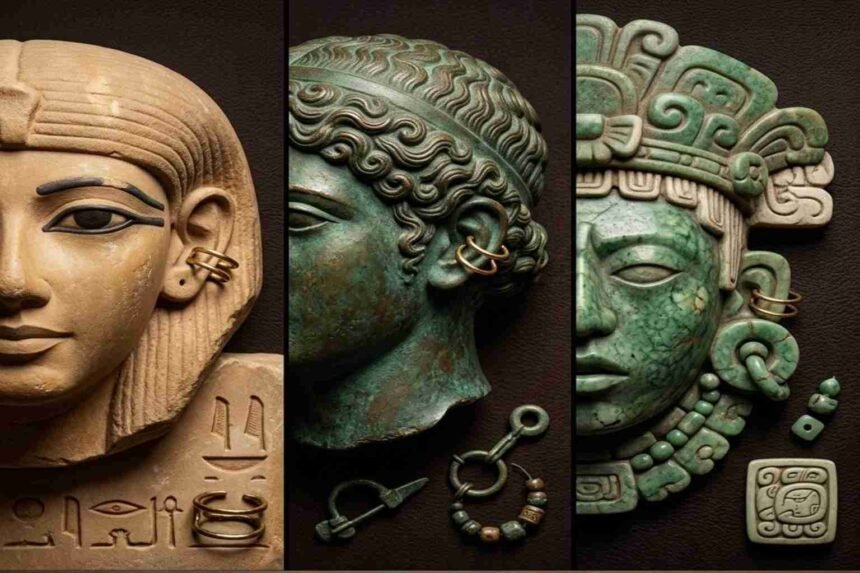
Before the ear cuff became a fixture of contemporary jewellery edits, it spent several thousand years doing considerably more serious work. Across ancient Egypt, the Indian subcontinent, pre-Columbian Mesoamerica, and the courts of the Roman Empire, the upper ear was not neutral territory. What you wore there communicated rank, allegiance, spiritual standing, and in some cases, the willingness to go to war.
This is not a history of decoration. It is a history of meaning worn on the body.
Egypt: The Ear as a Site of Divine Access
Ancient Egyptian ear adornment predates the New Kingdom, but it was during the reign of the pharaohs — roughly 1550 to 1070 BCE — that upper-ear jewellery became systematically codified. Archaeological finds from royal tombs show ear cuffs and full cartilage pieces in gold, electrum, and faience, worn by both men and women of the ruling class.
What is less commonly discussed is the theological dimension. Egyptian texts reference the ear as the organ through which divine instruction entered the body. Priests who served oracular functions wore ear ornaments as markers of that receptive capacity — the ear adorned was the ear attuned. Gold, the metal associated with Ra and the eternal body of the gods, was the material of choice precisely because it was understood to carry solar resonance. Wearing it at the ear was not vanity. It was theology.
The Indian Subcontinent: Architecture for the Ear
Nowhere in the ancient world was upper-ear adornment developed with more structural sophistication than on the Indian subcontinent. Sculptures from the Gupta period (4th–6th century CE) and earlier Kushan and Satavahana works show elaborate ear compositions — multiple piercings along the helix, conch, and tragus, layered with rings, chains, and cuffs that extended toward the hairline.
In Rajasthan in particular, the tradition of kaan jewelry (from the Sanskrit karna, meaning ear) held distinct social and spiritual weight. Different caste communities had distinct codes for ear adornments. Warriors wore pieces at the upper cartilage as protective markers — the belief that metal at the body’s periphery formed a kind of energetic barrier was widespread and functionally integrated into pre-battle ritual. Priests and temple dancers wore ear ornaments that identified their ritual roles and the deities they served.
This was not symbolic in the diluted, modern sense. It was operational. The jewelry was understood to do something — to mark, to protect, to align.
Rome and the Mediterranean: Status Worn in Plain Sight
Roman ear adornment offers a different angle. In the Republican period, elaborate ear jewelry on men was considered foreign and excessive — by the Imperial period, that position had eroded entirely. Military commanders and members of the patrician class wore gold earpieces as indicators of rank that were readable at a distance, in public life and in ceremony.
Roman ear cuffs found across the Empire — in Britain, North Africa, Syria — show a consistent formal vocabulary: coiled forms, animal heads, geometric closures. These were not decorative experiments. They were legible signals in a society where personal adornment functioned as a kind of visual language, read immediately and interpreted accurately by anyone who encountered you.
Pre-Columbian Mesoamerica: The Weight of the Ear
Among the Maya and Aztec elite, ear adornment took a form that the term “cuff” barely captures. Ear spools — large gauge insertions worn at the lobe and sometimes the upper ear — were made from jade, obsidian, gold, and ceramic, with a size that increased in proportion to social rank. The largest pieces were reserved for rulers and high priests.
What matters here is not the scale but the logic: the ear was understood as a place where identity and spiritual standing were made permanent and visible. Adornment at that site was never incidental.
How Noir KĀLA Carries This Forward
The lineage described above did not disappear. It shifted — compressed into trend cycles, stripped of its context, and eventually reassembled by makers who understand what was lost in that compression.
Noir KĀLA works directly with multi-generational artisans in Rajasthan, the same region where the karna jewelry tradition described above developed over centuries. Their ear cuffs are crafted in 925 sterling silver — a noble, durable material that holds its form and finish through years of wear, not just seasons. Where gold appears, it is gold vermeil: 22k gold over 925 sterling silver, substantial rather than decorative.
The brand’s newer pieces have moved into harder formal territory — architectural edges, darker surface treatments, a grungy and futuristic undercurrent that sits alongside rather than against the historical weight of the form. The result is ear cuffs that read simultaneously as ancient and contemporary, which is exactly what the best iterations of this jewelry have always done.
The protective and symbolic nature of upper-ear adornment is not something Noir KĀLA explains at length. It is built into the design logic of the pieces themselves.
Conclusion:
Across Egypt, Rajasthan, Rome, and Mesoamerica, the same underlying conviction recurs: the ear is significant, and what you place there carries consequence. The ear cuff’s current moment in contemporary jewelry is less a trend than a return — a rediscovery of an instinct for adornment that has never actually gone dormant. It was waiting for people to start asking what these pieces originally meant, and to want that meaning back.