


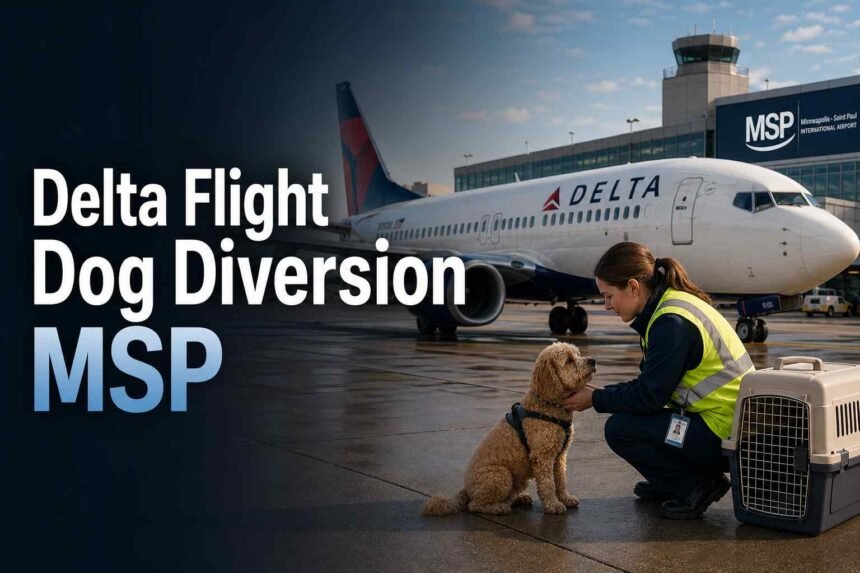
On May 26, 2025, a Delta flight dog diversion made national headlines after Delta Air Lines rerouted Flight 694 to Minneapolis–Saint Paul International Airport (MSP) because a cabin pet fell seriously ill mid-flight. The Airbus A321 was en route from Detroit (DTW) to Los Angeles (LAX) when the dog became unwell roughly an hour after departure. This is a factual breakdown of what happened, why the diversion occurred, and what it means for pet travelers.
- What Happened on Delta Flight 694
- Delta’s Official Response and Safety Statement
- Why the Flight Was Diverted to Minneapolis (MSP)
- Impact on Passengers and Flight Operations
- Cost and Financial Implications of the Diversion
- Animal-Related Flight Diversions: A Broader Pattern
- Delta’s Pet Travel Policy Explained
- Public and Expert Debate: Was the Diversion Justified
- Fact-Check — Did This Really Happen
- Conclusion of Delta Flight Dog Diversion
- FAQs
- FAQ 1: Why did Delta flight 694 divert to Minneapolis?
- FAQ 2: What happened to the dog after the diversion?
- FAQ 3: How long was the flight delayed because of the dog diversion?
- FAQ 4: Should the dog owner have to pay for the diversion?
- FAQ 5: What is Delta’s pet policy for cabin travel?
- FAQ 6: Is a flight diversion for a sick pet common?
- FAQ 7: How did Delta define the dog as a “customer” in its statement?
- FAQ 8: Was the viral social media post about the Delta dog diversion real?
What Happened on Delta Flight 694
Delta Flight 694 departed Detroit Metropolitan Wayne County Airport at 8:28 p.m. on Memorial Day 2025. About an hour into the five-hour flight, a passenger’s dog began showing clear signs of serious illness. Cabin crew quickly asked whether any veterinarians were onboard — and one was.
That veterinarian provided emergency care on the spot. Despite that effort, the situation remained serious enough that the captain made the call to divert. The flight was rerouted to Minneapolis, a Delta hub, where emergency medical personnel were already waiting at the gate.
The dog and its owner deplaned in Minneapolis and received immediate veterinary attention. Flight 694 resumed at 10:30 p.m. and landed at LAX at 12:55 a.m. — 2 hours and 25 minutes behind schedule.
Delta’s Official Response and Safety Statement
Delta released a clear statement after the incident:
“The safety of our customers and people comes before everything else at Delta. That’s why Delta flight 694 diverted to MSP to ensure a cabin pet that became ill received proper care.”
That wording sparked its own conversation. By referring to the dog as a “customer,” Delta effectively placed the animal within its circle of care — not just as cargo or property. Some travelers found that framing reassuring. Others found it controversial.
The airline confirmed the dog recovered. Delta did not apologize for the diversion or suggest the decision was debatable. From the carrier’s standpoint, it was straightforward: a living being onboard needed help, and the crew acted accordingly.
Why the Flight Was Diverted to Minneapolis (MSP)
Minneapolis was the logical choice for several reasons. MSP is a major Delta hub and crew base, meaning the airline had the infrastructure and personnel already in place to handle an unplanned stop.
The captain, operating as the pilot-in-command, carries full authority over diversion decisions. The onboard veterinarian advised that continuing the flight could be life-threatening to the animal. That recommendation, combined with the operational reality of being closer to MSP than LAX at that point in the journey, made the diversion a clear call.
There were also secondary factors. An animal in visible distress affects the entire cabin — both emotionally and practically. Reports indicated the aircraft may have required cleanup upon landing, which explains why the ground delay extended beyond a simple offload.
Impact on Passengers and Flight Operations
The 181 passengers and six crew members onboard experienced a 2.5-hour delay. For many, that was just an inconvenience. For others — those with connecting flights, rental car reservations, or time-sensitive plans — the delay carried real consequences.
This particular flight was also the last of six daily Delta departures between DTW and LAX. That timing, combined with it being Memorial Day weekend (one of the busiest travel days of the year, with nearly 8,000 delayed flights recorded across the U.S. that day), made the delay harder to recover from for affected passengers.
Delta did not publicly detail what compensation, if any, was offered to passengers for the delay.
Cost and Financial Implications of the Diversion
Who Bears the Cost of a Pet-Related Diversion
Flight diversions are expensive. Costs include:
- Additional fuel for the unplanned routing
- Extended crew time, which may push crews toward duty limit thresholds
- Re-accommodation expenses for passengers who miss connections
- Ground handling and aircraft cleaning at MSP
Conservative estimates place unscheduled diversions in the range of tens of thousands of dollars, depending on aircraft type, location, and delay length.
Some analysts, including aviation blogger Matthew Klint, argued that the dog owner should bear these costs since traveling with a pet is an elective decision. The counterargument — raised by Ben Schlappig of One Mile at a Time — is equally valid: boarding a plane is also an elective act for humans, and airlines don’t bill passengers whose medical emergencies cause diversions.
Under current FAA regulations and standard contracts of carriage, airlines have no enforceable mechanism to bill a pet owner for a diversion caused by the animal’s illness. Delta absorbed the cost.
Delta’s Pet Revenue vs. Diversion Expense
Delta collects roughly $50 million annually in pet fees, based on an estimated 250,000 cabin pets per year at approximately $200 per booking. That revenue base effectively functions as a built-in risk pool for incidents like this one.
| Metric | Estimate |
| Annual cabin pets on Delta | ~250,000 |
| Per-booking pet fee | ~$200 |
| Estimated annual pet revenue | ~$50 million |
| Estimated diversion cost (single event) | $10,000–$50,000+ |
A single diversion, even a costly one, represents a fraction of that annual pet revenue. The argument that this incident was financially catastrophic for the airline doesn’t hold up under scrutiny.
Animal-Related Flight Diversions: A Broader Pattern
Pet and animal-related diversions are uncommon but not unheard of. Here are several recent examples:
| Date | Airline | Incident |
| February 2022 | AirAsia | Snake spotted in overhead bin; flight diverted to Kuching for fumigation |
| April 2024 | United Airlines | Dog defecated in aisle; flight diverted to Dallas for cleaning |
| September 2024 | SAS | A live mouse was found in a passenger’s meal; the aircraft changed in Copenhagen |
| January 2025 | KLM | Foul odor from 100 cargo pigs affected cockpit air quality; diverted to Bermuda |
| April 2025 | American Airlines | Service dog attacked a passenger; flight diverted to Colorado Springs |
The Delta incident is notable because it involved a sick pet in the cabin — not a safety threat, a hygiene issue, or an aggressive animal. That makes it rarer and, for many, more sympathetic.
Delta’s Pet Travel Policy Explained
Cabin Pets: Rules and Requirements
Delta allows small dogs, cats, and household birds in the cabin on domestic flights within the contiguous U.S. Key requirements include:
- Pet must be at least 8 weeks old
- Must fit in a soft-sided, ventilated carrier under the seat in front
- One-way fee: $150, collected at check-in
- Counts as the passenger’s carry-on item
- Limited number of pets permitted per flight
Service Animals vs. Emotional Support Animals
Delta follows federal requirements for service animals. Passengers traveling with a trained service animal must complete documentation through Delta’s website before flying.
Emotional support animals are not recognized as service animals under the current Delta policy and are treated as cabin pets subject to standard fees and restrictions. This distinction matters — especially in the context of the DL694 incident, where the dog involved was a personal pet, not a certified service animal.
The abuse of fake service animal designations remains a separate, ongoing issue in commercial aviation. This case did not involve that — but it reignited the broader conversation.
Public and Expert Debate: Was the Diversion Justified
Aviation bloggers and readers split sharply on this. Matthew Klint (Live and Let’s Fly) argued the dog owner should be billed for diversion costs, framing pet travel as an elective luxury. Ben Schlappig (OMAAT) pushed back, pointing out that human medical diversions follow the same logic, and no one proposes billing sick passengers.
A few practical points settle most of the debate:
- The dog recovered. The outcome validates the decision.
- The diversion was rare. Pet-related diversions rarely happen, which undermines the argument that this sets a costly precedent.
- The PR math is simple. If Delta had not diverted and the dog had died on board, the reputational damage would have far exceeded any diversion cost.
- Pet fees exist for a reason. Delta profits from pet travel. Absorbing a rare emergency is part of that business model.
Fact-Check — Did This Really Happen
Yes — verified. Snopes investigated this story in September 2025 after a viral Facebook post from a user named “Karen Miller” spread the story with AI-generated-style text and a suspicious profile image. Two AI detectors flagged the post as partially machine-generated.
Despite the suspicious framing of the viral version, the underlying event was real. Delta confirmed the incident directly. It was reported by the Los Angeles Times (Clara Harter) and Newsweek (Sophie Clark) at the time it occurred in May 2025.
The takeaway: the story was real, but the viral September 2025 version was likely AI-generated content designed to look emotionally authentic and spread easily.
Conclusion of Delta Flight Dog Diversion
Delta’s decision to divert Flight 694 to MSP was the right call. A dog was seriously ill, a veterinarian on the ground confirmed the risk, and the captain exercised the authority every pilot-in-command holds. The dog recovered. The passengers landed safely, if late.
The real value in this story isn’t the drama — it’s what it reveals about pet travel on commercial flights. If you’re flying with a pet, understand the rules, carry documentation, and recognize that emergencies are rare but possible. Airlines like Delta have policies built around absorbing these costs, not passing them to individual owners.
Planning to fly with your pet? Review Delta’s current cabin pet requirements on delta.com before booking to avoid surprises at check-in.
FAQs
FAQ 1: Why did Delta flight 694 divert to Minneapolis?
A dog traveling as a cabin pet became seriously ill about an hour into the flight. The onboard veterinarian assessed the situation as potentially life-threatening. The captain made the decision to divert to Minneapolis (MSP), the nearest Delta hub, where emergency medical personnel were waiting.
FAQ 2: What happened to the dog after the diversion?
Delta confirmed the dog recovered after receiving veterinary treatment in Minneapolis. The dog and its owner deplaned at MSP, and Flight 694 resumed its journey to Los Angeles roughly 2.5 hours later.
FAQ 3: How long was the flight delayed because of the dog diversion?
The diversion caused a 2-hour and 25-minute delay. The flight was originally scheduled to arrive in Los Angeles at 10:31 p.m., but landed at 12:55 a.m. All 181 passengers were affected.
FAQ 4: Should the dog owner have to pay for the diversion?
Under current airline contracts of carriage and FAA regulations, there is no enforceable mechanism for Delta to bill the pet owner. Delta absorbs these costs as part of its operating expenses, partially offset by the roughly $50 million in annual pet fees the airline collects.
FAQ 5: What is Delta’s pet policy for cabin travel?
Delta allows small dogs, cats, and household birds in the cabin on domestic U.S. flights. Pets must be at least 8 weeks old, fit in a soft-sided ventilated carrier under the seat, and travel for a one-way fee of $150. The pet counts as the passenger’s carry-on item.
FAQ 6: Is a flight diversion for a sick pet common?
No. Pet-related diversions are very rare. While animal-related diversions do occur — involving snakes, mice, and service dog incidents — a diversion caused specifically by a sick cabin pet is unusual. Dozens of flights divert daily for human medical issues; pet diversions represent a tiny fraction of those.
FAQ 7: How did Delta define the dog as a “customer” in its statement?
Delta’s spokesperson used the phrase “cabin pet that became ill received proper care” in a statement that opened with “the safety of our customers, and people come before everything.” The framing placed the pet within Delta’s duty of care, prompting public debate about how airlines define and protect non-human passengers.
FAQ 8: Was the viral social media post about the Delta dog diversion real?
The incident was real, but the viral version that spread on Facebook and X in September 2025 showed signs of being AI-generated. Snopes investigated and confirmed the underlying event through Delta’s own statement and original reporting by the Los Angeles Times and Newsweek from May 2025.