


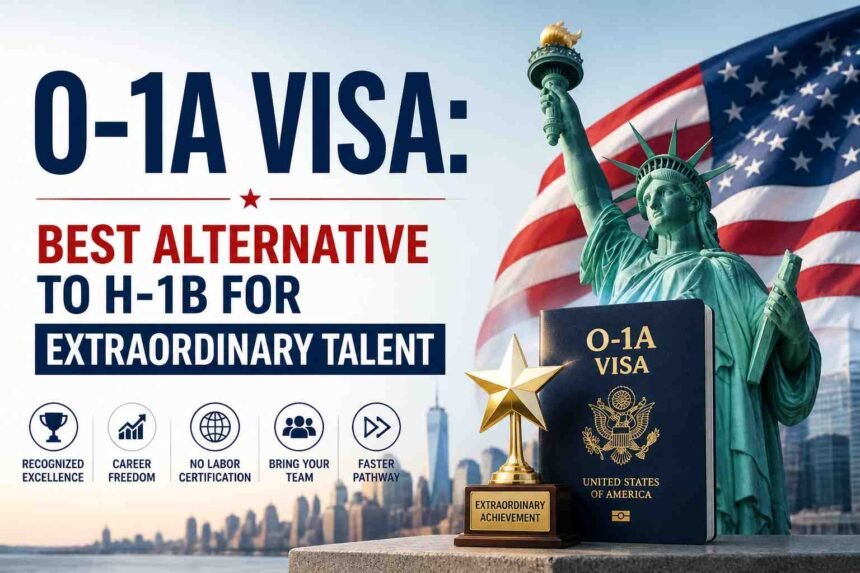
The United States has consistently attracted the best and brightest from around the world, offering a wealth of opportunities for those who drive technological, academic, and entrepreneurial ventures. For professionals at the pinnacle of their fields, the O-1A visa provides a strategic route to living and working in the U.S. This visa is reserved for individuals who have distinguished themselves through extraordinary achievement and recognition in disciplines such as science, business, education, or athletics.
While several work visa options exist, many face annual quotas or complex lotteries. The O-1A stands apart by allowing qualified individuals to bypass much of this uncertainty, focusing strictly on proven merit and impact. This provides both applicants and U.S. employers with a reliable path to recruit elite talent, benefiting the nation’s economy and global standing.
Applying for the O-1A visa involves a meticulous review of one’s accomplishments and a structured process to demonstrate why the applicant stands out in their profession. Understanding these requirements can make all the difference for those considering this career move and for employers seeking key international hires.
The U.S. continues to rely on a vibrant influx of specialized knowledge, especially in areas of intense global competition. For many, the O-1A visa is not only a symbol of recognition but also a critical tool for supercharging innovation and fostering global collaboration.
Understanding the O-1A Visa
The O-1A category is specifically designed for individuals who can prove exceptional ability through sustained acclaim, either on a national or global stage. It is a non-immigrant visa, meaning it permits a temporary stay for work purposes, but it is not subject to the annual caps that apply to some other visa types. This distinction offers greater flexibility for both the applicant and their U.S. sponsor, making it especially attractive in fast-moving sectors like tech, science, and finance.
Unlike many other work visas, the O-1A does not have a standard or predetermined list of qualifying professions; instead, it focuses on the quality and impact of one’s achievements. Applicants must show documented evidence of their extraordinary ability and the recognition they have achieved from peers or authorities in their field.
Eligibility Criteria
The eligibility standards for the O-1A visa are rigorous, reflecting the goal of attracting only the most accomplished professionals. To qualify, candidates must present strong evidence in several categories.
- Evidence of nationally or internationally recognized awards or prizes indicating excellence in the field.
- Memberships in associations that require outstanding achievements or significant contributions from their members.
- Published material about the candidate in major professional journals, newspapers, or national publications.
- Original contributions of major significance, such as research, inventions, or unique projects within their discipline.
- Authorship of scholarly articles in esteemed journals or books.
- A consistently high salary or compensation that reflects extraordinary ability.
- Participation as a judge or expert evaluating the work of peers in similar or related fields.
- Holding key roles in organizations known for excellence and distinction.
Further details on these criteria and examples of supporting documentation can be found on the U.S. Citizenship and Immigration Services (USCIS) website.
Application Process
The O-1A application requires careful planning and documentation. The process generally includes these major steps:
- Petition Filing: Only a U.S. employer or agent can submit Form I-129 on behalf of the applicant. Self-petitioning is not allowed.
- Submission of Evidence: The application must be accompanied by clear evidence demonstrating the applicant’s extraordinary ability and recognition in their field.
- Consultation Letter: A written advisory opinion from a peer group, labor organization, or professional association must be included to validate the applicant’s credentials.
- Approval and Visa Interview: Once USCIS approves the petition, the applicant can proceed to a U.S. consulate or embassy for a visa interview and final approval to enter the United States.
Each step is subject to specific timing and document requirements. Delays are common when supporting evidence is missing or deemed insufficient, so many applicants choose to work with legal professionals specializing in immigration law.
O-1A Visa vs. H-1B Visa
Although both the O-1A and H-1B visas permit highly skilled individuals to work in the U.S., they appeal to different talent pools and have distinct processes. The O-1A visa is reserved for individuals who have demonstrated extraordinary ability, not simply advanced credentials. In comparison, the H-1B targets those in specialty occupations requiring at least a bachelor’s degree, but demand typically far exceeds supply due to the visa cap and random selection process. Because the O-1A is not subject to an annual lottery or numerical limit, it is often the only feasible option for elite candidates when H-1B quotas have already been reached.
- Eligibility: O-1A requires a higher threshold, focusing on documented excellence, while H-1B is based on having a degree and a qualifying job offer.
- Cap Limit: O-1A has no annual cap; H-1B is subject to strict quotas and a lottery system that can make obtaining the visa a matter of chance.
- Duration: O-1A visas can be initially granted for up to three years and renewed in one-year increments. H-1B visas are generally valid for 3 years, extendable for up to 6 years total.
For a practical comparison of these and other employment visa categories, see the New York Times coverage of recent H-1B updates.
Impact on U.S. Innovation
O-1A visa holders play a pivotal role in sustaining U.S. leadership in technology, science, entrepreneurship, and academia. Many have launched groundbreaking startups, developed transformative scientific discoveries, or driven major technological advances for American firms. Their ability to collaborate, compete, and contribute at the highest levels keeps the country at the forefront of innovation.
This visa category is also frequently used by founders and senior technical experts whose skills and insights are instrumental in shaping high-growth industries. According to Forbes, a significant portion of America’s most innovative companies have at least one foreign-born founder or technical leader who entered the U.S. under high-skilled visas such as the O-1A.
Further, the presence of O-1A professionals deepens the country’s talent pool. It increases knowledge transfer, which contributes to the U.S.’s robust research environment and its continued investment in cutting-edge developments.
Challenges and Considerations
Despite these advantages, the O-1A visa is not without its challenges. The eligibility requirements are very strict, with a high standard of proof and extensive documentation necessary to make a compelling case. Each submission must show how the individual’s achievements place them at the very top of their field. Because many of the application criteria involve subjective judgments, collecting persuasive evidence and persuasive peer support is essential.
Additionally, the complexity of the process, along with its reliance on employment sponsorship, often necessitates engaging with qualified immigration attorneys. These professionals can help ensure that each piece of evidence is well presented and that all procedural requirements are met, thereby reducing the risk of unnecessary delays or denials. For more information on these complexities, a useful guide can be found at Reuters legal resources.
Conclusion
The O-1A visa remains one of the most powerful instruments for individuals with extraordinary skills who wish to contribute to the U.S. economy and scientific leadership. By understanding its eligibility criteria and application process, both applicants and employers can make informed decisions about leveraging this unique pathway. For those who meet the requirements, this visa opens opportunities that extend far beyond traditional work authorizations, fueling innovation and growth across the country.