

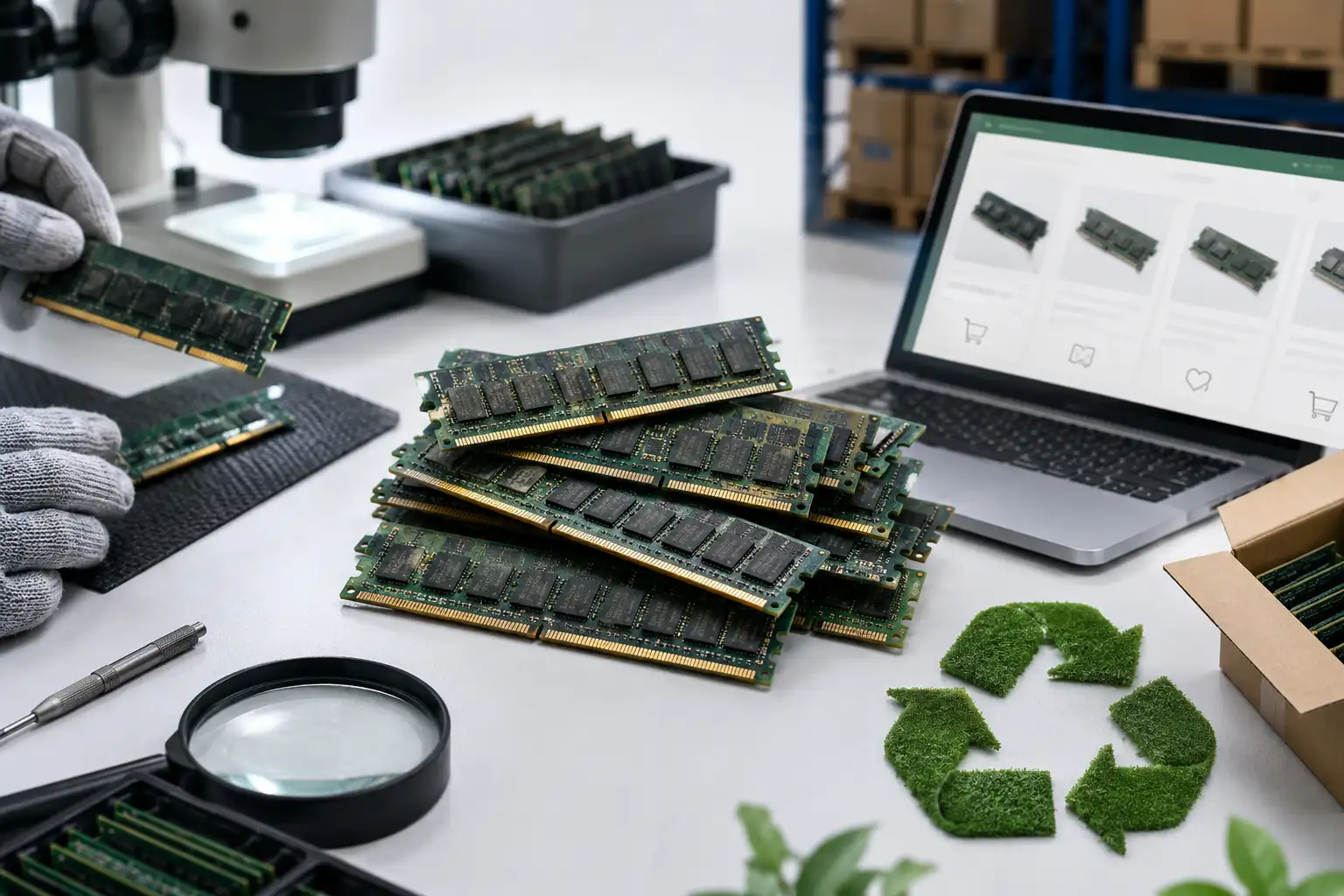
Selling used DDR RAM can be more complex than it first appears. Value depends on several factors, including generation, speed, capacity, and current market demand.
- How To Determine Your RAM Resale Value
- DDR Generation and Speed Ratings
- Brand and Manufacturer Affect
- Ecc Server Vs Consumer Ram Pricing
- Current Market Conditions
- Module Capacity and Matched Sets
- Preparing Your DDR RAM for Sale
- Testing RAM Functionality
- Cleaning Memory Modules
- Gathering Specifications And Documentation
- Taking Quality Photos
- Data Security And Compliance When Selling RAM
- Conclusion
Small differences in specifications can shift pricing more than expected. Buyers also look for tested, clean modules with clear documentation.
This article explains how to assess resale value, prepare memory for sale, and choose the right remarketing path. It also covers data handling basics and compliance concerns that often get overlooked.
With the right approach, sellers can avoid common mistakes and make informed decisions that lead to better returns and smoother transactions.
How To Determine Your RAM Resale Value
Finding the best remarketing options for used DDR RAM memory means understanding how multiple pricing factors work together, something many sellers overlook.
With the right approach and by leveraging platforms like Big Data Supply, you can avoid undervaluing your hardware and maximize the return on your used RAM.
DDR Generation and Speed Ratings
Generation trumps everything else in determining base value. DDR5 modules command the highest prices, followed by DDR4, then DDR3. To cite an instance, a 16GB DDR5-5600 non-ECC module fetches $122-250 USD at buyback, while the same capacity in DDR4-3200 brings $67-94 USD. DDR3-1600 pulls just $5-14 USD.
Speed ratings within each generation create pricing tiers. DDR4-3200 sells for 15-20% more than DDR4-2400 at equivalent capacities. DDR5-6400 commands premiums over DDR5-4800, with 32GB registered modules priced at $540-838 USD versus $423-799 USD.
Gamers and enthusiasts who need maximum performance find higher frequencies appealing.
Brand and Manufacturer Affect
Brand matters less than you’d think. Only a handful of actual DRAM manufacturers exist (Samsung, SK Hynix, Micron), and most brands add heatsinks to chips from these sources. Kingston, Corsair, and Crucial maintain strong reputations for reliability.
Motherboard compatibility is what brand consideration involves. Staying with Qualified Vendor Lists (QVL) reduces compatibility issues. Timing differences between expensive and cheaper RAM from the same manufacturer fall within nanoseconds, creating negligible real-life performance gaps.
Ecc Server Vs Consumer Ram Pricing
ECC RAM carries substantial premiums. The extra parity chips add roughly 25% to manufacturing costs, and this translates to resale values. A 32GB DDR4-3200 ECC registered module sells for $90-470 USD, while non-ECC consumer RAM of similar capacity and speed brings $113-140 USD.
Server memory features additional cost drivers. Registered memory has buffer chips on address lines, adding latency but allowing larger configurations. Fully buffered modules with data line buffers cost even more. Rank count matters too, with quad-rank modules commanding premiums over single or dual-rank configurations.
Current Market Conditions
Market timing affects what buyers will pay. DRAM pricing remains unstable throughout 2026 due to multiple pressures. DDR4 contract prices jumped 18-23%, while DDR5 increased 12% for the third consecutive month. Some DDR4 kits tripled in price between October 2025 and January 2026. 32GB sets rose from $60-90 USD to $150-180 USD.
Manufacturers discontinued DDR3 and DDR4 production by late 2025, and Samsung implemented 3-5% price increases. This shortage created the problem. Budget builders scramble for affordable options, and even DDR3 has seen renewed interest.
Module Capacity and Matched Sets
Capacity scales pricing non-linearly. A single 32GB DDR4 module doesn’t cost twice what a 16GB module does. 32GB DDR5-5600 non-ECC sells for $260-387 USD, while 16GB brings $122-250 USD. Larger capacities become scarce during shortages, magnifying premiums.
Matched sets fetch 10-15% more than individual modules sold separately. Dual-channel operation requires matched capacity for optimal performance. Selling complete kits (2x16GB, 4x8GB) attracts serious buyers who value guaranteed compatibility.
Preparing Your DDR RAM for Sale
Presentation makes or breaks your sale. Buyers scroll past dirty, untested modules, whatever the price. Clean, verified RAM with proper documentation moves fast and commands top dollar.
Testing RAM Functionality
You can’t sell what you can’t verify works. Start with Windows Memory Diagnostic if you’re on a PC. Type “Windows Memory Diagnostic” in the search box, select “Restart now and check for problems,” and the tool runs a series of memory tests.
Mac users can hold down the “D” key during startup to access Apple Diagnostics, which checks RAM along with other hardware components automatically. MemTest86 remains the industry standard for deeper verification. Download the ISO file from memtest86.com and create a bootable USB drive using Rufus, then boot from that drive.
The program runs multiple test passes independent of your operating system and checks all memory locations. Different software might catch errors others miss, so both tools provide a second opinion. Errors might appear. Try reseating the module by removing and reinserting it to check the connection.
Clean the gold edge connector parts to improve contact between the memory and the slot. Test in a different working slot to rule out motherboard damage. Even faulty server-grade or high-capacity RAM holds value for recycling or component harvesting.
Cleaning Memory Modules
Handle modules by their edges only and avoid the pins and exposed components. Compressed air removes most dust and debris from both sides of the module. A soft-bristle toothbrush or cotton swab works for stubborn dirt without damaging components. Never use liquids or chemicals, as they can damage RAM severely.
A pencil eraser cleans RAM contacts and removes residue from the gold fingers. Contact quality improves, and connection issues decrease. Inspect edge connectors for corrosion, scratches, or discoloration during cleaning. Check memory chips for cracks, burn marks, or loose components. Look at the circuit board for warping or breaks.
Gathering Specifications And Documentation
Buyers need exact details. Capture model numbers, capacity, speed ratings, and generation information visible on module labels. Check manufacturer websites for warranty validity, as modules still under warranty command higher prices. Detailed inventory lists with part numbers and quantities speed up the valuation process.
Taking Quality Photos
Clear images from multiple angles attract serious buyers. Photograph labels showing specifications and model numbers. Document defects rather than hiding problems if they exist.
Natural lighting near a window works better than flash, which creates harsh shadows and washes out details. Get close enough to fill 80% of the frame with the module. Take several shots and select the sharpest ones before listing.
Data Security And Compliance When Selling RAM
Data security concerns trip up many sellers, but the technical reality is simpler than you’d expect. RAM operates differently from storage drives. Understanding this difference protects you from unnecessary worry while keeping you compliant.
Understanding RAM Data Volatility
RAM doesn’t store data long-term. Everything erases once you shut the computer off. This volatile nature means selling DDR RAM memory carries nowhere near the risk of disposing of hard drives or SSDs.
Certain enterprise systems use specialized configurations that may temporarily hold sensitive information. Server environments running specific workloads occasionally cache data in ways that persist slightly longer than standard consumer applications.
Cold boot attacks can exploit relatively slow data decay in unpowered DRAM. Techniques extend recovery windows to minutes or hours using cold temperatures.
There’s a risk of data leaks or privacy breaches if RAM hasn’t been handled properly. This becomes especially relevant for regulated industries like healthcare or finance, where compliance failures trigger penalties and reputational damage.
Chain Of Custody Documentation
The chain of custody tracks who handles equipment from collection through final disposition. This chronological documentation records custody, control, transfer, analysis, and disposition at every stage.
Proper documentation confirms asset origin, ownership, and configuration history. Audit records provide proof of regulatory compliance across controlled industries. Financial recovery matches disciplined information protection when traceable handling practices exist throughout the process.
Certifications To Look For In Buyers
Partnering with certified ITAD providers delivers compliance with standards such as R2v3 and e-Stewards. These certifications confirm adherence to the highest standards in electronics recycling and RAM disposition.
NAID AAA certification covers physical destruction and data sanitization. Both scheduled and surprise audits are included. ADISA verifies strict data security and environmental practices through regular process audits. ISO 27001 demonstrates information security management systems for handling data-bearing devices.
R2v3 and RIOS certifications match ISO environmental, quality, and safety processes. Verify active certification badges rather than accepting claims at face value, especially when prices seem unusually low.
Conclusion
Understanding how DDR RAM memory is priced helps you make smarter resale decisions. Generation, speed, and capacity shape the base value, while condition and presentation influence final offers.
Testing and proper cleaning build buyer confidence, and clear documentation speeds up the process. Market timing can also shift pricing, especially during supply changes.
Data security is less of a concern than with storage devices, but proper handling still matters in regulated settings. Selling through reputable buyers with verified certifications adds another layer of trust. A careful, informed approach leads to fair pricing, fewer delays, and a more reliable resale experience overall.