


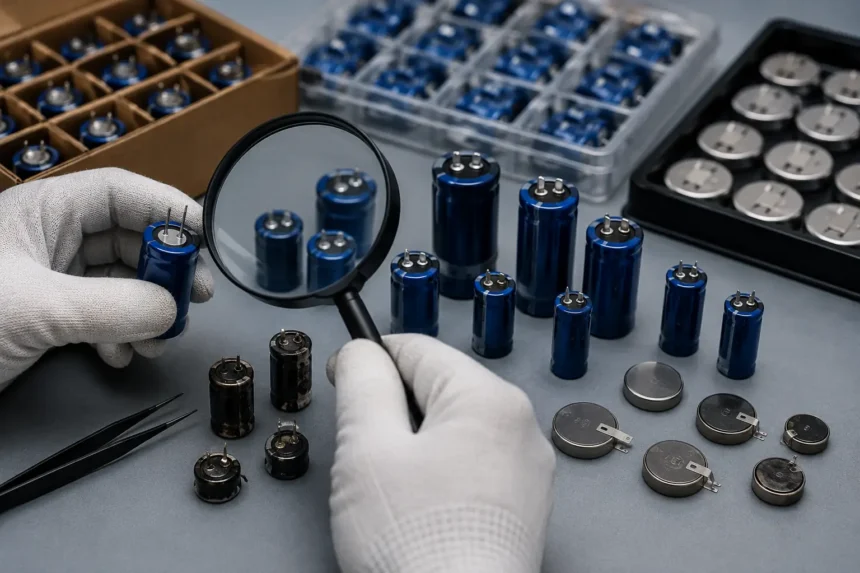
Counterfeit electronic components have quietly become one of the most dangerous problems in global manufacturing supply chains. Estimates from the Electronic Components Industry Association suggest that hundreds of millions of fake parts move through international markets every year — and the buyers often never know until a system fails. When it comes to supercapacitors specifically, the problem is worse than most procurement teams expect.
- The Scale of the Counterfeit Problem in Capacitor Supply Chains
- How to Identify a Fake Supercapacitor Before It Reaches Your System
- Inspect the Lot Code and Date Markings
- Check Original Factory Packaging and Seals
- Request and Verify the Datasheet Against Known Specs
- Test ESR and Capacitance Against Rated Values
- Verified Supercapacitor Supplier vs Red Flag Seller — At a Glance
- Common Mistakes Wholesale Buyers Make When Sourcing Supercapacitors
- Where to Actually Source 100% Original Supercapacitors
- Conclusion
- FAQ’s
- How do counterfeit supercapacitors pass initial visual inspection?
- What certifications prove a supercapacitor is 100% original and not refurbished?
- Is it safe to source industrial supercapacitors from online wholesale platforms?
- What is the safest way to verify a supercapacitor supplier before placing a bulk order?
- How do electrolytic capacitor wholesale prices compare to supercapacitor bulk pricing?
Fake units are increasingly difficult to detect on arrival, routinely passing visual inspection and even basic bench tests. This article is a field guide for wholesale buyers and sourcing engineers who need to identify legitimate channels, recognize warning signs before money changes hands, and locate a genuine supercapacitor for sale from a supplier they can actually trust. The stakes are not abstract: one bad batch in the wrong application can cost far more than the margin saved.
The Scale of the Counterfeit Problem in Capacitor Supply Chains
Counterfeit capacitors enter the supply chain through multiple vectors, none of them obvious at the point of purchase. Gray-market distributors — operating legally in some jurisdictions but outside manufacturer-authorized networks — are among the most common entry points.
These distributors often source discontinued stock, rejected lots, or reconditioned parts and repackage them with new markings. Electrolytic capacitor wholesale markets are particularly vulnerable to this, as high volumes and thin margins create pressure to cut corners on verification at every tier of the distribution chain.
Online marketplaces have compounded the problem significantly. Platforms that aggregate third-party sellers offer little to no authentication for the electronic components listed on them. A procurement manager searching for bulk capacitor stock can easily land on a listing from an unverified reseller who obtained the units from an untraceable origin. The parts may carry a recognizable brand name, a convincing lot code, and a competitive price — and still be completely counterfeit.
The consequences of installing fake components are not limited to performance degradation. Supercapacitors that fail to hold charge as rated can cause data loss in backup power systems, equipment shutdowns in industrial controls, and cascading failures in energy recovery applications.
Beyond operational damage, counterfeit components can void manufacturer warranties, fail regulatory audits, and, in worst-case scenarios, create thermal runaway events. The financial exposure from a single contaminated batch — measured in rework costs, field replacements, and liability — routinely dwarfs any savings made at purchase.
How to Identify a Fake Supercapacitor Before It Reaches Your System
Inspect the Lot Code and Date Markings
Every genuine component carries traceability markings that correspond to verifiable production records. On a 100% original supercapacitor, the lot code and date code should be crisp, consistently formatted, and cross-referenceable with the manufacturer’s traceability database. Blurred ink, inconsistent font sizing, or codes that don’t resolve in any manufacturer lookup system are immediate disqualifiers — don’t rationalize them away.
Check Original Factory Packaging and Seals
Authentic supercapacitors ship in manufacturer-sealed tape-and-reel, tube, or tray packaging with unbroken seals and intact anti-static protection. Repackaged counterfeits are frequently spotted by damaged inner trays, resealed bags, mismatched label fonts, or packaging materials that don’t match the manufacturer’s current standards. If the packaging looks like it has been opened and resealed — even carefully — treat the entire lot as suspect.
Request and Verify the Datasheet Against Known Specs
Every legitimate supercapacitor supplier should be able to produce an original manufacturer datasheet on request, not a scanned copy or a generic sheet repurposed from a similar part number. Cross-reference the capacitance, ESR, voltage rating, and temperature range against the manufacturer’s published specifications on their official website.
Discrepancies in rated values, especially capacitance tolerance or leakage current specs, are a reliable indicator that the documentation — and likely the parts — are not genuine.
Test ESR and Capacitance Against Rated Values
Electrical testing is the final line of defense before installation. Measure the equivalent series resistance (ESR) and actual capacitance of a sample from the lot using a proper LCR meter or impedance analyzer. Genuine units will fall within the tolerance band stated on the manufacturer’s datasheet.
Counterfeit or degraded parts frequently measure significantly below rated capacitance and show elevated ESR — meaning they will fail under load exactly when the application demands peak performance.
Verified Supercapacitor Supplier vs Red Flag Seller — At a Glance
Making a sourcing decision under time pressure is where most errors occur. A structured side-by-side comparison gives procurement teams a fast framework for evaluating a potential vendor before committing to a purchase order — especially when dealing with unfamiliar suppliers or new channels.
| Verified Supercapacitor Supplier Traits | Red Flag Seller Traits |
| Provides full lot traceability to the original manufacturer | Cannot confirm or discloses no supply chain origin |
| Pricing is consistent with market rates for the brand | Pricing is significantly below market without explanation |
| Holds ISO 9001 and relevant component handling certifications | No quality certifications or certifications cannot be verified |
| Ships in original, sealed manufacturer packaging | Parts arrive in generic, repackaged, or damaged packaging |
| Provides the original manufacturer’s datasheet on request | Supplies only scanned, generic, or photocopied documentation |
| MOQ terms are clearly stated and consistent | MOQ changes after the initial quote or are vague in writing |
| Offers Certificate of Conformance and inspection reports | Refuses or delays providing QC documentation |
| Engages competently with technical questions about specifications | Deflects or gives generic answers to technical queries |
If a seller refuses to provide a Certificate of Conformance or cannot answer basic questions about component traceability, treat it as a hard stop — not a negotiation point. Pricing below the recognized market rate for a known brand is seldom a legitimate deal; it is the most reliable indicator that something in the supply chain has been compromised.
Common Mistakes Wholesale Buyers Make When Sourcing Supercapacitors
Price pressure and procurement deadlines have a way of eroding due diligence that procurement teams know, in principle, they should never skip. When a project is behind schedule, or a budget has been cut mid-quarter, buyers start making decisions they would not make under normal conditions — and counterfeit components exploit exactly that window. The problem is not ignorance; most experienced sourcing professionals know the rules. The problem is the specific circumstances under which those rules get quietly set aside.
Time constraints are equally dangerous. When a production line is waiting on components, the urgency to close a purchase can override the patience required for proper supplier vetting. Buyers may accept a supplier’s verbal assurances in place of documentation, or approve a sample lot without running electrical tests, simply because the project timeline won’t accommodate a delay. These are understandable pressures — but they are also the exact conditions under which fake parts find their way into finished products.
- Approving a supplier based on price alone without requesting any traceability documentation.
- Accepting a scanned or second-hand datasheet as proof of component authenticity.
- Skipping electrical testing on incoming lots because the parts “look right.”
- Placing a large bulk order after verifying only a small, potentially cherry-picked sample.
- Assuming a well-known brand name on the label is sufficient proof of origin.
Every one of these shortcuts has a documented history of resulting in counterfeit components reaching production. The only reliable protection is a sourcing policy that requires documented traceability, electrical verification, and a confirmed genuine supercapacitor for sale from a certified, authorized channel — without exceptions for time pressure or budget.
Where to Actually Source 100% Original Supercapacitors
The safest sourcing channels for a 100% original supercapacitor are those with the shortest, most transparent distance between the manufacturer and the buyer. Authorized distributors — those with a formal distribution agreement with the original equipment manufacturer — represent the most reliable option for most wholesale buyers. These distributors are contractually obligated to maintain traceability, stock only genuine components, and adhere to quality handling standards.
For high-volume procurement, direct factory partnerships with manufacturers like Maxwell (now part of Vishay), Murata, Eaton, or Nichicon offer the highest level of supply chain control, with purchase orders fulfilled directly from the production facility.
Verified online suppliers are a legitimate channel, but only when they can demonstrate full traceability documentation, hold recognized quality certifications, and provide responsive technical support. The same diligence applies when sourcing Electrolytic capacitor wholesale stock alongside supercapacitors — gray-market risk is not unique to one component type, and a supplier who cannot document the origin of one product category likely cannot document others either.
When evaluating any supercapacitor supplier, request their Certificate of Conformance, their authorized distributor agreement, and a sample datasheet before discussing pricing or volume. A legitimate supplier will provide all of these without hesitation.
Conclusion
The economics of counterfeit components are deceptively simple: fake parts are cheap to produce, easy to distribute, and difficult to detect — until they fail. The cost of that failure, measured in equipment damage, production downtime, warranty liability, and reputational exposure, consistently exceeds any savings made at the point of purchase. Every bulk order placed without proper supplier verification carries this risk.
Protecting your supply chain is not a matter of being overly cautious; it is a matter of understanding where the actual cost lies. When you are ready to place your next order, look specifically for a genuine supercapacitor for sale from an authorized, traceable, and fully documented source. Your production line — and your liability exposure — depends on getting that decision right.
FAQ’s
How do counterfeit supercapacitors pass initial visual inspection?
Counterfeit manufacturers replicate brand markings, lot codes, and packaging well enough to fool a standard visual check. Because most incoming inspections rely on appearance rather than electrical measurement, fake parts that look correct will pass. Electrical testing and documentation verification are the only methods that reliably catch them.
What certifications prove a supercapacitor is 100% original and not refurbished?
A Certificate of Conformance (CoC) from the manufacturer or authorized distributor is the primary standard. For regulated industries, AS6081 and AS9120 provide the strongest assurance frameworks. Always cross-reference the CoC with a traceable lot number validated directly with the manufacturer.
Is it safe to source industrial supercapacitors from online wholesale platforms?
It can be, but platform reputation alone is not enough — many do not screen sellers at all. Independently verify certifications, request traceability documentation, and electrically test incoming lots before installation. For critical industrial supercapacitor applications, never skip these steps regardless of the platform.
What is the safest way to verify a supercapacitor supplier before placing a bulk order?
Confirm the supplier holds an authorized distributor agreement with the manufacturer, then request a CoC and a datasheet with a traceable lot code. Ask a specific technical question — a legitimate supercapacitor supplier will answer it without hesitation. Order a sample lot and test it electrically before committing to full volume.
How do electrolytic capacitor wholesale prices compare to supercapacitor bulk pricing?
Electrolytic capacitors are far cheaper — standard aluminum electrolytics in electrolytic capacitor wholesale markets typically cost just a few cents per unit. Supercapacitors range from under a dollar to several dollars per unit at volume, depending on capacitance and voltage rating. Listings priced near electrolytic capacitor levels are a strong counterfeit warning sign.