

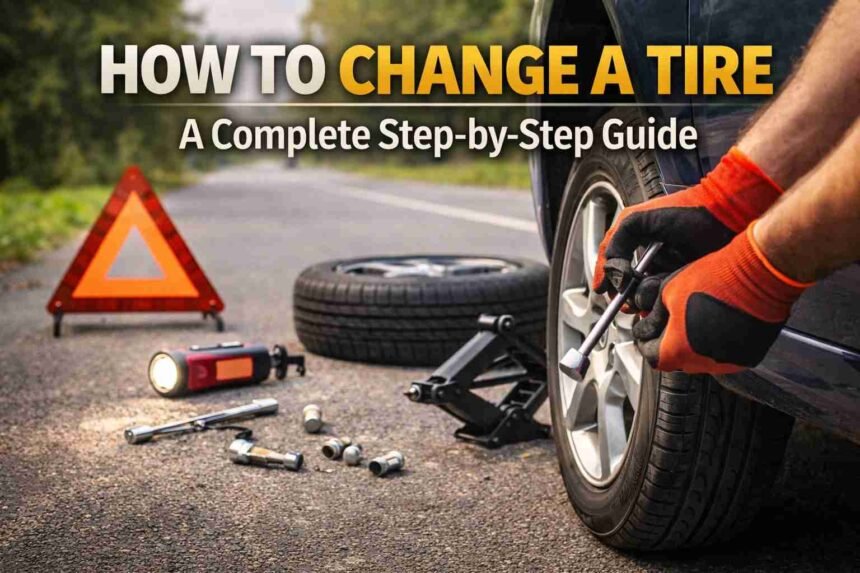
Knowing how to change a tire is one of those skills most drivers never think about — until they’re standing on the roadside watching traffic rush past. A flat tire rarely gives notice. It can happen from a nail, a piece of broken glass, a curb hop, or simply years of neglected tire maintenance. The good news? With the right tools and a clear process, getting back on the road takes about 15–20 minutes.
- What You Need to Change a Tire
- How to Change a Flat Tire Step-by-Step
- Step 1 – Move to a Safe Location
- Step 2 – Check Your Spare Tire and Secure the Vehicle
- Step 3 – Remove the Wheel Cover (If Applicable)
- Step 4 – Loosen the Lug Nuts
- Step 5 – Position the Jack and Raise the Vehicle
- Step 6 – Remove the Flat Tire
- Step 7 – Mount the Spare Tire
- Step 8 – Lower the Vehicle and Tighten the Lug Nuts
- Step 9 – Replace the Wheel Cover and Store Equipment
- Spare Tire Types and Limitations
- Full-Size Spare vs. Donut Spare
- How Far Can You Drive on a Spare Tire
- How Fast Can You Drive on a Spare Tire
- Tire Change Safety Tips
- How to Check and Maintain Your Spare Tire
- When to Replace Your Tires
- Alternatives to Changing a Tire
- Conclusion
- FAQs
- How often should I check my spare tire?
- Does roadside assistance cover tire changes?
- What should I do if my spare tire is also flat or damaged?
- How do I know when to replace my tires?
- What should I do if I get a flat tire in an unsafe location?
- What is the difference between a spare tire and a donut?
- Can I drive normally on a full-size spare tire?
What You Need to Change a Tire
Before touching the flat, gather everything first. Scrambling for tools mid-job wastes time and creates risk.
Essential items:
- Car jack
- Lug wrench (cross-shaped or L-shaped)
- Spare tire (inflated and ready)
- Owner’s manual
Recommended extras to keep in your trunk:
- Wheel wedges
- Tire pressure gauge
- Flathead screwdriver
- Portable tire inflator
- Reflective triangle or road flares
One thing many drivers overlook — the spare tire sitting in the trunk for two years may have lost pressure without anyone knowing. Check it monthly along with your other tires.
How to Change a Flat Tire Step-by-Step
Step 1 – Move to a Safe Location
Don’t stop the moment you feel something wrong. If you’re on a highway or in a blind curve, keep moving at a slow speed until you reach a flat, firm surface — a parking lot, straight road shoulder, or side street. Grass and soft dirt create instability under a jack.
Leave at least six feet between your driver’s door and the nearest traffic lane. Turn on hazard lights immediately, even in daylight.
Step 2 – Check Your Spare Tire and Secure the Vehicle
Once stopped, check the spare’s inflation pressure before committing to the swap. The correct PSI is listed in your owner’s manual or on the door jamb placard. A flat spare makes a bad situation worse.
Next, secure the vehicle:
- Automatic transmission: Shift to Park, apply the parking brake, shut off the engine.
- Manual transmission: Apply the parking brake, engage first gear on level ground or a hill (reverse if facing downhill), then shut off the engine.
Place wheel wedges — or bricks, rocks, or wood — against the tires at the opposite end from the flat to prevent rolling.
Step 3 – Remove the Wheel Cover (If Applicable)
Steel wheels often have a decorative hub cap. Pop it off with the flat end of the lug wrench or a flathead screwdriver. Some vehicles use a pry bar and socket combination tool instead. Check your owner’s manual to avoid cracking the cover.
Alloy wheels typically don’t have removable covers, so skip this step if that’s what you have.
Step 4 – Loosen the Lug Nuts
With the vehicle still on the ground, place the lug wrench over each nut and turn counterclockwise — just enough to break the resistance. Don’t remove them yet.
The reason to loosen before jacking: the wheel still carries vehicle weight, which gives you something to push against. Once the tire is in the air, the wheel spins freely, and you lose that leverage.
If your vehicle has wheel locks, you’ll need the lug key — usually stored in the glove box — before the lock nut will budge.
Step 5 – Position the Jack and Raise the Vehicle
This step matters more than most people realize. Placing a jack in the wrong spot can damage the chassis or cause the vehicle to slip.
Locate the jack points — reinforced sections of the frame typically marked by small arrow-shaped notches along the vehicle’s sills. Your owner’s manual shows the exact positions. On electric vehicles, correct jack placement is especially critical to avoid damaging the high-voltage battery beneath the floor.
Expand the jack until it contacts the lifting point firmly, then raise the vehicle until the flat tire clears the ground by two to three inches. Do not lean on or push against the car while it’s elevated on a jack stand.
Step 6 – Remove the Flat Tire
With the wheel off the ground, remove the lug nuts completely and set them somewhere they won’t roll away — your upturned hub cap works well. Grip the tire on both sides and pull it straight toward you along the wheel studs. Roll it away and set it aside.
Step 7 – Mount the Spare Tire
Lift the spare tire and align the lug holes with the wheel bolts on the hub. This can take a couple of attempts — tires are heavier than they look. Slide it onto the hub fully, making sure the valve stem faces outward.
Thread each lug nut on by hand until the wheel sits snug against the hub. Don’t use the wrench yet — the wheel is still in the air and can spin.
Step 8 – Lower the Vehicle and Tighten the Lug Nuts
Lower the jack slowly — counterclockwise on a scissor jack, or via the release valve on a hydraulic jack. Let the vehicle settle fully onto its suspension before removing the jack.
Now tighten the lug nuts using a star or crisscross pattern, not in a circle. This ensures even seating across all contact points.
| Wheel Type | Tightening Pattern |
| 4-lug | Cross (diagonal pairs) |
| 5-lug | Star (skip one, then continue) |
| 6-lug | Opposite pairs, move clockwise |
Apply firm, consistent pressure. Under-tightened lug nuts are a real safety risk at speed.
Step 9 – Replace the Wheel Cover and Store Equipment
Tap the hub cap back into place by hand if your vehicle has one. Avoid hammering it — a misaligned hit can dent or crack the cover permanently.
Secure the flat tire in the trunk using any retainer strap if your vehicle has one. Store the jack, lug wrench, and all remaining tools. Leave nothing loose in the cargo area.
Spare Tire Types and Limitations
Full-Size Spare vs. Donut Spare
Not all spares are equal — and the type sitting in your trunk significantly affects what happens next.
| Feature | Full-Size Spare | Donut (Compact) Spare |
| Size | Matches regular tires | Smaller, narrower |
| Weight | Heavier | Lighter |
| Speed limit | Same as regular tires | 50 mph max |
| Distance limit | No restriction | 50 miles max |
| Long-term use | Yes | Temporary only |
Donut spares are common on smaller vehicles due to space and weight savings. According to Kelley Blue Book, driving too fast or too far on a compact spare creates real safety risks, including handling instability.
How Far Can You Drive on a Spare Tire
Treat a donut as a bridge, not a destination. The 50-mile limit isn’t arbitrary — compact spares lack the tread depth, diameter, and structural strength for extended highway use. Get to a tire shop as quickly as possible for a permanent replacement.
Full-size spares that match your other tires carry no mileage restriction, though it’s still worth having the damaged tire inspected to determine if repair is possible.
How Fast Can You Drive on a Spare Tire
The 50-50 rule applies to donut spares: stay under 50 miles per hour and drive no more than 50 miles total. Beyond that threshold, handling, braking, and structural integrity all degrade. Full-size spare owners follow the same speed guidelines as any other tire.
Tire Change Safety Tips
A few habits separate a clean tire change from a dangerous one:
- Always keep your tools organized in one location in the trunk — not scattered across the cargo area.
- Practice the process once in your driveway before you ever need to do it under stress. Consumer Reports recommends a dry run specifically for this reason.
- Never place any part of your body under a vehicle that’s raised on a jack stand — these stands can shift on uneven ground.
- On a highway shoulder, stay on the passenger side of the vehicle while working, away from traffic.
How to Check and Maintain Your Spare Tire
Most spare tires sit neglected until they’re urgently needed. By then, it’s too late to discover a problem.
Compact spares generally require around 55 to 60 PSI — significantly higher than a standard tire. Use a dedicated tire pressure gauge to check it monthly. Also, inspect the tread surface for cracking or dry rot, particularly on vehicles that sit for long periods. Discount Tires recommends checking your spare before any extended road trip, not just on a regular monthly schedule.
When to Replace Your Tires
A flat tire makes the decision obvious. But worn tires deserve equal attention — they’re just less dramatic about failing.
Bridgestone recommends replacing any tire where the tread depth has fallen below 2/32 of an inch. The penny test offers a quick field check: press a penny upside down into a tread groove. If Abraham Lincoln’s full head is visible, the tire needs replacing. If the top of his head disappears into the tread, you still have usable life remaining.
Beyond tread depth, look for sidewall bulges, cracking, or uneven wear patterns — all signs a visit to a tire service professional is overdue.
Alternatives to Changing a Tire
Some vehicles no longer include a spare. Instead, manufacturers equip them with one of the following:
Tire Inflator and Sealant Kit: A compressor and sealant canister that temporarily seals minor punctures and re-inflates the tire. It works for small tread-area punctures but not sidewall damage. It’s a bridge to the repair shop, not a fix.
Run-flat tires: These reinforced tires can continue operating after a puncture — typically for up to 50 miles at reduced speed. They’re common on newer luxury and performance vehicles. Check your owner’s manual to see if your vehicle is equipped.
If you’re in a location where neither option works, Ford Roadside Assistance (1-800-241-3673) and most other manufacturers’ roadside programs dispatch help directly. Roadside coverage also comes standard with many auto insurance policies and extended warranty plans.
Conclusion
Changing a flat tire isn’t complicated, but it demands the right tools, correct technique, and situational awareness. The drivers who handle it calmly are almost always the ones who prepared ahead of time — spare tire inflated, tools organized, process understood. Once done, head straight to a tire service professional to inspect the damaged tire and determine whether repair or full replacement makes sense. A spare gets you there; it doesn’t replace the need for a proper fix.
FAQs
How often should I check my spare tire?
Check it monthly alongside your regular tires, and always before a long road trip. Verify both pressure and tread depth. Discount Tires recommends not waiting for a flat to discover your spare is compromised.
Does roadside assistance cover tire changes?
Most plans do — but only if you have a usable spare on hand. Coverage terms vary by provider, so review your specific plan details before assuming help includes a full tire change.
What should I do if my spare tire is also flat or damaged?
Don’t attempt to drive on it. Call a towing company or your roadside assistance provider. If you’re in immediate danger from traffic, contact local highway emergency services.
How do I know when to replace my tires?
The 2/32″ tread depth threshold from Bridgestone is the industry standard. Use the penny test for a quick check. Also watch for sidewall cracking, bulging, or persistent pressure loss — any of these signals replacement, not repair.
What should I do if I get a flat tire in an unsafe location?
Keep moving slowly with hazard lights on until you reach a safer spot — at least partially off the road with enough shoulder clearance. If no safe stopping point is reachable, call for help and stay inside the vehicle with your seatbelt on.
What is the difference between a spare tire and a donut?
A full-size spare matches your regular tires in diameter and construction. A donut (compact spare) is smaller, lighter, and carries strict speed and distance limits — 50 mph and 50 miles maximum, per KBB guidelines.
Can I drive normally on a full-size spare tire?
Yes, provided it matches your other tires in size and type. There are no separate speed guidelines or mileage restrictions for a matching full-size spare. That said, get the original tire inspected as soon as practical.


