



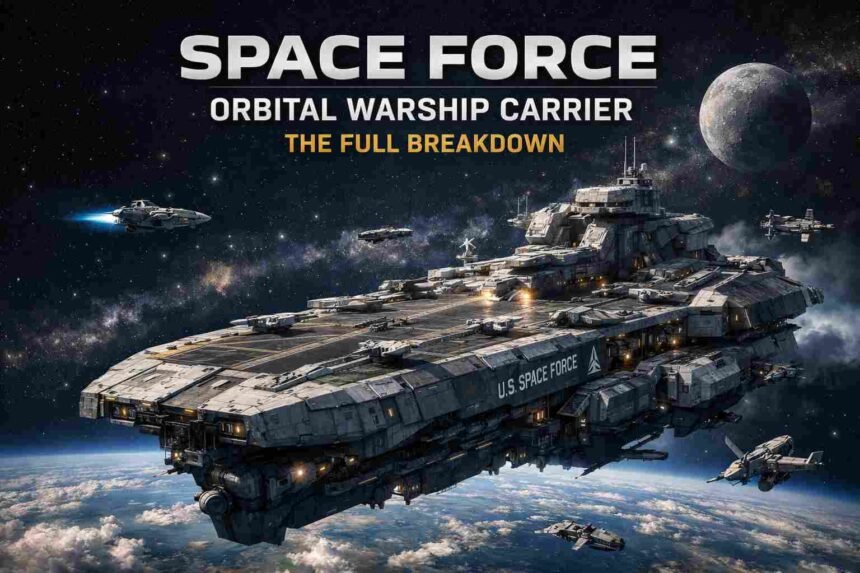
The space force orbital warship carrier is no longer science fiction. What once existed only in defense circles and military strategy papers is now an active program drawing serious attention from aerospace engineers, defense analysts, and military strategists worldwide. The U.S. Space Force, working with Seattle-based aerospace company Gravitics, is developing an orbital platform designed to store and deploy maneuverable spacecraft — organized in squadrons — directly from Earth orbit.
- What Is a Space Force Orbital Warship Carrier?
- Historical Context and Development
- How the Orbital Carrier Actually Works
- Development Timeline and Contract Details
- Potential Capabilities of the Orbital Warship Carrier
- Satellite Deployment and Reconnaissance
- Weapons and Defense Systems
- Command and Control Infrastructure
- Deployment and Drone Support
- Crew and Life Support
- Technologies Required to Build Orbital Military Platforms
- Strategic Advantages in a Contested Space Domain
- Challenges and Realistic Limitations
- Legal Concerns and International Space Treaties
- Future Possibilities for Space-Based Defense Systems
- Ethical Considerations and Global Implications
- Current Development Status
- Conclusion
- FAQs
- What is the Space Force orbital warship carrier?
- Is the Space Force orbital warship carrier real or just a concept?
- Who is building the Space Force orbital warship carrier?
- When will the first Space Force orbital warship carrier launch?
- How does the orbital warship carrier deploy spacecraft?
- Does the U.S. Space Force currently have offensive weapons in space?
- Would a space warship carrier violate the Outer Space Treaty?
- Can the orbital warship carrier be used offensively?
- How much does the Space Force orbital warship carrier cost?
- How far away is this technology realistically?
- What threats is the Space Force orbital warship carrier designed to counter?
- What is China’s current space military capability?
With $60 million in STRATFI funding secured and a 2026 demonstration planned, this project marks a serious shift in how America approaches space superiority against growing threats from China and Russia. As militarization of space accelerates, Guardians of the USSF are preparing for a new era of space warfare — one where anti-satellite weapons, orbital dominance, and rapid response define the battlefield. SpaceWERX is driving the innovation, and the world is watching.
What Is a Space Force Orbital Warship Carrier?
A space force orbital warship carrier is a large, reusable mothership spacecraft designed to operate permanently in Earth orbit. It functions as a mobile military platform — part floating warehouse, part launch pad — built around naval strategies developed over a century of maritime warfare.
Unlike traditional satellites, which are launched once and operate alone, the orbital carrier stores multiple smaller maneuverable spacecraft inside a protected hull. On command, it opens and deploys them into precise orbits within hours.
The closest analogy is a naval aircraft carrier. Just as a carrier keeps fighter jets ready near global hotspots, this orbital platform keeps spacecraft ready near critical orbits — without waiting months for a ground launch. The shift mirrors the transition from battleships to aircraft carriers in World War II — a fundamental change in how military power is projected across vast distances. In this case, those orbital distances span hundreds of miles above Earth in low-Earth orbit (LEO) or geostationary-adjacent positions.
Key platform roles include:
- Deploying surveillance assets and communication relays
- Launching defensive interceptors and drones on demand
- Serving as a command-and-control hub for space-based operations
- Projecting power across orbital distances with flexibility and rapid deployment
Historical Context and Development
The idea of orbital military platforms dates back to the Cold War, when both the U.S. and the Soviet Union viewed space as the next strategic high ground. Early concepts focused on stationary platforms or surveillance satellites, limited by the propulsion and autonomous systems available at the time. Reconnaissance planes had already proven the value of aerial intelligence — space was simply the next frontier for strategic defense.
Advances in satellite technology, reusable launch vehicles, and AI-driven autonomous systems have since made the concept viable. The communications infrastructure that modern militaries depend on — GPS, early-warning networks, secure data links — runs entirely through orbital assets. Protecting and projecting those assets requires a platform that can operate, adapt, and respond in orbit. The Space Force Orbital Carrier is the most concrete realization of decades of sustained operations thinking.
How the Orbital Carrier Actually Works
The platform’s operational logic is straightforward and built around speed.
Step 1 — Pre-positioning: The carrier launches once into a strategic orbit — likely low-Earth or geostationary-adjacent — with its payload already aboard.
Step 2 — Storage: Smaller vehicles remain protected from radiation and micrometeorites inside the carrier’s hull until needed.
Step 3 — On-demand deployment: When a threat emerges, the carrier receives a command and releases the exact spacecraft needed into a custom deployment orbit.
Step 4 — Rapid response: Traditional ground launches take 5+ months from decision to orbit. The orbital carrier cuts that to hours.
Gravitics CEO Colin Doughan described the concept as “a pre-positioned launch pad in space” that bypasses traditional launch constraints and enables operators to select a deployment orbit on demand.
The Diamondback prototype — unveiled in late 2025 — features a satellite-style structure that expands in orbit. Full-scale versions aim for 60 cubic meters of internal volume and capacity for 5,000–10,000 kg of cargo. The protected volume inside the hull keeps payloads shielded from the harsh orbital environment. Future variants may support space-to-space refueling and serve as staging points for deeper missions, with reusability built in to reduce long-term costs.
Development Timeline and Contract Details
| Milestone | Date |
| STRATFI contract awarded | March 2025 |
| Gravitics begins detailed design | March 2025 |
| Diamondback prototype unveiled | November 2025 |
| Payload Space Investor Summit debut | November 2025 |
| Orbital demonstration target | 2026 |
| Potential operational capability | 2028–2029 |
In March 2025, SpaceWERX — the Space Force’s innovation arm — awarded Gravitics a STRATFI (Strategic Funding Increase) contract worth up to $60 million. The funding blends government dollars, SBIR resources, and private investment to accelerate development. Gravitics immediately began detailed design work following the contract award.
The Diamondback variant was unveiled at Payload’s Space Investor Summit in November 2025. It is designed to prove core deployment technology before full-scale builds begin, demonstrating that the carrier can successfully achieve first flight and deploy assets from orbit. If the 2026 orbital demonstration succeeds, operational carriers and commercial spin-off launches could follow within 2–3 years.
Potential Capabilities of the Orbital Warship Carrier
Satellite Deployment and Reconnaissance
The carrier’s primary peacetime role is deploying and maintaining space assets. This includes communication satellites, surveillance platforms, reconnaissance units, and inspection satellites that monitor orbital activity and hostile spacecraft. Communication relays keep the broader network operational across contested regions. Space situational awareness — tracking thousands of objects in orbit — is a core function that underpins every other mission the platform supports.
Weapons and Defense Systems
Potential defensive payloads include:
- Directed-energy weapons — high-powered lasers and dedicated laser defense systems to disable hostile satellites
- Kinetic interceptors — projectiles or missiles launched from orbit against ASAT threats
- Electronic warfare systems — jamming and spoofing enemy communications and navigation
- Automated collision avoidance — protecting the carrier and its cargo from debris and inbound ASAT missiles
- Missile-warning sensors — early detection of launch events targeting U.S. space assets
- Electronic countermeasures — disrupting adversary targeting and guidance systems
Command and Control Infrastructure
The platform would operate as a hardened command hub with AI-assisted targeting, real-time data links to ground-based command centers, and threat assessment systems resistant to jamming. AI manages navigation, operational coordination, and mission sequencing across deployed assets. Autonomous operations capability ensures function even during crew-off periods.
Deployment and Drone Support
The carrier acts as a hub for orbital drones, maintenance vehicles, and rapid-launch systems. Hangar bays store autonomous spacecraft ready for immediate release. Modular payload bays allow mission-specific equipment swaps, enabling multi-layered missions and sustained operational flexibility from a single platform.
Crew and Life Support
Extended missions require long-duration life support, radiation shielding, and reliable energy generation via solar panels. Designs account for a rotating crew with autonomous fallback operations suited to the harsh space environment.
Technologies Required to Build Orbital Military Platforms
Advanced Propulsion
Chemical rockets are too inefficient for tactical orbital maneuvering. Viable alternatives include:
- Nuclear thermal propulsion — higher thrust-to-weight ratios than chemical engines
- Ion drives — fuel-efficient for sustained acceleration
- Nuclear pulse propulsion — theoretically powerful but politically complex
In-Space Manufacturing and Assembly
A carrier of this scale cannot launch whole from Earth. It requires orbital assembly using autonomous robotic systems, modular construction techniques, and orbital fuel depots. Resupply infrastructure and precision docking systems are essential for long-duration operations. SpaceX, NASA, and Orbital Reef are already developing related in-space assembly infrastructure, with modular spacecraft designs that could directly support this program.
Power Generation
Directed-energy weapons demand enormous power output. Space-rated fission reactors are the most practical solution for providing the sustained, high-output power such a platform requires. Nuclear reactors — specifically fission reactors — are considered the most viable option. NASA’s Kilopower project has demonstrated small fission reactors suitable for space applications, though scaling to weapons-grade power output remains a significant engineering challenge.
Materials Science
The orbital environment demands specialized materials capable of withstanding temperature swings from +250°F to -250°F, high-energy particle radiation, micrometeorite impacts, and atomic oxygen erosion in low-Earth orbit. Advanced composite materials and shielding solutions are essential for long-term structural integrity.
Strategic Advantages in a Contested Space Domain
China’s People’s Liberation Army Strategic Support Force and Russia’s Aerospace Forces are both investing heavily in anti-satellite weapons, jamming systems, and on-orbit maneuvering capabilities. Both nations are pursuing offensive space capabilities designed to degrade U.S. orbital superiority. The U.S. needs faster ways to replace lost assets and counter these threats.
The orbital carrier directly addresses this:
- Tactical responsiveness — replace a blinded spy satellite in hours, not months
- Deterrence — a pre-positioned carrier raises the cost of any attack on U.S. space assets
- Multi-role flexibility — deploy electronic warfare pods, missile-warning sensors, or communication relays wherever the Joint Force needs them
- Space dominance — securing orbital regions as a strategic asset for national security and global defense planning
- Stabilizing factor — strategic oversight of key orbits reduces the risk of miscalculation by adversaries
Space Force Chief Gen. Chance Saltzman has stated clearly that space superiority is the USSF’s prime imperative. Early-warning satellites and GPS infrastructure depend on maintaining that edge. The orbital carrier is one of the tools built to deliver it, turning the platform into a true multi-role asset for rapid logistics support and space-based missile interception.
Challenges and Realistic Limitations
No system this ambitious comes without obstacles:
- Power — Long-duration missions require advances in solar arrays or nuclear options beyond current capability
- Deployment mechanisms — Hardware must perform flawlessly in a vacuum across repeated cycles
- Radiation hardening — Both carrier and cargo must survive prolonged exposure in the orbital environment
- Orbital debris — Collision avoidance at scale remains an unsolved operational challenge as space debris density grows
- Propulsion systems — Defense mechanisms for repositioning under threat require propulsion that doesn’t yet exist at scale
- Life support — Crewed configurations add weight, complexity, and cost to an already demanding platform
- Cost — The $60 million demonstration is a fraction of full operational system costs; total defense investment will be significantly higher
Reusability is central to making this economically viable over time.
Legal Concerns and International Space Treaties
The 1967 Outer Space Treaty prohibits placing weapons of mass destruction in orbit and bans military bases on celestial bodies like the Moon. It was written to preserve international peace and prevent conflict from extending into space. However, it does not explicitly ban conventional weapons platforms in space — a legal grey area that nations are already exploiting.
Russia’s 2021 anti-satellite missile test generated orbital debris that threatened civilian infrastructure — GPS navigation, weather forecasting, financial transactions, and internet connectivity for billions of people. China and Russia are both developing kinetic weapons and directed-energy weapons capable of targeting U.S. satellites.
Deploying an orbital warship carrier would almost certainly trigger an arms race, pushing rivals toward asymmetric countermeasures. Political consensus across multiple administrations — and hundreds of billions in sustained investment — would be required to see the program through. International space law, collaborative treaties, and clear safeguards are essential to prevent escalation and avoid a diplomatic crisis that could destabilize the entire orbital environment.
Future Possibilities for Space-Based Defense Systems
Several near-term developments signal the direction of travel:
- X-37B — The U.S. Air Force’s autonomous spaceplane has completed multiple classified missions, demonstrating long-duration military operations in orbit
- SpaceX Starship — Dramatically reduces launch costs, making large-scale orbital construction and reusable launch vehicles economically realistic
- Cislunar security — Both the U.S. and China are treating Earth-Moon space as strategically significant, with patrol missions and monitoring programs in development
By 2030, USSF planners envision fleets of tactically responsive platforms patrolling key orbits. Commercial applications — satellite servicing, asteroid mining logistics, space tourism staging — could follow military deployment. Hybrid crewed-uncrewed carriers linked to terrestrial command centers for real-time operations represent the next evolution. Budget priorities, international policies, and the pace of innovation will determine how fast contested space becomes a fully operational warfighting domain.
Ethical Considerations and Global Implications
The militarization of space raises questions that go beyond technology and treaties:
- Should orbital platforms carry offensive capabilities at all?
- How do international treaties regulate debris generation from space weapons tests?
- What safeguards prevent accidental conflicts triggered by autonomous systems acting without human authorization?
Satellite jamming, cyber intrusions, and shadowing maneuvers are already occurring in orbit today. The space force orbital warship carrier accelerates a process that has been underway for decades. Sustainable use of space — for defense and civilian purposes alike — requires international space power competition to be governed by clear rules before geopolitics and political will fail to prevent an incident that forces the issue.
Current Development Status
Gravitics and SpaceWERX are in an active demonstration phase. Defense agencies and space research organizations are simultaneously exploring unmanned orbital platforms, advanced propulsion systems, and space-based logistics as precursors to full-scale carriers.
The Space Force has framed the program around combat readiness, positioning the carrier as a warfighting service asset that strengthens partnerships with joint, commercial, and international partners. Guardians of the USSF are being trained and prepared for operations in this new domain. The space defense posture of the United States depends on making this transition from concept to operational platform — and the groundwork is already being laid.
Conclusion
The space force orbital warship carrier is moving from concept to hardware. The Diamondback prototype is advancing, the 2026 orbital demonstration is on schedule, and Gravitics’ partnership with the USSF gives the United States a meaningful head start in orbital infrastructure.
Whoever holds the high ground in the 21st century shapes the outcome of future conflicts. Space security is no longer abstract — it underpins GPS, communications, and military command systems worldwide. Advanced propulsion research, reusable launch vehicles, and modular spacecraft designs are all converging toward a platform that could redefine space defense for decades to come. The next chapter of military operations beyond Earth is already being written.
FAQs
What is the Space Force orbital warship carrier?
It is an orbital platform — officially called the Orbital Carrier — developed by the U.S. Space Force and Gravitics. It stores and deploys smaller maneuverable spacecraft from orbit, functioning like a naval aircraft carrier in space.
Is the Space Force orbital warship carrier real or just a concept?
It is real and in active development. Gravitics secured a $60 million STRATFI contract in March 2025, the Diamondback prototype was unveiled in November 2025, and an orbital demonstration is planned for 2026.
Who is building the Space Force orbital warship carrier?
Gravitics, based in Seattle, is the prime contractor. The program is funded and overseen by SpaceWERX, the innovation arm of the U.S. Space Force.
When will the first Space Force orbital warship carrier launch?
The initial technology demonstration is targeted for 2026. Operational capability could follow within 2–3 years of successful testing.
How does the orbital warship carrier deploy spacecraft?
Pre-positioned vehicles are stored in the carrier’s hull, then released into custom orbits on demand — bypassing ground launches entirely.
Does the U.S. Space Force currently have offensive weapons in space?
The USSF acknowledges developing capabilities to deny, degrade, and disrupt adversary space assets. Specifics remain classified.
Would a space warship carrier violate the Outer Space Treaty?
The 1967 treaty bans weapons of mass destruction in orbit but does not explicitly prohibit conventional weapons platforms. A carrier armed with kinetic or directed-energy weapons would occupy a legal grey area and could trigger significant diplomatic consequences.
Can the orbital warship carrier be used offensively?
Current designs focus on defensive missions — satellite replacement and threat monitoring. The platform is a carrier, not an armed warship, though future variants may carry additional capabilities.
How much does the Space Force orbital warship carrier cost?
The demonstration phase is funded up to $60 million. Full operational versions will cost significantly more, though reusability is designed to reduce long-term defense investment.
How far away is this technology realistically?
The demonstration is scheduled for 2026. Full operational deployment depends on breakthroughs in propulsion, power generation, and in-orbit assembly — likely placing a mature system several years away.
What threats is the Space Force orbital warship carrier designed to counter?
Anti-satellite weapons, jamming, lasers, and cyberattacks from adversary nations. The carrier enables rapid replacement or augmentation of critical space assets when they come under threat.
What is China’s current space military capability?
China’s PLA Strategic Support Force oversees military space operations, including anti-satellite missile tests, surveillance satellites, and navigation systems. China is also developing reusable spacecraft with potential dual-use military applications.