


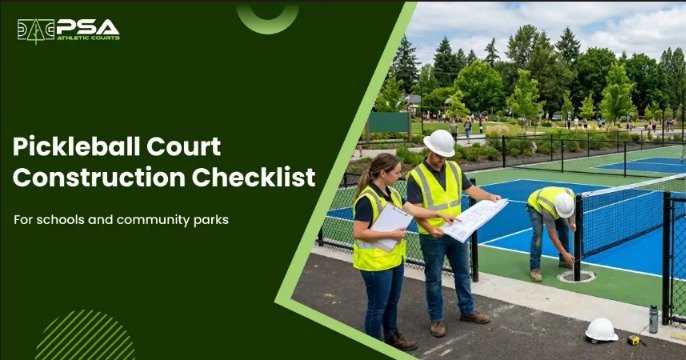
Pickleball is rapidly becoming one of the most popular sports in schools and public recreation spaces. As demand grows, many institutions are investing in dedicated courts, but successful projects require careful planning, not just surface installation.
- 1. Evaluate Site Conditions and Space Availability
- 2. Plan Court Dimensions and Layout
- 3. Design for High-Traffic Usage
- 4. Choose the Right Surface System
- 5. Install Proper Drainage and Slope
- 6. Add Fencing, Lighting, and Safety Features
- 7. Plan Multi-Court Layouts for Scalability
- 8. Ensure Compliance with Regulations and Standards
- 9. Establish a Maintenance Plan
- Choosing the Right Construction Partner
- Final Thoughts
A structured pickleball court construction checklist helps ensure courts are safe, durable, and compliant with standard dimensions. For schools and community parks, where usage is high and budgets must be optimized, following a step-by-step process is essential.
Below is a professional checklist used by experienced builders to guide pickleball court construction from planning to completion.
1. Evaluate Site Conditions and Space Availability
The first step in any project is assessing whether the site can support a full-court layout.
Key factors include:
- Available land area
- Soil stability
- Drainage capability
- Accessibility for players and maintenance
Understanding the size of a pickleball court helps determine whether the location can accommodate proper playing and safety zones.
2. Plan Court Dimensions and Layout
A standard pickleball court measures:
- 20 feet wide × 44 feet long (playing area)
- Recommended total area: 30 × 60 feet, including clearance
For schools and parks, layout planning should also consider:
- Multiple adjacent courts
- Walkways and spectator space
- ADA accessibility
Accurate planning ensures safe and efficient use of space.
3. Design for High-Traffic Usage
Unlike residential courts, school and park courts experience constant use.
Design considerations include:
- Durable surface materials
- Reinforced base layers
- Wider buffer zones for safety
- Efficient drainage systems
According to experienced court specialists such as Pine State Courts, high-traffic environments require stronger base preparation to prevent premature surface failure.
4. Choose the Right Surface System
Surface selection directly affects durability and performance.
Common options:
- Asphalt with acrylic coatings
- Concrete base systems
- Modular sport tiles
Professional pickleball court builders evaluate climate conditions and usage levels to recommend the most suitable surface type.
5. Install Proper Drainage and Slope
Water management is critical for outdoor courts.
Best practices include:
- 1% slope for runoff
- Perimeter drainage systems
- Proper grading during site preparation
Poor drainage is one of the leading causes of cracks and surface deterioration.
6. Add Fencing, Lighting, and Safety Features
For schools and community parks, additional infrastructure is essential.
Important elements:
- Perimeter fencing (typically 10–12 ft high)
- LED lighting for extended use
- Benches and seating areas
- Safety signage
These features improve usability and ensure safe operation for all age groups.
7. Plan Multi-Court Layouts for Scalability
Public facilities often benefit from multiple courts.
Multi-court planning includes:
- Shared fencing
- Efficient spacing between courts
- Central walkways
- Optimized land usage
This approach increases capacity without significantly increasing land requirements.
8. Ensure Compliance with Regulations and Standards
Schools and public parks must meet local and national standards.
This includes:
- Proper court dimensions
- ADA accessibility compliance
- Safety clearances
- Surface traction standards
Following official guidelines ensures long-term usability and reduces liability risks.
9. Establish a Maintenance Plan
Construction is only the beginning. Long-term performance depends on regular maintenance.
Maintenance includes:
- Surface cleaning
- Crack inspection
- Periodic resurfacing
- Drainage monitoring
Learning how professionals simplify pickleball court installation and maintenance helps reduce long-term costs and extend court lifespan
Choosing the Right Construction Partner
Selecting experienced professionals is critical for successful execution.
Qualified pickleball court designers ensure:
- Accurate layout planning
- Proper drainage integration
- Long-term durability
- Cost-efficient construction
For schools and municipalities planning new facilities, experienced teams like Pine State Courts provide site-specific guidance aligned with usage demands and budget constraints.
Final Thoughts
Building pickleball courts for schools and community parks requires more than just meeting basic dimensions. A structured construction checklist ensures that courts are durable, safe, and capable of handling high usage.
By following these steps, facilities can create long-lasting pickleball courts that serve communities effectively for years.