


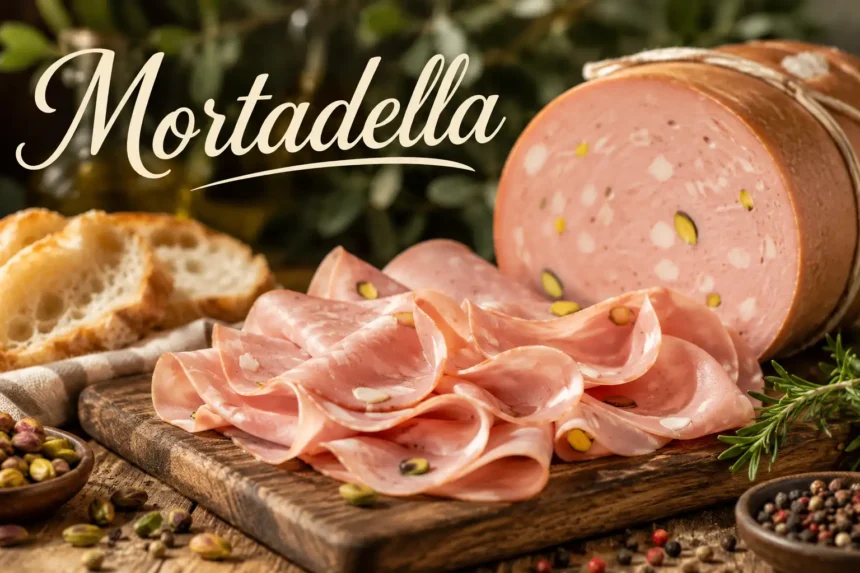
Mortadella is a heat-cured Italian sausage made from finely ground pork, fat cubes, and spices, protected by EU law under the Protected Geographical Indication (PGI) designation as Mortadella Bologna IGP. Most people in North America call it “fancy bologna” — and that comparison does it a serious injustice.
- What Is Mortadella, Exactly? (The Definition Most People Get Half Right)
- The Legal Definition of Authentic Mortadella Bologna IGP
- What Does Mortadella Actually Taste and Feel Like?
- The Real History of Mortadella
- The Two Origin Theories Historians Still Debate
- How Bologna Became the Capital of Mortadella
- Industrialization and Global Spread
- How Mortadella Is Made
- Every Type of Mortadella You Should Know
- Mortadella vs. Bologna vs. Other Italian Cold Cuts
- Mortadella Nutrition — What You’re Actually Eating Per 100g
- What Most People Get Wrong When Buying and Storing Mortadella
- How to Eat Mortadella — Authentic Italian Ways and Global Adaptations
- Mortadella in Cooking — Beyond the Sandwich
- Conclusion
- FAQs
- Q: Is mortadella the same as bologna?
- Q: Is mortadella cooked or cured?
- Q: What does mortadella taste like?
- Q: How long does mortadella last in the fridge once opened?
- Q: Can you freeze mortadella?
- Q: What wine pairs best with mortadella?
- Q: What are the main types of mortadella?
- Q: How do I know if the mortadella I’m buying is authentic?
The confusion leads to bad buying decisions, poor pairings, and missed culinary experiences. This guide covers exactly what mortadella is, how it’s made, every wide variety, how it compares to other cold cuts, and how to buy, store, and eat it correctly.
What Is Mortadella, Exactly? (The Definition Most People Get Half Right)
Mortadella is not emulsified meat. That distinction matters more than most people realize.
Unlike bologna — where fat is blended invisibly into the meat paste — authentic mortadella contains visible white cubes of pork back fat suspended throughout the pink flesh. Those fat cubes are not a byproduct. They are a legal requirement under the EU’s IGP specification and a defining characteristic of the product’s texture and flavor.
The Legal Definition of Authentic Mortadella Bologna IGP
According to the Consorzio Mortadella Bologna, the official body overseeing production, authentic Mortadella Bologna IGP must be produced using at least 60% lean pork from the shoulder and back, combined with 40% cheek fat. The spice blend must include black pepper and may include myrtle berries. Pistachios are permitted as an optional addition.
The production zone covers several Italian regions, including Emilia-Romagna, Lombardy, Piedmont, and Veneto. Any product made outside these zones, or without meeting ingredient standards, cannot legally carry the Mortadella Bologna IGP name.
What Does Mortadella Actually Taste and Feel Like?
In my experience tasting both artisan and commercial varieties, the difference is immediate. Quality mortadella has a velvety, almost silky texture — firm enough to slice cleanly, soft enough to melt on the palate.
The flavor is mildly spiced, delicate, and subtly aromatic from the black pepper and myrtle. The fat cubes add richness without heaviness. Pistachio variants introduce a faint nuttiness that balances the savory base.
The Real History of Mortadella
The Two Origin Theories Historians Still Debate
The name “mortadella” has two credible Latin explanations, and scholars have not settled on either definitively.
The first traces the name to mortarium — the Latin word for mortar — referencing the stone tool used to grind pork meat in ancient Rome. An imperial-era bas-relief now displayed at the Archaeological Museum of Bologna depicts seven pigs beside a mortar and pestle, lending physical weight to this theory.
The second, considered more reliable by many historians, links the name to farcimen myrtatum — a Roman sausage stuffed with myrtle berries (myrtle becoming murtatum, then mortadella). Both Pliny the Elder and Varro referenced this preparation in their writings, making it a well-documented product of ancient Roman cuisine.
How Bologna Became the Capital of Mortadella
By the Renaissance, mortadella had become a staple at Italian banquets — a mark of culinary refinement. Bologna, already nicknamed La Grassa (“The Fat”) for the exceptional quality of its cuisine, became so synonymous with the product that in 1661, the city passed a formal law against counterfeit mortadella. That law established production standards that became the foundation for today’s IGP certification.
Industrialization and Global Spread
The 19th century brought mechanized production and the invention of the watertight can, which made global distribution possible for the first time. According to the Consorzio Mortadella Bologna, Italy, today produces hundreds of thousands of tons annually, with significant export volumes to the EU, the United States, and the Middle East. The core recipe, despite mechanization, has remained structurally unchanged.
How Mortadella Is Made
Ingredients Inside Every Authentic Mortadella
The ingredient list for IGP-certified mortadella is tightly controlled:
- Lean pork (shoulder, back) — minimum 60%
- Cheek fat cubes — approximately 40%
- Black pepper (whole or ground)
- Salt and curing agents
- Optional: myrtle berries, nutmeg, coriander, garlic, pistachios, olives
No artificial flavors, fillers, or binders are permitted in IGP-certified versions. Commercial non-IGP mortadella may contain stabilizers and emulsifiers.
The Cooking Method That Makes Mortadella Unique
The defining production step is slow cooking in dry air ovens — a technique overseen by specialized artisans called stufini. The seasoned meat paste is stuffed into casings (traditionally pig bladder, now almost universally artificial) in cylindrical forms weighing anywhere from 12 to 50 kilograms.
The sausage is cooked at controlled low temperatures for several hours, then immediately cold-shocked to stop cooking, and left to rest until it reaches room temperature. This process creates the dense, uniform, sliceable texture that mortadella is known for. No other major Italian cold cut uses this exact method.
Every Type of Mortadella You Should Know
| Type | Base Meat | Key Feature | IGP Certified? |
| Mortadella Bologna IGP | Pork | Black pepper, myrtle | Yes |
| Pistachio Mortadella | Pork | Green pistachios added | Yes (variant) |
| Truffle Mortadella | Pork | Black truffle flecks | Artisan only |
| Lower-fat Mortadella | Pork | Reduced cheek fat ratio | Varies |
| Halal Beef Mortadella | Beef | Halal-certified production | No |
| Chicken Mortadella | Chicken | Lighter, leaner profile | No |
IGP-Certified vs. Commercial Mortadella
A Consorzio-certified producer like Salumi Pasini or Veroni must follow documented production protocols and submit to third-party auditing. A supermarket brand labeled simply “mortadella” may use emulsified fat, lower-grade cuts, and added stabilizers.
The visual test is the fastest check: IGP mortadella has clearly defined, firm, white fat cubes. Commercial imitations often show blurred, irregular fat distribution or a grayish tint.
Halal, Chicken, and Beef Mortadella
These are adapted products, not authentic IGP mortadella — but they are legitimate in their own right. According to the Global Halal Food Market Report (2024), the halal processed meat segment is growing at approximately 6.3% annually, driven by demand in the Middle East, North Africa, and Muslim-majority diaspora markets in North America.
Beef and chicken mortadella use the same emulsification and slow-cooking process as pork versions, with dedicated halal-certified facilities to prevent cross-contamination.
Mortadella vs. Bologna vs. Other Italian Cold Cuts
Mortadella vs. Bologna — The Real Differences
| Feature | Mortadella Bologna IGP | American Bologna |
| Origin | Emilia-Romagna, Italy | USA (derived from mortadella) |
| Fat | Visible cubed back fat | Fully emulsified, invisible |
| Meat | Pork shoulder + cheek fat | Pork, beef, or chicken blend |
| Spices | Myrtle, black pepper, nutmeg | Mild, minimal |
| Certification | EU PGI protected | USDA regulated only |
| Texture | Dense, sliceable, velvety | Uniform, rubbery |
American bologna was developed as an industrial adaptation — cheaper to produce, milder in flavor, and designed for mass-market appeal. The USDA permits a much wider range of ingredients and meat sources than the EU’s IGP standard allows.
How Mortadella Compares to Prosciutto and Salami
After tasting all three on a charcuterie board, the functional differences become clear. Prosciutto is dry-cured and raw — intensely savory, almost translucent in thin slices, with a concentrated salt finish. Salami is fermented and aged — sharper, acidic, firmer. Mortadella sits between the two in terms of intensity: cooked, mild, and creamy. On a board, it acts as the palate-cleanser between stronger cured meats.
Mortadella Nutrition — What You’re Actually Eating Per 100g
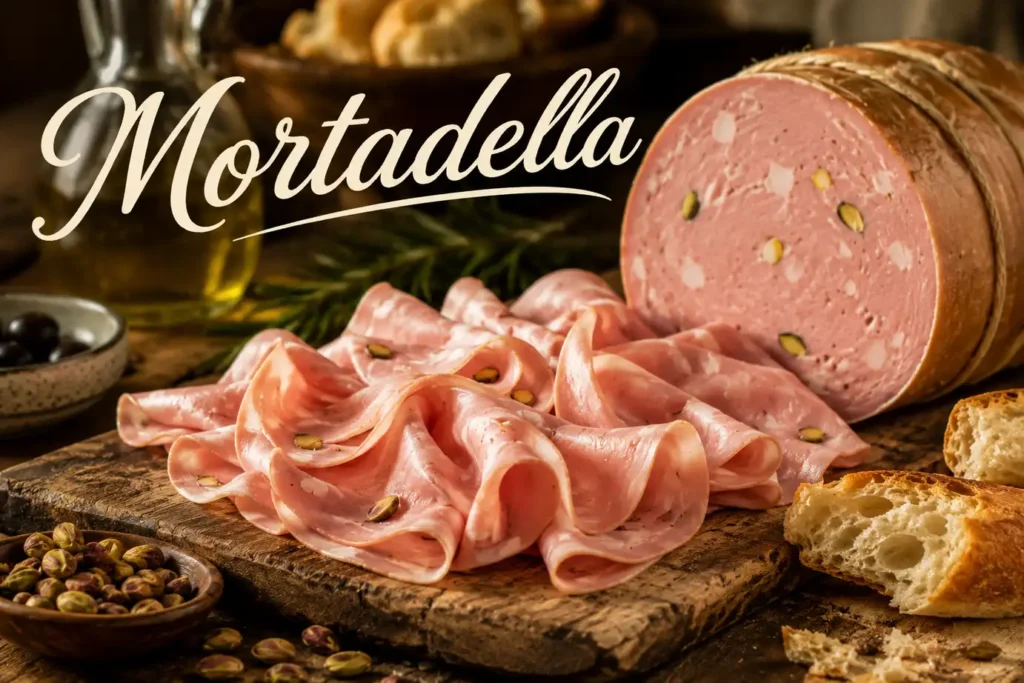
According to Salumi Pasini’s published nutritional data, pure pork mortadella contains approximately 317 kcal per 100g. A pork-beef blended variety reaches around 388 kcal per 100g. The macronutrient breakdown matters for dietary planning:
- Protein: ~15g per 100g
- Total fat: ~26–30g (predominantly saturated)
- Sodium: ~700–900mg per 100g
- B1, B2, and niacin: present in meaningful quantities
- Zinc, iron, and phosphate: moderate contributions
The sodium level deserves honest framing. At roughly 700–900mg per 100g, a standard 50g serving delivers 35–45% of the WHO’s recommended daily sodium limit of 2,000mg. For reference, an equivalent serving of prosciutto crudo contains a similar or higher sodium load. Mortadella is not uniquely high-sodium among Italian cold cuts — it is typical of the category.
Is Mortadella Healthy?
Mortadella is a processed meat. The WHO classifies processed red meats as Group 1 carcinogens based on consumption patterns at high volumes over long periods. At moderate intake — two to three servings per week — the risk profile is low for most healthy adults.
Leaner chicken or beef variants reduce the saturated fat load. For hypertension management, portion control matters more than total elimination.
What Most People Get Wrong When Buying and Storing Mortadella
The single most common mistake is buying pre-sliced mortadella in sealed plastic trays. Once sliced, the cut surface begins to oxidize rapidly. Quality degrades noticeably within 24 to 48 hours, even under refrigeration.
How to Identify High-Quality Mortadella at the Deli
Ask the deli counter to show you the cut face before slicing. Look for:
- Fat cube uniformity — cubes should be clearly defined, roughly 1cm, and distributed evenly
- Color — pale to medium pink, consistent throughout; gray edges indicate age
- Firmness — the sausage should feel dense, not spongy, when pressed
- Aroma — mildly sweet and spiced at the fresh cut; any sour or sharp smell indicates spoilage
- IGP seal — look for the Consorzio Mortadella Bologna label on the whole sausage casing
How Long Does Mortadella Last?
| Storage Method | Approximate Shelf Life |
| Whole, vacuum-sealed, refrigerated | Up to 6 months |
| Whole, opened, refrigerated | 5–7 days |
| Sliced, airtight container, refrigerated | 3–5 days |
| Sliced, frozen (vacuum-sealed) | Up to 2 months |
Freezing sliced mortadella changes its texture noticeably — the fat cubes become slightly grainy after thawing. It remains safe to eat but works better in cooked applications like pasta fillings or stromboli than in fresh sandwiches.
How to Eat Mortadella — Authentic Italian Ways and Global Adaptations
Classic Italian Serving Traditions
In Bologna, the simplest preparation signals the highest respect for the product. A mortadella panino — two slices of bread, several slices of mortadella, nothing else — is the canonical way to taste it properly. After testing this approach versus elaborate sandwich builds, the unadorned version reveals the flavor profile far more clearly.
When paired with wine, Lambrusco — the naturally sparkling red wine of Emilia-Romagna — is the canonical choice. Its slight acidity and effervescence cut through the fat cleanly. Pignoletto, a local white, works equally well for those who prefer a lighter pairing.
For a traditional antipasto setting, serve mortadella alongside giardiniera (pickled vegetables), other cold cuts, and crusty bread. Diced into fresh pasta fillings or layered into a roast are equally traditional uses.
Mortadella Around the World
In São Paulo, Brazil, the Sanduíche de Mortadela at the Mercado Municipal is one of the city’s most iconic street foods — a thick-cut, piled mortadella sandwich served hot, drawing thousands of visitors weekly. In Lebanon and across the Middle East, halal beef mortadella appears in mezze spreads and wraps as a mainstream protein.
In the United States, the gourmet deli revival of the early 2020s brought mortadella back to charcuterie boards and restaurant menus — notably at La Vita è Un Mozzico in Rome, which Bobby Flay cited as serving his favorite sandwich: mortadella with stracciatella on pizza bianca.
Mortadella in Cooking — Beyond the Sandwich
Mortadella functions as a cooking ingredient as effectively as it does a cold cut. Thin slices laid on pizza post-bake (never pre-bake — heat makes the fat render out) add a creamy, savory finish. Diced into a ricotta-parmesan filling for fresh pasta creates a classic Bolognese preparation.
A mortadella mousse — blended with cream cheese and a small amount of butter — makes a straightforward, elegant spread for crostini. The Torta di Pasquetta (Italian Easter tart) uses mortadella alongside ricotta and egg in a layered savory pastry, a regional tradition in parts of central Italy.
Conclusion
Mortadella is one of Italy’s most technically precise and legally protected food products — a heat-cured, fat-cubed, slow-cooked pork sausage with over 2,000 years of documented history and a legal production framework that most food products worldwide cannot match. Understanding the IGP certification, the production process, the variety landscape, and the correct buying and storage approach makes a material difference in the quality of what ends up on your plate.
The most important thing to take away: the fat cubes are not a flaw — they are the product. A quality mortadella is defined by the evenness of those cubes, the freshness of the cut face, and the presence of the Consorzio Mortadella Bologna seal.
Start at the deli counter. Ask to see the cut face. Choose a whole sausage slice over pre-packaged trays. Serve it simply first — on good bread, with nothing else — before building into recipes. That single step changes everything.
FAQs
Q: Is mortadella the same as bologna?
A: No. Mortadella Bologna IGP is an EU-protected Italian product with visible fat cubes, controlled ingredients, and a defined production zone. American bologna is a USDA-regulated product using fully emulsified fat and a wider mix of meats. They share ancestry but are not the same product.
Q: Is mortadella cooked or cured?
A: Mortadella is heat-cured, not raw-cured or fermented. It is cooked in dry air ovens at low temperatures for several hours by specialized artisans called stufini. Unlike prosciutto, it undergoes no aging or fermentation process.
Q: What does mortadella taste like?
A: Mortadella has a mild, velvety, and delicately spiced flavor. The black pepper and myrtle berries give it a gentle aromatic quality. The fat cubes add creamy richness without sharpness. Pistachio variants add a faint nuttiness. It is softer and milder than salami or prosciutto.
Q: How long does mortadella last in the fridge once opened?
A: Sliced mortadella kept in an airtight container lasts 3 to 5 days under refrigeration. A whole sausage, once cut, stays fresh for 5 to 7 days. Always wrap the cut face tightly to minimize oxidation and flavor loss.
Q: Can you freeze mortadella?
A: Yes, but with limitations. Vacuum-sealed slices freeze for up to 2 months. Thawed mortadella develops a slightly grainy texture in the fat cubes, making it better suited to cooked dishes like pasta fillings or stromboli than to fresh sandwiches.
Q: What wine pairs best with mortadella?
A: Lambrusco — the lightly sparkling red wine of Emilia-Romagna — is the traditional pairing. Its acidity and effervescence balance the fat cleanly. Pignoletto white wine works as a lighter alternative. Avoid heavily tannic reds, which overpower the delicate flavor.
Q: What are the main types of mortadella?
A: The primary types are Mortadella Bologna IGP (pork, certified), pistachio mortadella, truffle mortadella (artisan), lower-fat variants, halal beef mortadella, and chicken mortadella. Only pork-based versions produced in certified Italian regions carry the EU’s PGI designation.
Q: How do I know if the mortadella I’m buying is authentic?
A: Look for the Consorzio Mortadella Bologna IGP seal on the casing. At the deli, check for clearly defined white fat cubes, even pale pink flesh, and a mildly sweet aroma at the cut face. Avoid any product with blurred fat distribution, gray edges, or a sour smell.