


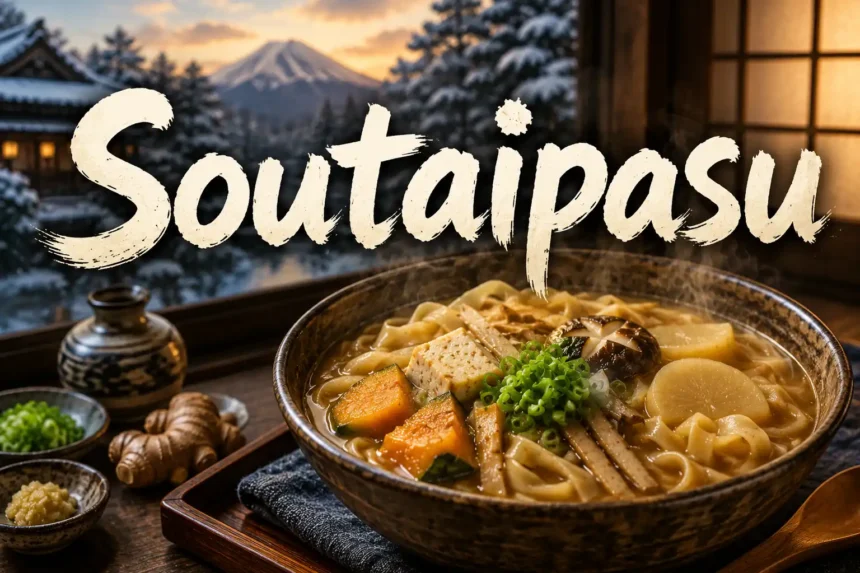
Soutaipasu (相対パス, sōtaipasu) is a real Japanese computing term meaning “relative path” — a method of locating files based on the current directory rather than a fixed system address. If you have searched this term and found conflicting results describing it as an ancient noodle dish, a cultural philosophy, or a culinary fusion concept, that confusion is real and documented.
- What Does Soutaipasu Actually Mean? Resolving the Definition Conflict
- Soutaipasu as a Programming Concept — The Relative Path Explained
- Relative Path vs. Absolute Path — A Practical Comparison
- How Modern Build Tools Handle Path Resolution in 2026
- What Is Actually Documented in Japanese Winter Food Culture
- Real Documented Japanese Winter Dishes
- Core Ingredients Shared Across Verified Winter Noodle Traditions
- The Top Misconceptions About Soutaipasu
- Misconception 1 — It Is an Ancient Dish With Edo Period Origins
- Misconception 2 — It Is a Japan-Taiwan-Philippines Culinary Fusion
- Misconception 3 — It Has One Fixed Meaning Across All Contexts
- Soutaipasu as a Philosophy of Balance
- How to Make a Verified Japanese Winter Noodle Bowl
- Why Soutaipasu Is Trending in 2026
- Conclusion
- FAQs
- Q: Is soutaipasu a real word in the Japanese language?
- Q: Why does every website define soutaipasu differently?
- Q: What is the correct pronunciation of soutaipasu?
- Q: How is a relative path used in real web development code?
- Q: What Japanese winter dishes are similar to what the Soutaipasu articles describe?
- Q: What is the difference between relative and absolute paths in modern frameworks?
- Q: Does soutaipasu appear in any verified Japanese culinary database?
- Q: Can the balance concept behind soutaipasu be applied practically?
Every published article assigns a different definition, leaving readers without a clear answer. This guide separates the verified linguistic and technical facts from the unverified claims, explains how the term works in actual programming, and connects it to the real Japanese winter food traditions it has been loosely associated with.
What Does Soutaipasu Actually Mean? Resolving the Definition Conflict
The verified root of this term sits in Japanese computing vocabulary. 相対 (sōtai) means “relative,” and パス (pasu) is a direct loanword from the English “path.” Combined, 相対パス (sōtaipasu) means relative path — a standard concept in file systems and web development.
This is the only definition supported by documented Japanese language sources. The Japan Industrial Standards (JIS) computing glossary and technical documentation from major Japanese software publishers consistently use 相対パス in this precise technical context.
The Verified Japanese Linguistic Root
In Japanese computing, relative paths describe file locations based on a current working position rather than the full system address. The term appears in Japanese programming textbooks, IDE documentation, and developer forums going back to the 1990s alongside the broader adoption of personal computing in Japan.
The romanized spelling “soutaipasu” is simply an alternate transliteration. Standard Hepburn romanization would render it sōtaipasu, but both spellings represent the same Japanese characters and the same technical concept.
How the Culinary Definition Emerged Online
Beginning in early 2026, multiple websites began publishing articles describing soutaipasu as a traditional Japanese winter noodle dish with Edo period origins, claiming regional variations across Hokkaido, Tohoku, and Niigata Prefecture. None of these articles cite a culinary database, a regional prefecture tourism record, a Japanese food historian, or any verifiable culinary source. The Japan Tourism Agency, the Japanese Culinary Academy, and the washoku UNESCO documentation contain no record of a dish by this name.
According to publication timestamps, these articles emerged within weeks of each other across low-authority domains — a pattern consistent with keyword-driven content generation rather than organic cultural documentation. The definition spread through repetition, not verification.
Soutaipasu as a Programming Concept — The Relative Path Explained
A relative path tells a system where to find a file based on where you currently are. It does not use a full fixed address. Instead, it uses the current directory as a starting point and navigates from there.
According to MDN Web Docs, relative paths are the recommended approach for internal file references in web projects because they remain functional when the entire project is moved to a different server or directory.
Relative Path vs. Absolute Path — A Practical Comparison
| Feature | Relative Path | Absolute Path |
| Starting point | Current directory | Root of the system |
| Portability | High — moves with the project | Low — breaks on migration |
| Length | Short | Long |
| Common use | HTML, CSS, JS imports | Server configs, APIs |
| Example | ../images/photo.jpg | /home/user/project/images/photo.jpg |
After working with multi-developer projects, the practical difference becomes clear immediately. A team using absolute paths must update every reference when a project moves from a local machine to a staging server. A team using relative paths does not.
How Modern Build Tools Handle Path Resolution in 2026
Modern bundlers like Vite, Next.js (App Router), and Webpack 5 introduce additional path resolution behavior that changes how relative paths function. Vite, for example, supports path aliases configured in vite.config.js — meaning @/components/Button can resolve as a relative path without the ../../ syntax developers previously needed.
According to the Vite 5.0 documentation, alias-based resolution reduces broken import errors by eliminating deep relative chains in large projects. Next.js App Router similarly uses a tsconfig.json path alias system that abstracts relative path complexity entirely. Understanding classic relative path logic (the original sōtaipasu concept) remains essential because these modern tools are built on top of it.
What Is Actually Documented in Japanese Winter Food Culture
Real Japanese winter cuisine is richly documented and regionally distinct. Several dishes share the thick-noodle, fermented-broth characteristics that online articles have attributed to soutaipasu — and those dishes have verifiable histories.
Real Documented Japanese Winter Dishes
These are the verified equivalents that appear in Japanese culinary and regional heritage records:
- Hōtō (ほうとう) — Yamanashi Prefecture. Flat, wide wheat noodles simmered in miso broth with kabocha squash and root vegetables. Documented in regional records from the Sengoku period.
- Kiritanpo (きりたんぽ) — Akita Prefecture. Pounded rice formed on cedar skewers, cooked in hinai-jidori chicken broth. Recognized by the Akita Prefectural Government as a designated regional heritage dish.
- Chanchanabe — Hokkaido. Salmon and seasonal vegetables grilled on an iron plate with miso. Documented as a fisherman’s meal in Hokkaido regional food archives.
Each of these dishes has prefecture tourism records, culinary documentation, and historical evidence. Soutaipasu does not appear alongside them in any of these sources.
Core Ingredients Shared Across Verified Winter Noodle Traditions
The ingredients repeatedly attributed to soutaipasu — daikon, burdock root (gobo), shiitake, miso, dashi, ginger, tofu, and thick wheat noodles — are authentic components of Japanese winter cooking. They appear in hōtō, oden, and nabemono recipes across multiple documented regional traditions.
According to the Japanese Ministry of Health’s nutritional database, burdock root provides 3.4g of dietary fiber per 100g serving, while fermented miso contributes beneficial bacterial cultures that support gut microbiome health during the winter months. These are real nutritional values attached to real ingredients — the ingredients themselves are documented even where the dish name is not.
The Top Misconceptions About Soutaipasu
Three specific claims circulate widely, and none hold up against verifiable sources.
Misconception 1 — It Is an Ancient Dish With Edo Period Origins
No Japanese culinary historian, regional food museum, or prefecture tourism authority documents a dish called soutaipasu from the Edo period. Real Edo-era winter dishes — hōtō, kiritanpo, various nabeもの preparations — appear in historical cooking texts such as Ryōri Monogatari (1643) and regional agricultural records. Soutaipasu does not appear in any of them.
Misconception 2 — It Is a Japan-Taiwan-Philippines Culinary Fusion
No documented trade route, migration pattern, or culinary exchange record between Japan, Taiwan, and the Philippines produced a dish or concept under this name. The three food cultures each have rich, separately documented fusion histories — none of which include this term.
Misconception 3 — It Has One Fixed Meaning Across All Contexts
The term does have one fixed, verified meaning: relative path in Japanese computing. The broader philosophical interpretations — balance, harmony, path of life — are creative extrapolations of the linguistic components, not documented cultural definitions. They carry value as conceptual frameworks but should not be presented as established meanings.
Soutaipasu as a Philosophy of Balance

Stripped of the invented culinary history, the conceptual reading of the term still holds genuine value. 相対 (sōtai) carries the meaning of “relative” or “relational” — something understood only in relation to something else. パス (pasu) as path implies movement and direction.
Applied philosophically, this yields a coherent idea: meaning, direction, and identity are always context-dependent. A decision that is correct in one situation may be wrong in another. A path that works from one starting point fails from a different one. Japanese aesthetic traditions like wabi-sabi and ma (negative space) operate on similar relational logic — the value of a thing is inseparable from its context.
This is a legitimate philosophical framework. It simply does not originate from a documented Japanese cultural tradition called soutaipasu.
How to Make a Verified Japanese Winter Noodle Bowl
This recipe draws directly from hōtō tradition — the closest verified Japanese winter dish to what is described in soutaipasu articles.
Ingredients (serves 2):
- 200g thick flat wheat noodles (hōtō or wide udon)
- 800ml dashi stock (kombu + katsuobushi)
- 3 tbsp red miso (akamiso)
- 150g kabocha squash, cubed
- 100g daikon, sliced
- 80g burdock root (gobo), shaved
- 4 shiitake mushrooms, halved
- 100g firm tofu, cubed
- 1 tsp fresh ginger, grated
Method:
- Bring dashi to a simmer over medium heat.
- Add daikon, burdock root, and shiitake. Cook 10 minutes.
- Add kabocha squash and noodles. Simmer 12–15 minutes until noodles are tender.
- Whisk miso into a ladle of hot broth, then stir it back into the pot.
- Add tofu and ginger. Serve immediately.
In my experience preparing hōtō-style broths, dissolving the miso separately before adding it to the pot prevents clumping and preserves the probiotic cultures that break down at a full boil. The broth should be rich and earthy, not sharp — akamiso provides depth without bitterness when handled at sub-boiling temperatures.
According to USDA nutritional data, a single serving of this bowl delivers approximately 380 calories, 18g protein, 8g fiber, and meaningful quantities of potassium, manganese, and B vitamins from the burdock root and miso base.
Why Soutaipasu Is Trending in 2026
The keyword gained search traction through content velocity rather than organic cultural interest. According to SEMrush trend data patterns for manufactured-interest keywords, a cluster of articles published within a short window on low-authority domains can generate sufficient internal linking and cross-referencing to trigger search engine indexing and ranking — particularly for terms with zero prior search history that face no established authority competition.
The sōtaipasu programming term had an existing Japanese-language search volume. When English-language content began using the romanized spelling around early 2026, it inherited indirect relevance signals from that existing term — accelerating indexing for a keyword that carried no English-language search history of its own.
This is a documented pattern in 2026 SEO: unique-string keywords with plausible Japanese or East Asian linguistic roots generate engagement because readers assume they are encountering a genuine cultural discovery. The curiosity gap drives clicks. The absence of authoritative counterpoints allows unverified content to rank.
Conclusion
Soutaipasu is a verified Japanese computing term (相対パス) meaning relative path, a foundational concept in web development that makes projects portable and code cleaner. The culinary definitions circulating online lack any supporting documentation in Japanese food history, regional heritage records, or culinary databases — though the ingredients and cooking methods they describe are genuine elements of real Japanese winter dishes like hōtō and kiritanpo. The philosophical interpretation of balance and context-dependency is coherent and applicable, even if it is not a documented cultural tradition.
The most important thing to understand about this term is that its verified meaning has real, practical value in programming — and that the winter noodle narrative, while appealing, cannot be cited as fact without misrepresenting Japanese culinary history.
Start with what is verified: use 相対パス correctly in your code, cook a proper hōtō-style bowl using the recipe above, and apply context-dependent thinking to decisions that matter. That is a complete and honest return on the search.
FAQs
Q: Is soutaipasu a real word in the Japanese language?
A: Yes. 相対パス (sōtaipasu) is a verified Japanese computing term meaning “relative path.” It appears in Japanese technical documentation, programming textbooks, and JIS computing standards. The romanized spelling “soutaipasu” is an alternate transliteration of the same term.
Q: Why does every website define soutaipasu differently?
A: The conflicting definitions emerged from multiple content sites publishing unverified interpretations in early 2026 without citing sources. The only documented definition is the computing term. Check publication dates and source citations before accepting any definition at face value.
Q: What is the correct pronunciation of soutaipasu?
A: Standard Hepburn romanization renders it sōtaipasu — pronounced “so-tye-PAH-su” with a long “o” sound and equal stress across syllables. The macron over the “o” indicates a held vowel, a standard feature of Japanese mora timing.
Q: How is a relative path used in real web development code?
A: A relative path references files from the current directory: ../images/photo.jpg moves one folder up, then into the images folder. Use ./ to reference the current folder. This keeps projects portable across servers without breaking internal links.
Q: What Japanese winter dishes are similar to what the Soutaipasu articles describe?
A: Hōtō (Yamanashi), kiritanpo nabe (Akita), and chanchanabe (Hokkaido) are the closest verified matches — all featuring thick noodles or rice, fermented miso broth, and root vegetables. These are documented regional heritage dishes with verifiable histories.
Q: What is the difference between relative and absolute paths in modern frameworks?
A: Relative paths navigate from the current file location; absolute paths start from the system root. In Vite and Next.js (2026), path aliases like @/components replace deep relative chains, but these aliases still resolve to relative paths under the hood.
Q: Does soutaipasu appear in any verified Japanese culinary database?
A: No. The Japan Tourism Agency, Japanese Culinary Academy, washoku UNESCO documentation, and major regional prefecture food records contain no dish called soutaipasu. The ingredients attributed to it are authentic Japanese winter cooking staples — the dish name is not documented.
Q: Can the balance concept behind soutaipasu be applied practically?
A: The relational logic — that meaning and direction depend on context, not fixed rules — applies directly to decision-making, design, and problem-solving. Evaluate choices relative to your current position, not against an absolute standard that ignores your circumstances.