


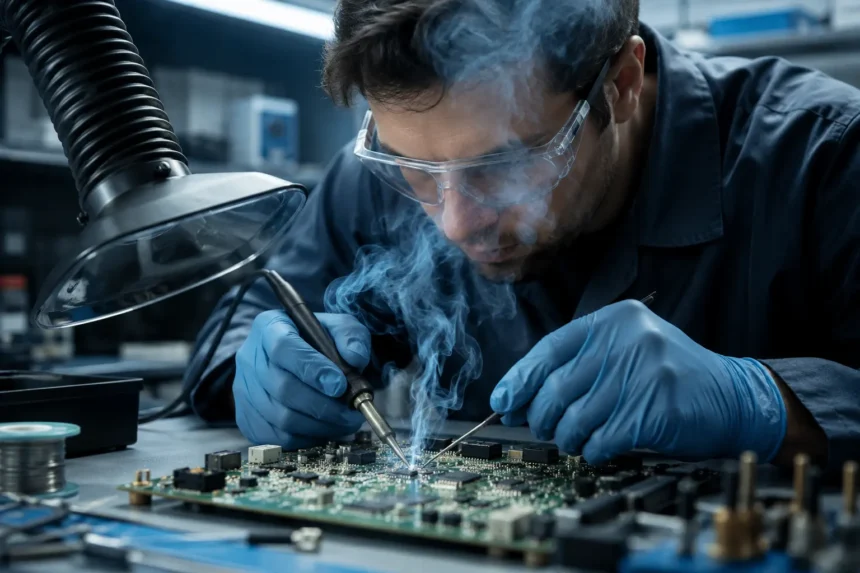
Soldering is a foundational process in electronics manufacturing and assembly, relied upon to join components and establish reliable electrical connections across countless applications. As essential as the technique is, it produces a byproduct that too many workers and employers continue to underestimate: soldering fume. These fumes form when solder materials and flux are heated to high temperatures, releasing a complex mixture of gases and fine particulate matter into the surrounding air. For anyone working in an electronics environment, understanding what soldering fume is and how it affects the body is both a professional obligation and a personal safety priority. The risks are real, thoroughly documented, and — critically — preventable with the right knowledge and equipment in place.
What Soldering Fume Actually Is
Soldering fume is not a single substance. It is a combination of chemical compounds released during the heating of solder and flux materials, and that distinction matters when assessing its hazards. When solder reaches its melting point, the flux — a chemical agent used to clean metal surfaces and encourage proper bonding — vaporizes and breaks down into a range of potentially harmful byproducts. These include colophony (rosin), isocyanates, aldehydes, and various metal particulates depending on which type of solder is being used.
The Health Risks Associated with Soldering Fume Exposure
Repeated or prolonged exposure to soldering fumes can produce a range of serious health conditions affecting the respiratory system, skin, and other organ systems throughout the body. Occupational asthma is among the most commonly reported conditions in electronics workers, typically developing after extended exposure to rosin-based flux fumes. What makes this particularly concerning is that once a worker becomes sensitized, even trace concentrations of the fume can trigger an asthmatic reaction — a condition that may become permanent over time.
Beyond asthma, soldering fumes have been linked to chronic bronchitis, rhinitis, eye irritation, and dermatitis through sustained workplace exposure. Where lead-containing solders are involved, systemic toxicity becomes an additional concern, since lead particles can be inhaled or inadvertently ingested, with documented effects on the nervous system, kidneys, and cardiovascular health accumulating over years.
Why Electronics Workers Face Elevated Risk
Electronics workers face a degree of exposure that sets them apart from those who solder only occasionally or as a secondary task. Professionals in electronics manufacturing, PCB assembly, and repair environments are often soldering continuously for hours at a stretch, day after day, which dramatically increases the cumulative dose of harmful substances entering the body over a career. Many soldering workstations are also located in enclosed or semi-enclosed spaces where airflow is limited, allowing fumes to build up to dangerous concentrations rather than dispersing safely. The sheer variety of flux formulations and solder alloys used across different projects adds further complexity to the risk profile, since each combination can generate a distinct mixture of airborne hazards.
The Role of Fume Extraction in Protecting Workers
Controlling soldering fume at the source is widely regarded as the most effective strategy for protecting workers in electronics environments. Engineering controls, specifically fume extraction systems, are recognized by occupational health authorities as the primary line of defense against inhalation exposure — not a supplementary measure, but the first and most important one. For operations involving continuous soldering across multiple workstations, a high quality fume extraction system for soldering captures airborne contaminants directly at the point of generation, before they have any opportunity to disperse into the breathing zone or migrate through the broader workspace.
These systems typically employ multi-stage filtration — combining HEPA filters with activated carbon stages — to address both fine particulates and chemical vapors in a single process. It is worth noting that relying solely on general ventilation or standard dust masks is not considered adequate protection against the fine particles and gases produced during soldering, as outlined in guidance from organizations such as the Health and Safety Executive (HSE) .
Additional Preventive Measures for a Safer Workspace
Fume extraction is the cornerstone of a soldering safety program, but it works best as part of a broader set of complementary practices. Workers should be trained to position their heads away from the fume plume and to avoid leaning directly over any active soldering point, a habit that is easy to overlook but makes a meaningful difference in exposure levels.
Where feasible, substituting higher-risk flux formulations with lower-emission alternatives addresses the hazard closer to its source, reducing overall airborne contamination before extraction even becomes necessary. Regular health surveillance — including lung function monitoring for workers with frequent soldering responsibilities — helps identify early signs of occupational illness before conditions progress to something more severe and harder to treat.
Conclusion
Soldering fume is a genuine occupational hazard that warrants serious attention in any electronics work environment, regardless of the scale of operations. The chemical complexity of these fumes, combined with the extremely fine particle size and the frequency of exposure faced by many electronics professionals, creates conditions where long-term health damage is a real and documented possibility without proper controls in place.
Understanding the composition of soldering fume, the workplace conditions that heighten risk, and the range of protective measures available puts you in a position to make informed, responsible decisions about safety. Adequate fume control is not an optional upgrade or a box to check — it is a fundamental responsibility for anyone overseeing or working within a soldering environment.