


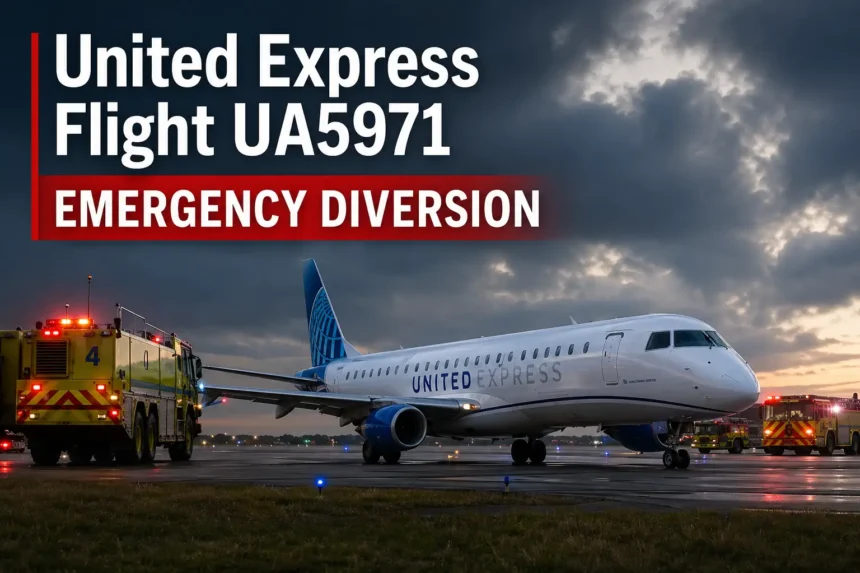
On August 28, 2025, United Express flight UA5971 declared an emergency mid-flight and diverted to Austin after encountering severe turbulence over Texas. The flight, operated by SkyWest Airlines on behalf of United Airlines, was carrying 39 passengers and four crew members from Aspen to Houston when the incident forced a rapid change of course. Two passengers were hospitalized, and the Federal Aviation Administration launched an investigation.
- What Is United Express Flight UA5971, and What Happened?
- Detailed Flight Timeline and Altitude Data
- Direct Impact on Passengers and Crew
- Aircraft Information — Embraer E175
- Official Responses and Ongoing Investigations
- What Is an Emergency Diversion in Aviation?
- How Pilots Handle In-Flight Emergencies
- Role of Air Traffic Control During a Diversion
- Passenger Experience and Airline Support After a Diversion
- How Dangerous Is Turbulence? What the Data Says
- Aviation Safety Protocols That Prevent Larger Disasters
- What This Incident Means for the Future of Air Travel
- Conclusion
- FAQs
- FAQ 1: What caused United Express flight UA5971 to declare an emergency?
- FAQ 2: Where was UA5971 diverted, and why was Austin chosen?
- FAQ 3: How many passengers were injured on SkyWest flight 5971?
- FAQ 4: What is squawk 7700, and what does it mean?
- FAQ 5: What aircraft was operating UA5971, and how old was it?
- FAQ 6: How far did the plane drop during the turbulence event?
- FAQ 7: Are emergency diversions dangerous for passengers?
- FAQ 8: Is turbulence becoming more common and more dangerous?
What Is United Express Flight UA5971, and What Happened?
SkyWest Airlines operated flight UA5971 under the United Express brand — a regional carrier arrangement where SkyWest flies routes on United’s behalf under a Capacity Purchase Agreement.
The flight originated at Aspen Pitkin County Airport (ASE) with a delayed departure of 5:02 PM local time, significantly later than its 1:25 PM scheduled slot. It climbed to flight level FL390 for the southbound route to Houston George Bush Intercontinental Airport (IAH).
Everything proceeded normally until the aircraft passed near Fort Worth. At that point, the Embraer E175 — registered N110SY, an 11.3-year-old regional jet delivered to SkyWest in 2014 — hit violent air without warning. The crew diverted immediately, landing safely at Austin-Bergstrom International Airport on runway 18R.
Detailed Flight Timeline and Altitude Data
Sequence of Events Leading to the Emergency
ADS-B data captured by Flightradar24 tells the story in precise numbers. As the aircraft cruised at 39,000 feet near Fort Worth, it encountered what aviation trackers classify as severe turbulence at approximately 00:27 UTC.
The recorded maximum barometric vertical rate hit –11,456 feet per minute at 00:27:31 UTC — a figure that reflects a single-moment calculated rate, not a sustained descent. Within 44 seconds, the plane dropped from 39,000 feet to 34,650 feet before the crew regained altitude, climbing back to 37,450 feet by 00:28:50 UTC.
| Time (UTC) | Altitude (Feet) | Event |
| 00:27:06 | 39,000 | Cruising — turbulence impact begins |
| 00:27:31 | 34,650 | Max vertical rate of -11,456 ft/min recorded |
| 00:28:50 | 37,450 | The aircraft climbs back after stabilization |
| 00:30:57 | Descending | Squawk 7700 general emergency declared |
Emergency Declaration and Diversion to Austin
At 00:30:57 UTC, the flight crew activated squawk 7700 — the universal transponder code that signals a general emergency to air traffic control. Controllers immediately prioritized the aircraft, clearing a direct path to Austin-Bergstrom International Airport.
The crew initiated a controlled descent from FL390 toward 10,000 feet, completing the approach and touching down safely. Medical personnel were already standing by at the gate upon arrival.
Direct Impact on Passengers and Crew
The conditions inside the cabin during those 44 seconds were severe. Based on ATC audio from LiveATC and passenger accounts shared publicly, the scene was chaotic.
Key documented effects included:
- Oxygen masks deployed automatically as cabin pressure fluctuated
- Passengers not wearing seatbelts were thrown upward, with at least one person hitting the ceiling multiple times
- A passenger in the lavatory sustained facial injuries and lost teeth upon striking the overhead surface
- The pilot radioed ahead requesting a stretcher and confirmed, “There is bleeding as well.”
- Belongings littered the aisle, and an in-flight magazine lodged itself in a gap in the overhead structure
Austin-Travis County EMS evaluated all 43 individuals — 39 passengers and 4 crew — on arrival. Two adults were transported to area hospitals. No injuries were reported as life-threatening.
Aircraft Information — Embraer E175
The aircraft at the center of this incident was an Embraer E170-200LR, commercially known as the E175. SkyWest Airlines took delivery of this specific jet in 2014, making it 11.3 years old at the time of the incident.
The E175 is a standard workhorse in the United Express fleet, routinely deployed on short-to-medium regional routes across the United States. SkyWest operates it under a Capacity Purchase Agreement with United Airlines, meaning United controls scheduling, branding, and ticketing while SkyWest handles aircraft and crew operations.
This particular aircraft, registered N110SY, had no prior publicly documented incidents before August 28, 2025.
Official Responses and Ongoing Investigations
SkyWest Airlines issued a statement shortly after the incident:
“SkyWest flight 5971, operating as United Express from Aspen to Houston, was diverted to Austin-Bergstrom International Airport after experiencing turbulence. The flight landed safely and was met by medical personnel upon arrival. Our highest priority is the safety and well-being of all onboard, and we are working with our partner United to assist customers.”
The Federal Aviation Administration confirmed it was actively investigating, with early findings pointing to pressurization issues compounding the effects of the atmospheric turbulence event. The National Transportation Safety Board, which tracks turbulence-related injuries across the industry, noted a rising trend in such incidents nationally. The remainder of the flight to Houston was canceled, and passengers were assisted with rebooking.
What Is an Emergency Diversion in Aviation?
An emergency diversion occurs when a flight crew decides that landing at the original destination is no longer the safest option. The crew diverts to an alternate airport based on proximity, runway availability, and emergency service capability.
Common triggers include:
- Mechanical issues — Even a minor warning light can justify an early landing for inspection
- Medical emergencies — A passenger or crew member requiring urgent care
- Severe weather — Turbulence, thunderstorms, or extreme wind conditions
- Security concerns — Onboard threats or unauthorized behavior
In the case of UA5971, severe turbulence combined with a possible pressurization anomaly drove the crew’s decision. Aviation authorities design aircraft with multiple backup systems precisely so crews have options when primary conditions deteriorate.
How Pilots Handle In-Flight Emergencies
Pilots train for emergency scenarios in certified simulators long before they operate real commercial routes. When something unusual occurs, the response follows a disciplined process, not instinct alone.
The crew works through a memorized or referenced checklist, communicates with ATC to declare the emergency and request priority routing, and informs passengers once the aircraft trajectory is secured. Simultaneously, the airline’s operations center monitors the situation and coordinates on the ground.
On UA5971, the crew’s decision to squawk 7700 and begin descent was made within minutes of the turbulence event — a response aligned with standard emergency training and FAA expectations.
Role of Air Traffic Control During a Diversion
The moment a crew squawks 7700, the emergency transponder code shifts their aircraft to the top of ATC’s priority list. Controllers clear the airspace, redirect other traffic, and issue a direct routing to the diversion airport.
For UA5971, Austin-Bergstrom’s ground teams were notified well before landing. Fire trucks, medical teams, and airport ground staff positioned themselves accordingly. This coordination happens in real time, and the result — medical personnel waiting at the gate — is a direct product of that system working as designed.
Passenger Experience and Airline Support After a Diversion
Diversions are disorienting. Passengers rarely receive detailed explanations mid-flight. Crew typically announces a landing at an alternate airport due to a “technical” or “operational” reason, keeping communication calm and controlled.
After landing, the process shifts to ground support:
- Passengers deplane and are directed to the terminal
- Airline staff assist with rebooking on the next available flight
- Accommodation is arranged if an overnight delay is necessary
- Medical attention is provided on-site before passengers continue
SkyWest coordinated with United to support all 39 passengers from UA5971 following the Austin landing.
How Dangerous Is Turbulence? What the Data Says
Turbulence Fatality Statistics
Turbulence-related deaths are extremely rare on commercial flights. According to BBC reporting, only four documented fatalities from turbulence have occurred since 1981. The most recent was a 73-year-old man aboard Singapore Airlines Flight 321 in May 2024, a Boeing 777-300ER that encountered extreme turbulence during meal service, injuring over 140 people.
Most serious turbulence injuries share one common factor: the affected passengers were not wearing seatbelts at the time of impact.
Is Turbulence Increasing Due to Climate Change?
The scientific consensus points toward yes. Professor Paul Williams of the University of Reading, an atmospheric scientist who studies jet stream behavior, projects that severe clear-air turbulence events could double or triple over the coming decades as climate change alters upper-atmosphere wind patterns.
Clear-air turbulence is particularly dangerous because it produces no visible warning — no clouds, no radar returns. Predictive weather software is improving, but the technology has not yet reached a point where flight crews can reliably detect and avoid every encounter. Industry groups, including the Flight Safety Foundation, are pushing for more specialized trauma protocols for in-flight injuries, and some regulators are considering structural reinforcement requirements for regional jets operating in high-risk corridors.
Aviation Safety Protocols That Prevent Larger Disasters
The UA5971 diversion ended without fatalities — and that outcome reflects the effectiveness of layered safety systems, not luck.
Key protocols that applied directly to this incident:
- FAA maintenance regulations — Aircraft undergo pre- and post-flight checks; emergency equipment, including oxygen masks and fire extinguishers, is mandatory
- Redundant aircraft systems — If one component fails, backup systems maintain core flight functions
- ATC emergency priority — Squawk 7700 immediately reclassifies the aircraft in the control system
- Crew training standards — Simulator training covers rapid depressurization, turbulence, and emergency landings
- Real-time data access — Pilots have access to live system diagnostics and weather data throughout the flight
Regional jets like the E175 are engineered to handle significant structural stress. The aircraft absorbed the violent air event, maintained aerodynamic integrity, and flew on to a safe landing.
What This Incident Means for the Future of Air Travel
The UA5971 incident is one point in a growing pattern. Turbulence-related diversions are increasing in frequency, and regulators are responding.
Several operational changes are already underway across the commercial aviation industry:
- Major carriers are investing in advanced predictive weather routing software to identify unstable air corridors before entry
- Cabin crew on many airlines now enforce seatbelt use for the full duration of flights, not only during announced turbulence
- The Lancet and other medical bodies have highlighted the need for specialized inflight trauma protocols as injuries from turbulence become more clinically significant
- The FAA and NTSB are reviewing structural reinforcement requirements for regional jets operating routes that cross historically turbulent zones over Texas, the Rockies, and the Great Plains
For passengers, the clearest takeaway remains practical: keep your seatbelt fastened whenever seated, regardless of whether the sign is illuminated.
Conclusion
The United Express flight UA5971 emergency diversion demonstrated exactly how aviation safety systems are supposed to function under pressure. Trained pilots identified the threat, declared the emergency, and landed the aircraft without loss of life. Air traffic controllers coordinated an immediate response. Medical teams were on the ground before the aircraft arrived.
Two passengers were hospitalized, but all 43 people on board survived an event that recorded one of the most extreme vertical rate measurements captured in commercial aviation tracking data. The FAA investigation continues, and the findings will likely shape turbulence protocols for regional carriers operating in the coming years. Flying remains statistically safe — and incidents like this one are part of why it stays that way.
FAQs
FAQ 1: What caused United Express flight UA5971 to declare an emergency?
The flight encountered severe turbulence over Fort Worth, Texas, causing a rapid altitude drop. The FAA’s preliminary investigation also pointed to pressurization issues compounding the event. The crew activated squawk 7700 and diverted to Austin.
FAQ 2: Where was UA5971 diverted, and why was Austin chosen?
The flight diverted to Austin-Bergstrom International Airport (AUS). Air traffic control selected Austin based on proximity to the incident location, runway availability, and the airport’s emergency service capacity.
FAQ 3: How many passengers were injured on SkyWest flight 5971?
The flight carried 39 passengers and 4 crew members. Austin-Travis County EMS evaluated all 43 individuals on arrival. Two adults were transported to the hospital with non-life-threatening injuries.
FAQ 4: What is squawk 7700, and what does it mean?
Squawk 7700 is a universal transponder code that signals a general emergency to air traffic control. When a crew activates it, ATC immediately prioritizes that aircraft, clears airspace, and coordinates emergency services at the diversion airport.
FAQ 5: What aircraft was operating UA5971, and how old was it?
The flight was operated by an Embraer E175 (technically an E170-200LR), registered N110SY. SkyWest Airlines received the aircraft in 2014, making it 11.3 years old at the time of the incident.
FAQ 6: How far did the plane drop during the turbulence event?
Flightradar24’s ADS-B data shows the aircraft dropped from 39,000 feet to 34,650 feet — a descent of approximately 4,350 feet — within 44 to 45 seconds. The maximum recorded vertical rate was -11,456 feet per minute at a single moment.
FAQ 7: Are emergency diversions dangerous for passengers?
Most emergency diversions are precautionary and end safely. Aircraft carry multiple redundant systems, and crews train specifically for these scenarios. The vast majority of diversions result in safe landings with no serious injuries.
FAQ 8: Is turbulence becoming more common and more dangerous?
Research from Professor Paul Williams at the University of Reading projects that severe clear-air turbulence events could double or triple over the next few decades due to climate change altering jet stream patterns. Predictive technology is improving, but seatbelt compliance remains the single most effective protection for passengers during unexpected turbulence.