


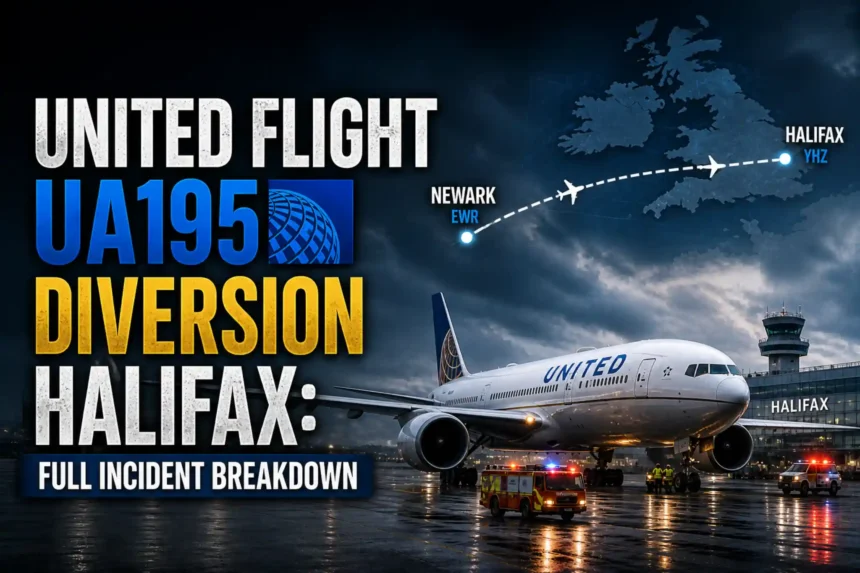
United Flight UA195 diverted to Halifax Stanfield International Airport on May 8, 2025, after the crew reached their maximum allowable duty time mid-flight. The Boeing 777-200ER, operating between Munich and San Francisco, made an unscheduled landing at YHZ — not due to a mechanical failure or emergency, but because federal aviation regulations required it. The flight resumed within hours, and all passengers arrived safely at their destination.
- Overview of United Flight UA195
- What Caused the United Flight UA195 Diversion to Halifax?
- Timeline of the Diversion Incident
- Why Was Halifax Chosen as the Diversion Airport?
- What Happened After Landing in Halifax?
- Role of Halifax Stanfield International Airport
- Aviation Safety Protocols and Regulatory Framework
- Passenger Experience and Social Media Reaction
- Impact on Travel Schedules and Airline Operations
- Similar Flight Diversions in Aviation
- Conclusion
- FAQs
Overview of United Flight UA195
UA195 is a long-haul transatlantic route operated by United Airlines, connecting Munich (MUC) to San Francisco (SFO). The aircraft on this particular flight was a Boeing 777-200ER, registered as N77019 — a widebody jet built for international routes carrying hundreds of passengers.
The flight departed Munich more than an hour behind schedule at approximately 13:16 CEST. What started as a routine delay turned into a diversion over the North Atlantic, ultimately ending in Nova Scotia before the aircraft ever reached North America’s West Coast.
What Caused the United Flight UA195 Diversion to Halifax?
Crew Duty Limits and Flight Time Regulations
The core reason behind this diversion was straightforward: the crew hit their legal duty hour ceiling. Aviation authorities — including the FAA in the United States and EASA in Europe — enforce strict Flight Time Limitations (FTL) to prevent pilot fatigue.
These regulations cover three key areas:
- Maximum on-duty hours per shift — including pre- and post-flight responsibilities
- Mandatory rest periods between flights
- Cumulative weekly and monthly duty caps to prevent long-term fatigue buildup
On long-haul flights, an augmented crew (additional pilots) can extend duty time to 12–14 hours. Without augmentation, limits are typically 8–9 hours. When Munich departure ran late, combined with Atlantic headwinds and air traffic routing, the remaining crew hours became insufficient to legally complete the flight to San Francisco.
Rather than risk operating beyond those limits, the airline diverted.
Operational Issue vs. Mechanical Failure
United Airlines officially labeled this a diversion due to an “operational issue” — a broad term the airline industry uses when the cause doesn’t involve hardware failure or medical crisis.
There was:
- No declared emergency
- No Mayday or PAN-PAN call
- No engine failure, fire, or smoke
- No passenger medical emergency
The decision was entirely preemptive. The crew identified the duty time problem mid-flight and coordinated with United’s operations center to select the safest and most logical diversion point. That airport was Halifax.
Timeline of the Diversion Incident
Here is the complete sequence of events:
| Time (UTC) | Event |
| May 8 — ~12:30 PM | Departed Munich, approx. 1 hour late |
| Over the North Atlantic | Crew duty hours flagged as insufficient |
| 3:21 PM | Aircraft safely landed at Halifax Stanfield (YHZ) |
| 3:30–4:20 PM | Crew change carried out; most passengers remained onboard |
| 4:27 PM | UA195 departed Halifax |
| May 9 — ~1:50 AM | The aircraft landed in San Francisco |
Total added delay: approximately 2–3 hours. The flight was never cancelled.
Why Was Halifax Chosen as the Diversion Airport?
Halifax isn’t a random choice. It serves as one of the most established diversion points on the transatlantic corridor for a specific set of reasons.
First, its geographic position makes it ideal. YHZ sits at a point along the Europe-North America route where aircraft crossing the Atlantic still have enough fuel and time to divert safely, without backtracking across the ocean or pressing further into the US northeast.
Second, Halifax Stanfield is fully capable of handling widebody aircraft like the Boeing 777. Many smaller regional airports cannot accommodate jets of that size.
Third — and most relevant to this incident — YHZ has reliable crew logistics infrastructure. United Airlines operates scheduled service to Halifax from multiple US cities, including Houston, Boston, Chicago, Denver, Los Angeles, Dallas, and Raleigh. That connectivity makes crew positioning and replacement significantly faster than at less-served airports.
The combination of location, aircraft capability, and crew logistics made Halifax the practical choice over any alternative.
What Happened After Landing in Halifax?
Crew Change and Ground Operations
The ground stop at YHZ was brief. A replacement crew was brought in while the aircraft sat on the tarmac. The entire transition took under an hour — from 3:21 PM when the plane landed to 4:27 PM when it departed again.
Most passengers stayed on board during the crew change. Ground staff at Halifax coordinated the crew handover and ensured the aircraft was ready to continue. There was no extended delay at the gate, no technical work performed on the plane, and no rebooking of passengers to other flights.
Passenger Handling and Airline Response
Passengers were informed about the reason for the stop before landing. United Airlines communicated that the diversion was due to crew duty hour limits — not a safety threat or equipment issue. That transparency helped manage anxiety onboard.
A small number of passengers may have deplaned briefly, but the majority waited on the aircraft. Once the new crew was in place, the flight departed and completed the journey to San Francisco without further interruption. No injuries occurred. No medical events were reported.
Role of Halifax Stanfield International Airport
YHZ handled this diversion with the kind of efficiency that comes from being a well-prepared hub. Air traffic control coordinated the landing slot on short notice, ensuring runway availability and sequencing without disruption to other arriving traffic.
Emergency services — including firefighters and paramedics — were on standby as standard protocol for any unscheduled arrival. Airport security and ground staff were also deployed to assist with passenger needs and crew logistics.
This is exactly the role regional airports play in global aviation safety. While Halifax isn’t a major hub like Newark or Frankfurt, its infrastructure is built to support exactly these types of transatlantic diversions. The response confirmed that.
Aviation Safety Protocols and Regulatory Framework
Crew duty regulations aren’t guidelines — they’re legally binding. The FAA in the US and Transport Canada in Canada both enforce these rules, and airlines operating international routes must comply with whichever standard applies to their operations.
When a crew approaches its maximum duty time, the airline’s operations control center gets flagged. The decision to divert is typically made jointly between the flight crew and ground operations. Pilots don’t wait until limits are exceeded — the diversion happens before that point.
Training reinforces this process. Crews practice diversion scenarios regularly, which means the execution on a real flight is methodical rather than reactive. Passengers rarely experience visible signs of concern from the crew because the situation is managed the same way as any planned procedure.
Passenger Experience and Social Media Reaction
Onboard Passenger Experience
Reactions onboard were mixed but ultimately measured. Passengers were surprised by the announcement but generally understood once the reason was explained. One Reddit user on the r/flightradar24 thread described it clearly: the crew had timed out over the Atlantic, and a replacement crew needed to take over before the flight could continue.
Several passengers noted the stop was short enough that it felt more like a technical pause than a real disruption. The frustration was primarily around the added hours, not the safety concern.
Social Media and Aviation Community Reaction
The diversion generated considerable tracking activity on FlightAware and FlightRadar24. Aviation enthusiasts noted the flight path deviation in real time, and screenshots of the unexpected Halifax stop circulated on Twitter/X and Reddit.
Initial speculation in aviation communities pointed toward mechanical issues, but those theories were corrected quickly once United Airlines confirmed the operational nature of the diversion. Most commentary shifted toward praising the airline’s decision to prioritize crew rest over schedule convenience.
Impact on Travel Schedules and Airline Operations
A 2–3 hour delay is inconvenient, but the flight reached San Francisco. Passengers with tight connections faced the most disruption, particularly those needing to connect to other domestic or international routes.
United Airlines’ ground teams managed onward travel adjustments where needed. Passengers with travel insurance had grounds to file delay claims depending on their policy terms. Those affected should check eligibility for delay compensation under DOT guidelines if the delay exceeded a qualifying threshold.
One broader implication worth noting: this incident — along with others in 2025 — raised questions about whether airline staffing levels on transatlantic routes are consistently matched to operational demands. When departure delays compound existing duty time constraints, diversions become more likely. It’s a systemic issue that the industry continues to address.
Similar Flight Diversions in Aviation
UA195 is far from unique. Diversions happen regularly across global aviation for a range of reasons:
| Flight | Aircraft | Reason | Diversion Point |
| KLM KL635 (May 2025) | Boeing 777-200ER | Passenger medical emergency | Glasgow Airport |
| JetBlue 967 (Feb 2025) | Airbus A320 | Reported engine issue | New York JFK |
| United 1544 (Feb 2025) | Boeing 757-200 | Possible engine issue | Newark |
| Southwest 4563 (Jul 2024) | Boeing 737-800 | Reported engine issue | Las Vegas |
Crew duty diversions, in particular, are a routine outcome of strict fatigue regulations — not signs of operational failure. They reflect the system working correctly.
Conclusion
The United Flight UA195 diversion to Halifax was a well-managed, regulation-driven decision — not a crisis. Crew duty limits exist precisely to prevent the kind of fatigue that could turn a long-haul flight into an actual emergency. By diverting to YHZ, United Airlines followed the rules, protected its passengers and crew, and resumed the flight within the hour.
Halifax Stanfield performed its role efficiently. The crew transition was smooth. Passengers arrived in San Francisco safely, if a few hours late. That outcome is exactly what aviation safety protocols are designed to produce.
FAQs
FAQ 1: Was there an emergency on board United Flight UA195?
No. United Airlines confirmed the diversion was an operational decision, not an emergency. There was no Mayday call, no mechanical failure, and no medical crisis. The crew diverted because they reached their maximum allowable duty time under FAA and EASA regulations.
FAQ 2: Why was Halifax chosen over other airports?
Halifax Stanfield is a well-positioned transatlantic diversion point with the infrastructure to handle widebody aircraft like the Boeing 777. It also has United Airlines route connectivity, which made crew positioning and replacement significantly faster than at alternative airports.
FAQ 3: What caused the diversion — crew fatigue or a mechanical issue?
Crew duty time limits caused the diversion. The flight ran late out of Munich, which reduced the remaining legal duty hours for the crew. There was no mechanical fault involved. United tagged it as an operational issue, which accurately reflects the crew-hours situation.
FAQ 4: Did passengers deboard the aircraft in Halifax?
Most passengers remained onboard during the crew change. The ground stop lasted under an hour. A small number may have deplaned temporarily, but the process was primarily a crew logistics operation, not a passenger disembarkation.
FAQ 5: How long was the delay caused by the diversion?
Passengers experienced approximately 2–3 hours of added delay. The aircraft landed at YHZ at 3:21 PM UTC and departed at 4:27 PM UTC, arriving in San Francisco at around 1:50 AM UTC on May 9, 2025. The flight was not cancelled.
FAQ 6: Did the same aircraft complete the journey to San Francisco?
Yes. The Boeing 777-200ER (N77019) continued to San Francisco after the crew was replaced in Halifax. No aircraft swap was necessary.
FAQ 7: Were passengers compensated for the delay?
United Airlines has not publicly detailed compensation for this specific diversion. Passengers affected by the delay may be eligible for compensation depending on their travel insurance terms and DOT delay guidelines. Those with qualifying policies should file claims directly.
FAQ 8: Does United Airlines regularly fly to Halifax?
Yes. United operates scheduled routes between YHZ and several US cities, including Houston, Boston, Chicago, Denver, Los Angeles, Dallas, and Raleigh. Return routes from Halifax also serve San Francisco, Las Vegas, and Seattle, which is part of why YHZ is a practical diversion point for United flights.