

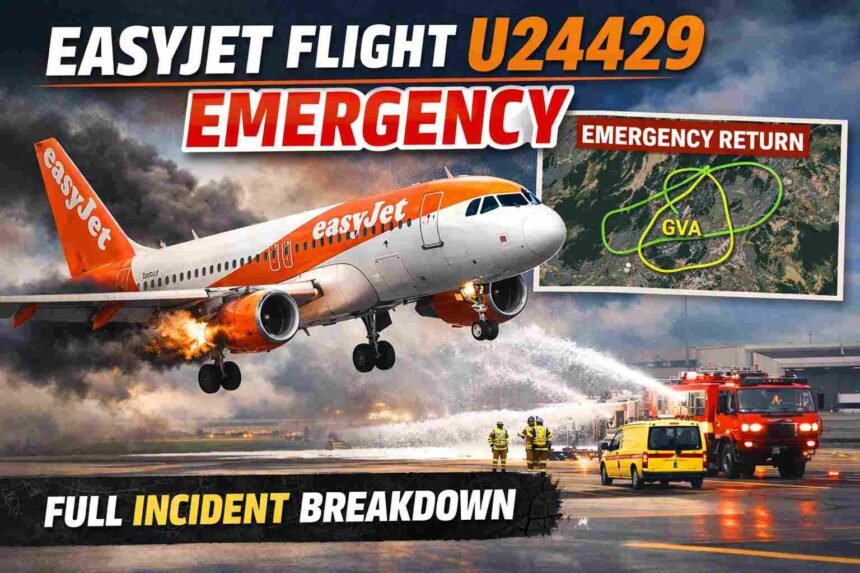
On the evening of 22 August 2025, the EasyJet flight U24429 emergency turned a routine short-haul journey into a serious aviation security event. The aircraft — an Airbus A320-214 registered OE-IJL, operating as EJU4429 — departed Lyon Saint-Exupéry Airport (LYS) bound for Porto Francisco Sá Carneiro Airport (OPO). Within minutes of takeoff, a 26-year-old Portuguese national suffering from an acute psychotic disorder attempted to force his way into the cockpit.
- Overview of EasyJet Flight U24429 Emergency
- What Triggered the Incident Onboard
- Crew Response and Emergency Procedures Followed
- Minute-by-Minute Timeline of the Emergency
- What Happened After Landing and Aftermath
- EasyJet’s Official Statement
- What Does Squawk 7700 Mean?
- Why the Cockpit Door Held — Cockpit Security in Modern Aviation
- Post-9/11 Cockpit Door Reinforcement
- The Two-Persons-in-the-Cockpit Rule
- Key In-Flight Security Measures
- Mental Health and Passenger Safety in Aviation
- How Aircraft Environments Affect Mental Health
- Factors That May Trigger In-Flight Episodes
- What Airlines Are Doing About It
- French Law on Cockpit Intrusion Attempts
- Rising Rate of Unruly Passenger Incidents Since the Pandemic
- Passenger and Crew Perspectives on the Incident
- Impact on Aviation, Tourism, and Airline Operations
- Lessons Learned from EasyJet Flight U24429 Emergency
- Why Incidents Like This Are Rare
- Conclusion
- FAQs
- What caused the EasyJet flight U24429 emergency?
- Did the plane land safely?
- What is squawk 7700?
- Were passengers in danger during the incident?
- What happened to the passenger involved?
- Was the aircraft grounded after the incident?
- What does French law say about cockpit intrusion attempts?
- How common are disruptive passenger incidents?
The crew declared squawk 7700 at 20,000 feet, turned the aircraft around, and landed safely back at Lyon in just 45 minutes. No one was injured. The passenger was hospitalised. The flight eventually continued to Porto that same evening. This breakdown covers every confirmed detail of the incident, what the response looked like from inside the aircraft, and what it reveals about modern aviation safety.
Overview of EasyJet Flight U24429 Emergency
Flight U24429 already departed one hour behind schedule, leaving Lyon on runway 35L at 18:34 CEST. The route covers a relatively short distance between France and Portugal, typically taking just under two hours.
Everything appeared normal until shortly after the aircraft climbed out of Lyon. A passenger began showing signs of extreme distress, and the situation deteriorated fast. What started as a welfare concern became a direct security threat when the individual attempted to force entry into the flight deck.
The crew’s response was immediate. The incident triggered emergency procedures that brought the Airbus A320 back to LYS before the situation could develop further.
What Triggered the Incident Onboard
Passenger Profile and Medical Condition
French police confirmed the passenger was a 26-year-old Portuguese national with no criminal record and no prior contact with law enforcement. Medical examinations carried out after landing revealed he was experiencing airsickness combined with an acute psychotic disorder, which left him in a state of delirium during the flight.
Looking at multiple aviation incident reports, one pattern keeps coming up. Passengers with no history of trouble can fall apart fast when airsickness hits alongside an untreated mental health condition. The U24429 case fits that pattern almost perfectly.
He was not previously known to authorities. French officials handled the case through the medical system rather than pursuing criminal prosecution, given the confirmed psychiatric diagnosis.
Passenger Behavior and Escalation
The individual became increasingly unstable shortly after takeoff. He moved toward the front of the cabin and attempted to force entry into the cockpit — a move that aviation security treats as one of the most serious possible threats on a commercial aircraft.
He ignored instructions from the cabin crew. Other passengers physically intervened. The combination of a disruptive passenger, a confined aircraft environment, and the direct threat to the flight deck forced the crew’s hand immediately.
Crew Response and Emergency Procedures Followed
The flight crew responded with precision. Pilots declared a general emergency by broadcasting squawk 7700 — the universal transponder code that flags an aircraft as emergency priority across every ATC radar in range. The aircraft stopped climbing and began turning back toward Lyon.
Meanwhile, cabin crew — assisted by fellow passengers — physically restrained the individual. Clear, calm communication from the crew prevented wider panic onboard. Air traffic control at Lyon cleared the airspace immediately and coordinated ground services for arrival.
What stands out here is how effectively the trained response absorbed a genuinely chaotic situation. Every layer worked: the crew contained the threat, the pilots communicated with ATC, and the ground teams were already in position before the aircraft touched down.
Minute-by-Minute Timeline of the Emergency
From Takeoff to Emergency Declaration
| Time (CEST) | Event |
| 18:34 | Flight U24429 departs Lyon, runway 35L — one hour delayed |
| ~18:40 | Cabin crew detect passenger distress |
| ~18:45 | Passenger attempts cockpit access — squawk 7700 activated at 20,000 feet |
| 18:45+ | The aircraft stops climbing and begins turning back to Lyon |
Emergency Landing and Ground Response
| Time (CEST) | Event |
| 19:19 | Aircraft lands on runway 35R — 45 minutes after departure |
| 19:19+ | Directed to the remote stand, French police and medical teams are already on standby |
| Evening | Passenger removed, aircraft released, flight continues to Porto |
What Happened After Landing and Aftermath
Police boarded the aircraft at the remote stand as soon as it stopped. The passenger was taken into custody and transferred to a French hospital for assessment and treatment. No injuries were reported among passengers or crew.
Once authorities cleared the aircraft, it was released and continued to Porto later that Friday evening. The operational impact was significant in terms of delay, but in terms of safety outcome, the procedural efficacy was complete. Every passenger reached their destination.
EasyJet’s Official Statement
EasyJet confirmed the incident publicly the morning after, stating: the flight returned to Lyon shortly after takeoff due to passenger behaviour, police met the aircraft on arrival, and once the passenger was removed, the service continued to Porto. The airline did not expand beyond this, with AFP reporting the statement on 23 August 2025.
The response was measured. EasyJet emphasised safety as the overriding priority without escalating the public narrative around the incident.
What Does Squawk 7700 Mean?
Squawk 7700 is the transponder code for a general emergency. When a flight crew sets it, the signal broadcasts across every air traffic control radar in range and flags the aircraft as an emergency priority automatically.
It covers any category of crisis:
- Mechanical failure
- Medical emergency
- Security threat
Controllers immediately clear the airspace, prioritise the aircraft for landing, and alert ground services at the nearest suitable airport. In the U24429 case, the squawk was set at 20,000 feet, and the aircraft was back on the ground within 45 minutes. Aviation trackers monitoring flight data noted the turn almost immediately after the code was activated.
Why the Cockpit Door Held — Cockpit Security in Modern Aviation
Post-9/11 Cockpit Door Reinforcement
The reinforced cockpit door on the Airbus A320 is one of the most significant safety changes introduced to commercial aviation after the September 11 attacks. Under ICAO standards enforced by EASA across European airspace, the flight deck door must remain locked from engine start. It can only be opened from the inside.
Most A320 family aircraft also carry a Cockpit Door Surveillance System — a CCTV-linked screen inside the cockpit that shows pilots exactly who is standing on the other side before any action is taken. The European Cockpit Association has confirmed that since reinforced doors entered service, no unauthorised cockpit intrusion attempt has ever succeeded on a commercial passenger aircraft.
The Two-Persons-in-the-Cockpit Rule
Following the Germanwings tragedy in March 2015, EASA issued Safety Information Bulletin SIB 2015-04, commonly called the two-persons-in-the-cockpit recommendation. It requires that whenever one pilot leaves the flight deck, a second authorised crew member steps in. The measure ensures no single individual is ever alone at the controls behind a locked door.
Key In-Flight Security Measures
- Reinforced doors that resist forced entry
- Strict access protocols — flight deck opens only from inside
- Continuous crew monitoring of the cabin
- CCTV surveillance linked directly to the cockpit
- Established security classification for cockpit intrusion attempts
Mental Health and Passenger Safety in Aviation
How Aircraft Environments Affect Mental Health
Aircraft cabins present a unique combination of stressors: pressurization changes, altitude, confined spaces, noise, and limited movement. For most passengers, these factors are manageable. For individuals with underlying vulnerabilities, the environment can accelerate a psychological crisis in ways that wouldn’t occur on the ground.
The U24429 passenger experienced airsickness on top of an undiagnosed or unmanaged acute psychotic episode. That combination — physical illness compounding psychiatric distress — created a volatile situation in a highly contained space.
Factors That May Trigger In-Flight Episodes
- Anxiety and fear of flying
- Panic attacks in confined environments
- Physical illness, including airsickness
- Pre-existing psychological conditions
- Acute psychosis triggered by stress or altitude-related discomfort
What Airlines Are Doing About It
Awareness is growing, but pre-boarding screening for mental health remains limited. Airlines are investing in de-escalation training for cabin crew, improved passenger monitoring protocols, and better coordination with airline regulatory bodies on reporting mental health-related incidents. The U24429 case added weight to calls for clearer pre-flight guidance for passengers with known psychiatric conditions.
French Law on Cockpit Intrusion Attempts
At the time of the incident, French Ordinance 2022-831 — enacted on 1 June 2022 — already classified attempted cockpit intrusion among the most serious in-flight offences under French aviation law:
- Up to 5 years in prison
- A fine of up to €75,000
- Administrative sanctions reported directly by carriers
Because the passenger carried a confirmed psychiatric diagnosis and no criminal history, French authorities routed the case through the medical system.
Three months later, France went further. Decree No. 2025-1063, published on 7 November 2025, gave French civil aviation regulators direct sanctioning powers over disruptive passengers for the first time:
| Offence | Penalty |
| First offence | €10,000 fine |
| Repeat offenders | €20,000 fine |
| Serious cases | No-fly ban up to 4 years (French-licensed carriers) |
French Transport Minister Philippe Tabarot linked the legislation directly to the summer 2025 wave of serious mid-flight incidents, with the U24429 cockpit attempt among the most prominent cases cited.
Rising Rate of Unruly Passenger Incidents Since the Pandemic
The U24429 incident was not isolated. According to IATA data, the annual rate of disruptive passenger incidents has worsened consistently since air travel recovered from the Covid-19 pandemic:
| Year | Rate of Disruptive Incidents |
| Pre-pandemic | 1 per 835 flights |
| 2022 | 1 per 568 flights |
| 2023 | 1 per 480 flights |
| 2024 | 1 per 395 flights |
EASA separately estimates that a commercial flight within Europe faces a passenger disruption approximately every three hours. Physical confrontations rose 61 percent in 2022 compared to the year before. While alcohol-driven incidents remain the most common category, mental health crises in flight are increasingly flagged by regulators as a distinct concern requiring specific pre-boarding screening protocols.
Ryanair responded to the broader trend by introducing fines of up to €500 for onboard misconduct — the first time the airline imposed direct financial penalties on disruptive travellers.
Passenger and Crew Perspectives on the Incident
Passengers described the return to Lyon as swift but deeply unsettling. The atmosphere onboard became tense the moment the individual began moving toward the front of the cabin. What normally would be a short two-hour hop to Porto became a 45-minute emergency return.
Most expressed relief at how decisively both crew and fellow passengers acted. In a crisis at altitude, how crew members communicate matters just as much as what they say. A calm, clear voice can stop panic from spreading through a cabin before it even starts. That is something that only becomes obvious when you watch it play out under real pressure.
The cabin crew maintained composure throughout — issuing clear instructions that prevented wider panic. When authority figures communicate calmly in a crisis, anxiety among those around them reduces significantly. That dynamic played out visibly on U24429.
Impact on Aviation, Tourism, and Airline Operations
Beyond the immediate incident, events like U24429 carry wider consequences. Every unscheduled landing costs thousands of euros in operational disruption. For EasyJet, the reputational challenge is managing public perception — ensuring the narrative centres on professional response rather than fear.
Portugal’s tourism industry depends heavily on consistent air connectivity, particularly during peak season. Repeated disruptions, however rare, create ripple effects for travel confidence. Lyon Saint-Exupéry Airport’s rapid, coordinated response — emergency vehicles deployed, medical teams positioned before landing — demonstrated exactly the kind of airport-level crisis readiness that maintains trust in European aviation.
Social media amplified the story within hours. Passengers shared their experiences across platforms, making EasyJet’s measured public statement more important than it might otherwise have been.
Lessons Learned from EasyJet Flight U24429 Emergency
For Airlines
- Invest in advanced crew de-escalation and restraint training
- Strengthen pre-boarding passenger monitoring, particularly for signs of acute distress
- Develop clearer in-flight communication strategies for security events
- Improve coordination with aviation regulatory bodies on mental health incident reporting
- Build faster crisis communication pipelines for public-facing statements
For Passengers
- Follow crew instructions immediately and without hesitation during any onboard incident.
- Report unusual or concerning behaviour to the crew early — don’t wait
- Be aware of personal health and fitness before flying, particularly on longer or connecting journeys
- Understand that cooperation between passengers and crew is a genuine safety factor, not a formality
Why Incidents Like This Are Rare
Commercial aviation operates within one of the most layered safety frameworks of any industry. Trained crews, international regulations enforced by ICAO and EASA, reinforced cockpit doors, and established emergency protocols combine to make serious incidents statistically very rare.
Attempted cockpit intrusions are even rarer — and successful ones, as the European Cockpit Association confirms, have not occurred on commercial passenger aircraft since post-9/11 security measures came into force. The U24429 event, despite how alarming it appeared in real time, is an example of those systems doing exactly what they were designed to do.
Conclusion
The EasyJet flight U24429 emergency lasted 45 minutes from takeoff to resolution on the ground. In that window, the cabin crew and fellow passengers restrained a disruptive individual, the pilots declared an emergency and turned the aircraft around, air traffic control at Lyon cleared the aircraft straight in, and emergency teams were positioned at the remote stand before the aircraft stopped moving.
The passenger who caused it received medical care, not a prison sentence, because the diagnosis warranted that response. The flight reached Porto. Everyone got where they were going.
What the incident leaves behind is a clear picture of aviation safety working as designed — and a sharper policy conversation about mental health, pre-boarding screening, and the legal consequences of in-flight misconduct.
FAQs
What caused the EasyJet flight U24429 emergency?
A 26-year-old Portuguese national suffering from airsickness and acute psychotic disorder attempted to force entry into the cockpit shortly after takeoff from Lyon. French police confirmed the medical diagnosis after the aircraft landed.
Did the plane land safely?
Yes. The Airbus A320 returned to Lyon and landed on runway 35R approximately 45 minutes after departure. No injuries were reported among passengers or crew.
What is squawk 7700?
It is the universal transponder emergency code. When pilots set it, every air traffic control radar in range identifies the aircraft as an emergency priority, clearing airspace and alerting ground services automatically.
Were passengers in danger during the incident?
The situation was contained quickly. Cabin crew and fellow passengers physically restrained the individual before any further escalation occurred. No one was harmed.
What happened to the passenger involved?
He was removed by French police at Lyon, transferred to a hospital, and treated for an acute psychotic disorder. He had no prior criminal record, and French authorities handled the case through the medical system rather than criminal prosecution.
Was the aircraft grounded after the incident?
No. Once the passenger was removed and the aircraft cleared, EasyJet released the flight, and it continued to Porto later that same evening.
What does French law say about cockpit intrusion attempts?
French Ordinance 2022-831 sets penalties of up to 5 years in prison and €75,000 in fines. Decree No. 2025-1063, enacted in November 2025, added regulatory fines of €10,000 for a first offence, €20,000 for repeat offenders, and no-fly bans of up to four years from French-licensed carriers.
How common are disruptive passenger incidents?
According to IATA, the rate worsened every year since the pandemic — reaching 1 disruptive incident per 395 flights in 2024, compared to 1 per 835 flights before Covid-19. Cockpit intrusion attempts remain rare but sit at the highest severity level in aviation security classification.