


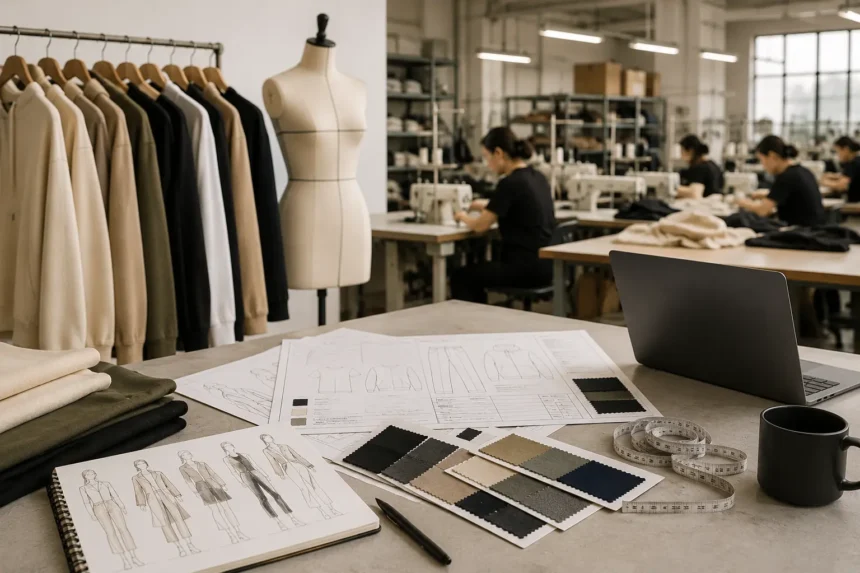
Starting a fashion brand looks exciting from the outside. A strong design idea, a clear aesthetic, and a growing market can make production feel straightforward. But once brands begin manufacturing, many realize that the difficult part is not designing products. It is producing them consistently.
- Why Choosing the Wrong Manufacturer Creates Expensive Problems
- What Clothing Manufacturers Actually Need Before Production Starts
- Why Fabric Decisions Affect Production More Than Most Brands Expect
- Why Guangzhou’s Fabric Market Matters to Fashion Brands
- What Fashion Brands Should Check Before Approving a Sample
- Why MOQ, Pricing, and Lead Time Often Get Misunderstood
- Conclusion
Late deliveries, sizing problems, unexpected fabric substitutions, and inconsistent stitching usually do not happen because factories are “bad.” More often, they happen because brands enter production without understanding how apparel manufacturing actually works.
Working with manufacturers is not simply about sending a design and waiting for finished garments. It involves communication, technical specifications, sourcing decisions, production planning, and realistic expectations around cost and quality.
Fashion brands that understand these moving parts early tend to avoid expensive mistakes later.
This article explains what brands should know before working with manufacturers, how production decisions influence garment quality, and why fabric sourcing often matters more than many first-time founders expect.
Why Choosing the Wrong Manufacturer Creates Expensive Problems
Many new fashion brands choose manufacturers based on one thing alone: price.
At first glance, this makes sense. Lower production costs seem like a smart business move, especially for growing brands trying to control cash flow.
But manufacturing problems rarely appear on the quotation sheet. They show up later.
A fabric shrinks unexpectedly after washing. Measurements vary between batches. Stitching becomes inconsistent. Lead times stretch longer than promised. Suddenly, the savings from lower pricing disappear through product returns, delayed launches, and unhappy customers.
The problem is that apparel manufacturing is highly detail-sensitive.
A factory producing casual cotton t-shirts may not necessarily be suitable for technical activewear. Similarly, a supplier experienced in bulk basics may struggle with detailed fashion garments involving embroidery, structured tailoring, or specialty trims.
That is why successful brands spend more time evaluating compatibility than simply comparing quotes.
Instead of asking, “Who is cheapest?” better sourcing questions often look like this:
| Question | Why It Matters |
| Does the factory specialize in my category? | Different garments require different expertise |
| Can they support my order volume? | Small brands and large brands need different production setups |
| Do they understand fabric behavior? | Fabric issues often affect fit and durability |
| Are they experienced with private label production? | Branding requirements vary significantly |
This becomes especially important when working with overseas suppliers, where communication delays and production misunderstandings can become expensive.
A good manufacturing relationship begins with clarity. And clarity starts long before production begins.
What Clothing Manufacturers Actually Need Before Production Starts
One common misunderstanding among new brands is assuming manufacturers can work from simple reference photos alone.
In reality, experienced manufacturers need detailed production information.
Even if a garment looks simple, small technical differences can completely change the result.
For example, two hoodies may appear nearly identical online but differ significantly in fabric weight, stitching tension, cuff construction, pocket placement, shrinkage behavior, and fit.
This is why experienced fashion brands prepare technical documentation before production starts.
Reliable clothing manufacturers usually require clear specifications to produce garments consistently rather than relying on guesswork.
At minimum, manufacturers typically need:
- Technical sketches or reference samples
- Measurement specifications (size chart)
- Fabric expectations
- Stitching instructions
- Label and branding requirements
- Packaging details
Without these details, production becomes interpretation.
And interpretation creates inconsistency.
For example, a brand may request “oversized fit,” but oversized can mean very different things depending on region, trend, and factory understanding.
One supplier may create a boxy streetwear silhouette, while another may simply add width without adjusting sleeve balance or shoulder drop.
The result is often disappointment rather than poor manufacturing.
A simple production comparison makes this easier to understand.
| Production Input | Likely Result |
| Reference image only | Higher production uncertainty |
| Tech pack + size specs | More consistent outcomes |
| Fabric sample approved | Better material consistency |
| Detailed trim instructions | Fewer branding errors |
The strongest manufacturing partnerships happen when expectations are documented clearly from the start.
But even perfect documentation cannot solve another major issue that many brands underestimate.
Fabric selection.
Why Fabric Decisions Affect Production More Than Most Brands Expect
Fabric decisions shape nearly everything in apparel production.
- Fit.
- Comfort.
- Durability.
- Shrinkage.
- Color appearance.
- Production cost.
Yet many brands treat fabric selection as a secondary step after design.
That usually creates problems.
For example, two garments using the same pattern can fit completely differently depending on the fabric composition.
A heavyweight cotton fleece hoodie behaves differently from a lightweight cotton-poly blend. Stretch recovery changes. Drape changes. Structure changes.
This matters because production consistency depends heavily on material behavior.
Fabric weight, often measured in GSM (grams per square meter), can significantly affect the final garment’s feel.
A lightweight 160 GSM cotton t-shirt may feel breathable for summer collections, while a 280 GSM version creates a more structured streetwear appearance.
Neither is automatically right nor wrong. The decision depends on product positioning.
Below is a simplified comparison.
| Fabric Weight | Common Use |
| 140–180 GSM | Lightweight t-shirts |
| 180–240 GSM | Standard casualwear |
| 250–320 GSM | Streetwear and premium basics |
| 320+ GSM | Hoodies and structured garments |
Another overlooked factor is shrinkage.
Some natural fibers change shape after washing if they are not pre-treated or tested correctly.
This can create sizing inconsistency across production batches.
For example, a medium-sized shirt may technically leave production correctly, but shrink enough after washing to fit more like a small.
This is why many experienced brands test fabrics before mass production begins.
And fabric sourcing itself plays an equally important role.
Why Guangzhou’s Fabric Market Matters to Fashion Brands
When fashion brands talk about sourcing, Guangzhou often becomes part of the conversation.
That is because the city has developed one of the largest textile ecosystems supporting garment manufacturing, trend sourcing, and fabric development.
For many brands, access to a large Fabric Market creates flexibility that smaller sourcing regions may not offer.
Instead of depending on limited local supplier options, brands can compare fabric categories, finishes, and pricing more efficiently.
This matters because fashion moves quickly.
A trend that appears in spring may already feel outdated by late summer.
Factories and sourcing teams often rely on textile markets to adapt quickly to changing demand.
For example, brands sourcing oversized hoodies may compare brushed fleece, French terry, and heavyweight cotton blends depending on pricing and seasonality.
Similarly, swimwear, activewear, or technical fashion products may require specialty stretch fabrics that smaller supplier networks simply cannot provide easily.
The advantage of large sourcing ecosystems is not just variety.
It is speed.
Manufacturers can test alternatives faster, replace unavailable materials more efficiently, and solve sourcing bottlenecks without delaying production for months.
Still, fabric availability alone does not guarantee a successful product.
Sampling matters just as much.
What Fashion Brands Should Check Before Approving a Sample
Many production mistakes happen because brands rush sample approval.
Excitement often takes over.
The product looks visually close to expectations, so approval happens quickly.
Later, problems appear.
Fabric feels different after washing. Stitching loosens. Measurements shift. Zippers fail. Color fades.
This is why experienced brands evaluate samples carefully.
Before approving production, brands should check:
- Fabric feel and thickness
- Wash performance
- Stitch consistency
- Fit across multiple body types
- Print or embroidery durability
- Measurement accuracy
- Label positioning
The goal of sampling is not perfection.
It is problem prevention.
Fixing issues during sampling is relatively inexpensive.
Fixing them after thousands of units are produced is not.
Why MOQ, Pricing, and Lead Time Often Get Misunderstood
MOQ, or minimum order quantity, is one of the biggest frustrations for smaller fashion brands.
New businesses often assume factories are unwilling to work with smaller orders.
But MOQ usually reflects manufacturing practicality rather than inflexibility.
Factories need production efficiency.
Running machines, sourcing fabric, and organizing labor for tiny quantities may not be commercially realistic.
Pricing works similarly.
A lower MOQ often means a higher cost per piece.
Bulk orders reduce material costs and improve efficiency.
Lead times also vary depending on complexity.
Simple t-shirt production may move faster than structured garments requiring embroidery, specialty trims, or custom dyeing. Brands that understand these realities usually build stronger factory relationships.
Conclusion
Working with manufacturers successfully requires more than finding someone who can make clothes. The strongest fashion brands understand production before scaling it.
They know that fabric decisions influence fit, washing performance, and customer satisfaction. They understand why technical specifications matter. And they recognize that manufacturing works best when communication is detailed rather than assumed.
Whether sourcing through experienced clothing manufacturers or exploring textile options through a large Fabric Market, long-term success often comes down to preparation.
Fashion production rarely rewards guesswork. Brands that approach manufacturing with clarity, realistic expectations, and technical understanding usually avoid the costly problems that slow growth later.