


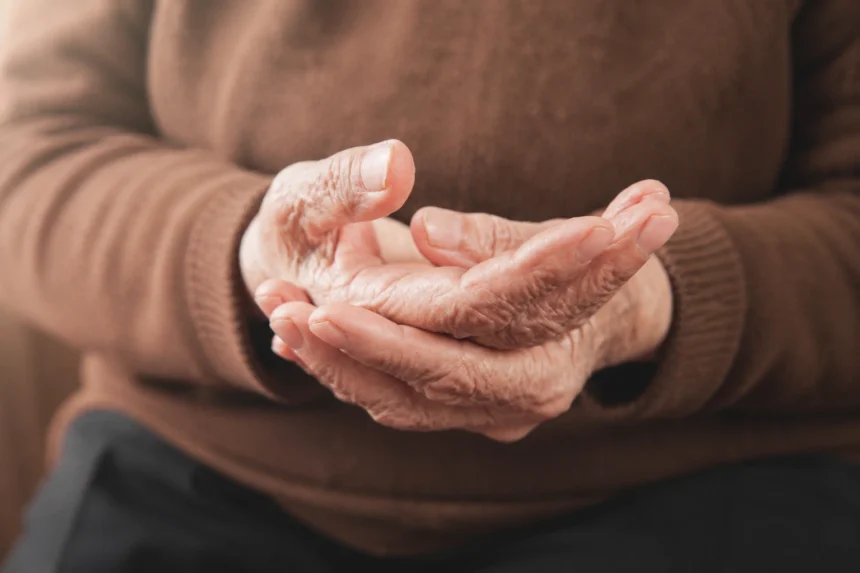
You notice your father’s coffee cup rattling in his hand at breakfast. Your mother signs a birthday card, and the signature looks nothing like her usual handwriting. These moments stop caregivers cold — and the first question is almost always the same: is this normal, or is something wrong?
Tremors in elderly people are common, but that does not mean they are uniform. The causes range from benign and manageable to conditions that warrant prompt evaluation. Understanding what causes tremors in the elderly is the first step toward the right answer.
Is Shaking a Normal Part of Aging?
Some degree of motor change is a natural part of growing older. Muscle mass declines, nerve conduction slows, and fine motor coordination requires more effort than it once did. This can produce mild unsteadiness, but it does not typically cause visible, rhythmic shaking.
True tremors — involuntary, repetitive muscle movements — are not a standard feature of healthy aging. When they appear, something specific is happening in the nervous system or elsewhere in the body, and identifying what the critical task is.
The Most Common Causes of Tremors in the Elderly
Essential Tremor
Essential Tremor is the most common movement disorder in adults over 60, affecting an estimated 4 to 5 percent of people in that age group. It produces a rhythmic shaking that typically occurs during movement — reaching for a glass, writing, or pouring liquid — rather than at rest. The hands and arms are most often affected, though head tremors in the elderly are also frequently linked to Essential Tremor.
Genetics play a significant role: roughly half of all people with Essential Tremor have a family member with the condition. It is not life-threatening, but it is progressive and can significantly affect independence over time.
Parkinson’s Disease
Parkinson’s Disease is the second most common cause of tremor in older adults. Unlike Essential Tremor, the shaking associated with Parkinson’s Disease typically occurs at rest — when the hand is lying still in the lap, for example — and often diminishes during intentional movement. It usually begins on one side of the body before gradually affecting both sides.
Parkinson’s Disease also produces a broader set of symptoms beyond tremor, including muscle rigidity, slowed movement, and balance difficulties. A clear explanation of Essential Tremor and Parkinson’s Disease, including how clinicians distinguish between the two conditions, is an important reference for anyone trying to make sense of a new tremor diagnosis.
Medication-Induced Tremor
A significant and frequently overlooked cause of what causes hand tremors in elderly patients is medication. Many drugs commonly prescribed to older adults can trigger or worsen shaking, including certain antidepressants, antipsychotics, mood stabilizers such as lithium, some asthma medications, and stimulants. Because older adults are more likely to take multiple medications simultaneously, the risk of tremor as a side effect is correspondingly higher.
If tremor appeared shortly after a new medication was introduced or a dose increased, a pharmacist or physician should review the full medication list.
Other Medical Causes
Several other conditions can produce tremors in elderly people, including:
- Thyroid disorders. An overactive thyroid (hyperthyroidism) can cause fine, rapid shaking of the hands.
- Low blood sugar. Hypoglycemia — particularly relevant in older adults managing diabetes — can trigger sudden, generalized shaking.
- Anxiety and stress. Acute anxiety activates the sympathetic nervous system and can produce temporary tremor, especially in the hands.
- Alcohol withdrawal. In older adults with a history of alcohol use, tremor can be an early sign of withdrawal and requires immediate medical attention.
- Cerebellar disorders. Damage to the cerebellum, whether from stroke, multiple sclerosis, or other causes, can produce “intention tremor” — shaking that worsens as the hand approaches a target.
When Tremor Appears Suddenly
Gradual-onset tremor — shaking that develops slowly over months or years — is more commonly associated with Essential Tremor or early Parkinson’s Disease. Sudden shaking in seniors, appearing over hours or days, is a different matter and warrants more urgent investigation.
Sudden tremor can indicate stroke, a severe metabolic disturbance, a drug reaction, or alcohol withdrawal. Any abrupt-onset shaking accompanied by confusion, one-sided weakness, slurred speech, or loss of balance should be treated as a medical emergency.
Getting a Diagnosis
Tremor is a symptom, not a diagnosis. A physician evaluating causes of shaking hands in elderly patients will typically begin with a detailed history: when the shaking started, whether it occurs at rest or during movement, which body parts are affected, and what medications the person takes. A neurological examination follows, assessing coordination, reflexes, and gait.
Blood tests can rule out thyroid dysfunction, blood sugar abnormalities, and other metabolic causes. Brain imaging may follow. A referral to a movement disorder specialist is often the most valuable next step when the diagnosis is not immediately clear.
The Steadi-3 for Elderly Tremor Management
One option worth knowing about is the Steadi-3, an FDA-registered Class I medical device that uses passive magnetic stabilization to reduce hand tremor during everyday tasks. It requires no batteries, no charging, and no prescription. In a placebo-controlled clinical study, 84% of participants showed improved tremor control compared with no device, as assessed by blinded neurologists. It does not treat the underlying cause of tremor, but it can meaningfully reduce its functional impact on tasks such as eating, writing, and handling objects.
Conclusion
Tremor in an elderly parent or loved one is rarely something to wait out. Most causes are identifiable, many are treatable, and even those that are not — like Essential Tremor or Parkinson’s Disease — can be managed effectively with the right combination of medical care, therapy, and assistive tools. The earlier a cause is established, the sooner the right support can be put in place.
Have you noticed new or worsening tremor in an elderly parent or loved one? What was the first sign that prompted you to seek a medical evaluation, and how did the process unfold? Share in the comments — your experience could help another caregiver know what to watch for.